Enhancing Large Vessel Docking Capacity and Upgrading Runways
Strengthening Surveillance Capabilities in the Pacific Region
The Japanese government is set to revise its three major security documents to explicitly include the "strengthening of Pacific defense." This move is interpreted as an effort to keep China in check as it expands its military activities in the Pacific.
According to a report by Yomiuri Shimbun on January 11, the Japanese government plans to include in its security documents the need to develop ports, runways, and surveillance radar networks to enable the Self-Defense Forces to operate extensively in the Pacific.
The three major security documents, which form the foundation of Japan's security policy, are the National Security Strategy, the National Defense Strategy, and the Defense Buildup Program. The details regarding the strengthening of Pacific defense are expected to be specified in the Defense Buildup Program, which outlines defense equipment procurement policies and total defense spending.
Before the revision of the security documents, the Ministry of Defense plans to establish a "Pacific Defense Initiative Office" (tentative name) in April this year to begin a full-scale review of specific policies.
Japan is reportedly considering measures to strengthen Pacific defense, such as upgrading the port and runway on Ioto (Iwo Jima) and deploying radar on Kitadaitojima.
Ioto is an island located about 1,250 kilometers south of Tokyo, situated between the Japanese archipelago and Guam, which hosts a major U.S. military base. It is also located on the so-called "Second Island Chain," which connects the Ogasawara Islands, Guam, Saipan, and Indonesia. The island chain is a maritime security line defined by China.
The Japanese government plans to upgrade facilities on Ioto, which is outside the range of Chinese short-range ballistic missiles, so that large vessels can dock there, thereby enhancing the Maritime Self-Defense Force's transport capabilities. In addition, the government intends to repair the runway on Ioto, which has risen due to tectonic activity, to allow fighter jets to take off and land safely.
Kitadaitojima is an island located about 360 kilometers east of Okinawa Island. Last month, when the Chinese aircraft carrier Liaoning sailed between the islands of Okinawa Prefecture, it circled clockwise around Kitadaitojima, displaying a movement of encirclement.
The Japanese government is also considering the fact that Minamitorishima, an island near Kitadaitojima, contains rare earth deposits. As a result, plans are in place to deploy a mobile surveillance radar on Kitadaitojima and to develop a long-range missile firing range.
In addition, the government is considering expanding the runway with the future operation of Maritime Self-Defense Force escort ships being converted into de facto aircraft carriers in mind. While efforts have so far focused on building a radar network, Japan is now moving to significantly strengthen its regional surveillance capabilities.
Yomiuri Shimbun analyzed, "China is bolstering its military power to prevent U.S. forces from approaching through the Pacific in the event of a Taiwan contingency," and added, "Japan aims to reinforce the 'eyes of surveillance' of the Self-Defense Forces to enhance the deterrence and response capabilities of the U.S.-Japan alliance."
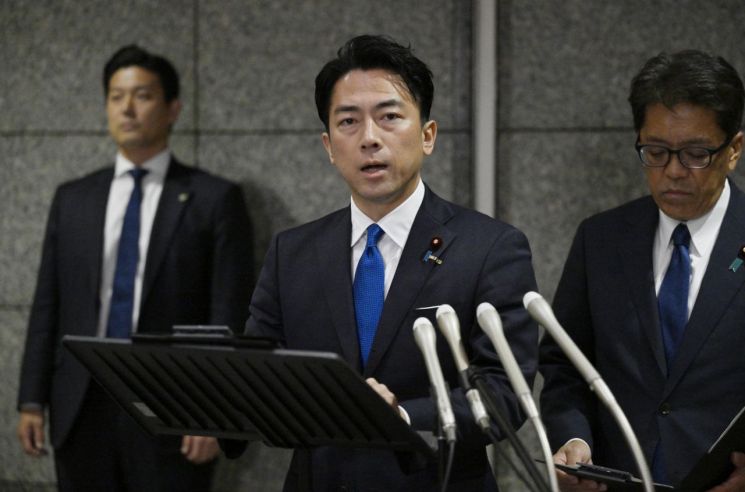 Shinjiro Koizumi, Minister of Defense, held an emergency press conference in the early morning of December 7 last year, protesting that the Chinese side had illuminated the Self-Defense Force fighter jet with radar. Photo by Yonhap News Agency
© The Asia Business Daily(www.asiae.co.kr). All rights reserved.
![Clutching a Stolen Dior Bag, Saying "I Hate Being Poor but Real"... The Grotesque Con of a "Human Knockoff" [Slate]](https://cwcontent.asiae.co.kr/asiaresize/183/2026021902243444107_1771435474.jpg)















