"Equivalent to 108 Standard Dujjonku at 6,500 Won Each"
Some Cafes Consider Reducing Sales Due to Ingredient Costs
Amid the recent craze for "Dubai Jjondeuk Cookie (Dujjonku)," a store has introduced a "King-size Dujjonku" priced at 300,000 won, drawing significant attention from online users. On social media platforms such as TikTok, videos and reviews of this dessert, which is so large it must be held with both hands, have gone viral.
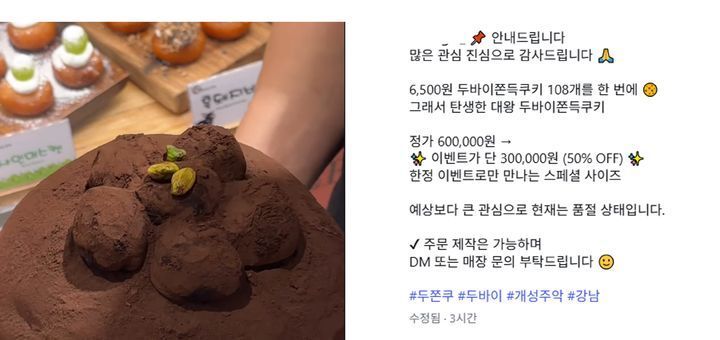 Amid the recent craze for "Dubai Jjondeuk Cookie (Dujjonku)," a store has introduced the "King-size Dujjonku" priced at 300,000 won. Official company SNS
Dujjonku is a Korean-style adaptation of the Middle Eastern dessert "Dubai Chocolate." It is made by wrapping thin kadaif noodles, pistachio spread, and marshmallow melted in chocolate. The new "King-size Dujjonku" is equivalent in size to 108 of the standard 6,500-won Dujjonku, making it the largest and most expensive version released so far.
The creator of the video commented in their review, "The quantity is 100 times that of the regular product," adding, "It was delicious but difficult to eat."
Previously, some stores sold a "Jumbo Dujjonku," which was about three times the size of the standard version and sold for 18,000 won each. The latest product appears to be part of a special event sale and a differentiation strategy.
Online users reacted with comments such as "The concept of pricing is getting out of hand," and "It feels like it was made all at once in a lump." Some have suggested that the Dujjonku craze may be nearing its end, but the dessert remains so popular that stores continue to sell out by midday.
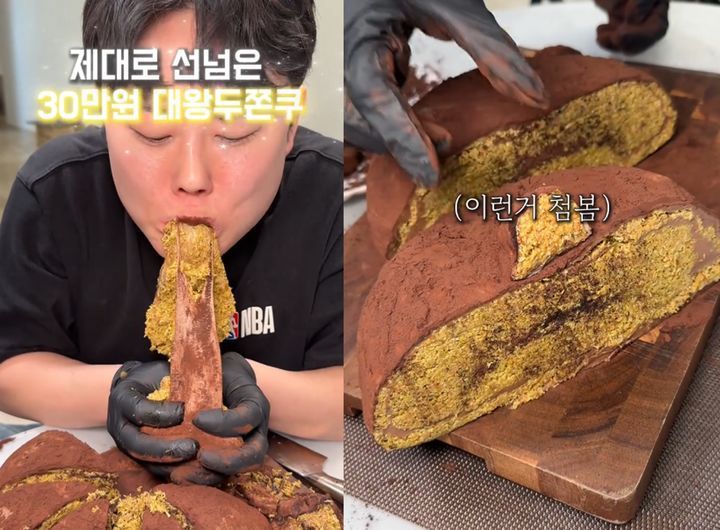 On the 8th, a review video titled "My friend brought something strange" featuring 'Daewang Dujjonku' was uploaded on TikTok. TikTok @gwasigi
Recently, Dujjonku sales have expanded beyond dessert shops to a variety of businesses, including burger restaurants, sushi bars, and chicken feet eateries. On delivery apps, it is often used as a side menu to meet the minimum order amount.
On the other hand, some dessert cafes have reduced or completely stopped selling Dujjonku due to rising ingredient costs. The price of pistachios, a key ingredient, has soared from 18,500 won last year to as much as 50,000 won recently, and the prices of other ingredients have also increased. According to profit margin data shared by one business owner on social media, the cost per Dujjonku is 2,940 won, with the cost ratio ranging from 38% to 46% depending on pistachio prices. This is nearly double the average cost ratio of 25% for other desserts. A cafe owner who discontinued sales said, "I put everything on the line to sell it, but it was a menu item that was difficult to make a profit from."
© The Asia Business Daily(www.asiae.co.kr). All rights reserved.
![Clutching a Stolen Dior Bag, Saying "I Hate Being Poor but Real"... The Grotesque Con of a "Human Knockoff" [Slate]](https://cwcontent.asiae.co.kr/asiaresize/183/2026021902243444107_1771435474.jpg)
















