Optimism Surrounds Economic Growth Strategy Announced on January 9
"Business Community to Lead Virtuous Cycle of Technological Innovation and Growth"
The Korean business community expressed optimism regarding the "2026 Economic Growth Strategy" announced by the government on January 9, stating that it is expected to invigorate the economy, which has been experiencing prolonged low growth, and help foster strategic industries.
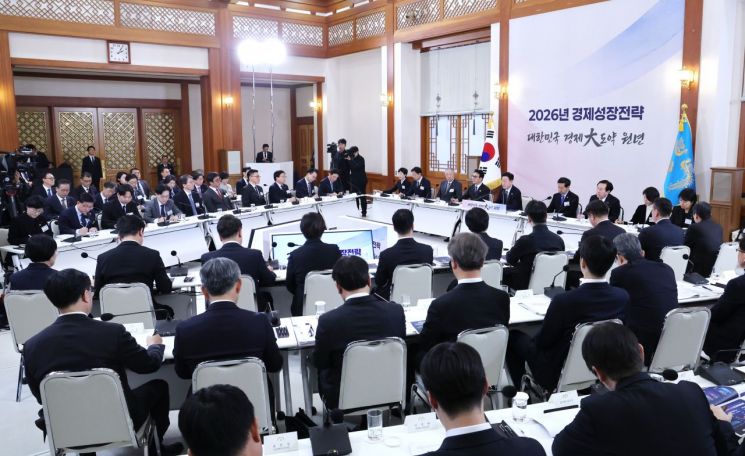 President Lee Jae-myung is attending the National Report Meeting on Economic Growth Strategy at the Blue House on the 9th. [Photo by Blue House Press Photographers]
Kang Seokgu, Head of the Research Division at the Korean Chamber of Commerce and Industry, commented, "At a time when concerns are mounting over the entrenchment of low growth in our economy, it is timely and welcome that the government has placed policy emphasis on growth and presented a comprehensive set of tasks." He added, "In particular, the full-scale support for the national strategic industries and the AI transformation, the introduction of a tax system to promote domestic production, the establishment of a Korean-style sovereign wealth fund, and the comprehensive review of regulations by company size are all meaningful as they represent a departure from past paradigms and a new policy approach." He further stressed, "As swift implementation is as important as the policy direction itself, I hope that institutional support will be provided with a sense of urgency."
Lee Sangho, Head of the Economic and Industrial Division at the Federation of Korean Industries, stated, "Amidst a deepening structural crisis such as weakened growth potential and increasing trade uncertainties, I hope that the economic growth strategy will serve as a new catalyst for the resurgence of the Korean economy." He added, "This year is a crucial golden time that will determine whether the Korean economy can break free from low growth and emerge as a leading nation." He also said, "The business community will take the lead in building a virtuous cycle of technological innovation and growth through bold investments and proactive talent development."
The Korea Employers Federation also commented, "To achieve a major leap forward for the Korean economy, the government has set the reinforcement of the foundations for a rebound in potential growth and regulatory reform as key policy directions." The federation continued, "We request that these policies be implemented swiftly in a way that can boost the vitality of our economy, which is at risk of prolonged low growth, and help secure future growth potential." It further stated, "In particular, to enhance the competitiveness of our companies in globally competitive fields such as artificial intelligence and advanced industries, we hope the government and the National Assembly will actively pursue more aggressive support measures and legislation, including regulatory reform, labor market flexibility, and tax improvements."
Jung Heecheol, Head of the Trade Promotion Division at the Korea International Trade Association, remarked, "The 2026 Economic Growth Strategy provides a timely and strong blueprint to overcome the structural limitations of our exports and secure future growth engines." He noted that the strategy designates advanced strategic industries such as semiconductors, defense, and bio as new growth pillars, and offers comprehensive support measures in finance, taxation, and research and development (R&D). He expressed his expectation that this will greatly empower Korean companies to gain a leading position in the global market. He also emphasized, "For the government's goals to achieve tangible results, bold regulatory reforms and dramatic tax incentives must be backed by bipartisan support from both the government and the National Assembly."
The Korea Federation of Middle Market Enterprises also issued a statement expressing strong agreement with the government's determination to present a new growth paradigm to achieve a rebound in potential growth and overcome polarization. The federation welcomed, "In particular, the government's decision to comprehensively review the simple size-based regulations, which have long been a key issue for businesses, and to rationalize economic penalties with the goal of a 30% improvement, is a desirable measure to ease the management burden on companies and promote more active investment and innovation." It also noted, "Expanding foreign exchange risk insurance for exporting middle-market and small businesses from 1 trillion to 1.2 trillion won, and increasing facility investment funds for these companies by about 1 trillion won to a record 54.4 trillion won, will greatly help strengthen corporate competitiveness."
The government has declared this year as the "First Year of Korea's Major Economic Leap" and announced the "2026 Economic Growth Strategy," a blueprint for the new year's economic policy with a target of 2% real growth. The strategy presents fostering national strategic industries and establishing a "Korean-style sovereign wealth fund" as key tasks, focusing on four main policy directions: active macroeconomic management, a rebound in potential growth, balanced national growth and overcoming polarization, and strengthening the foundations for a major leap forward.
© The Asia Business Daily(www.asiae.co.kr). All rights reserved.
![Clutching a Stolen Dior Bag, Saying "I Hate Being Poor but Real"... The Grotesque Con of a "Human Knockoff" [Slate]](https://cwcontent.asiae.co.kr/asiaresize/183/2026021902243444107_1771435474.jpg)
















