PEF Portfolios Struggle Against Industry and Earnings Headwinds
A significant number of domestic listed companies invested in by private equity fund (PEF) managers are experiencing sluggish stock performance. Even as the KOSPI reaches all-time highs, these companies have been unable to overcome the challenges of an industry downturn and weakened investor sentiment.
According to the investment banking (IB) industry on January 9, the stock price of Manyo Factory, which changed ownership to KL & Partners last year, has remained stagnant for a year. In March of last year, KL & Partners signed a stock purchase agreement (SPA) to acquire a 51.9% stake (8,494,598 shares) in Manyo Factory from its largest shareholder, L&P Cosmetic. The acquisition price per share was 22,367 won, making the total transaction amount approximately 190 billion won.
Buoyed by acquisition expectations, Manyo Factory's stock price rose from 14,890 won in January last year to as high as 20,800 won in February. However, it subsequently declined, closing at 15,130 won on January 8. This is 32.6% lower than the acquisition price per share.
The main reason for the sluggish stock price is cited as negative earnings growth. While K-beauty continues to gain popularity, especially among indie cosmetics brands, Manyo Factory's cumulative operating profit through the third quarter of last year was 8.4 billion won, down 43.6% compared to the same period the previous year. The anticipated impact of the acquisition has yet to be reflected in the company's performance.
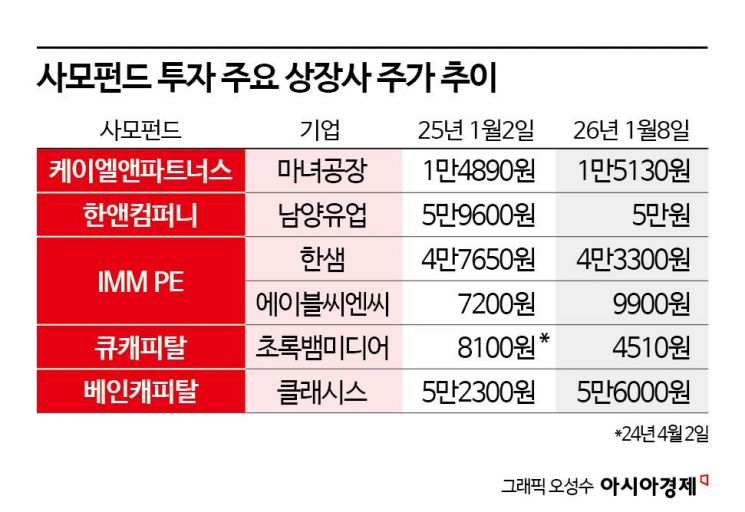
Other listed companies invested in by PEFs are showing similar trends. Namyang Dairy Products, backed by Hahn & Company, started last year at 59,600 won per share but closed at 50,000 won on January 8. After peaking at 83,800 won in August last year, the stock price has since declined, falling back to the 50,000 won range.
Chorokbaem Media, acquired by Q Capital, has also failed to recover its stock price. After facing the risk of delisting due to former Chorokbaem Group Chairman Won Youngsik's embezzlement and breach of trust charges, Chorokbaem Media resumed trading in April last year, but its rebound has been limited. The stock price, which was 8,100 won per share when trading resumed, is now hovering in the 4,500 won range.
The situation is not much different for Able C&C and Hanssem, both invested in by IMM PE. As of the close on January 8, Able C&C's stock price was 9,900 won, up 37.5% from January last year. However, considering that the stock price exceeded 28,000 won when IMM PE acquired the company in 2017, the recovery is still considered insufficient.
Hanssem recently decided to cancel 29.46% of its treasury shares, announcing a shareholder return policy worth approximately 330 billion won based on market value. However, with the prolonged slump in the housing market, the market response has been limited. Although the stock price temporarily rebounded following the announcement, it is currently lower than it was a year ago.
Lee Seonil, a researcher at BNK Investment & Securities, commented, "Hanssem continues to maintain profitability through strategic efforts despite the ongoing unfavorable environment," but added, "For sustained growth, a recovery in the housing market is essential."
Not all PEF-invested listed companies are underperforming. Classys, invested in by Bain Capital in 2022, is considered an exceptional case. The stock price, which was in the low 20,000 won range at the time of acquisition, closed at 56,000 won on January 8. With the company's value nearly tripling in three years, Bain Capital has recently initiated the process to sell its stake in Classys.
Industry insiders note that PEF participation in management or shareholder return policies alone are no longer enough to guarantee stock price increases. An IB industry source stated, "Expectations for the impact of PEF acquisitions are often already reflected in stock prices," adding, "Ultimately, what drives stock prices is the industry outlook and the sustainability of earnings."
© The Asia Business Daily(www.asiae.co.kr). All rights reserved.
![Clutching a Stolen Dior Bag, Saying "I Hate Being Poor but Real"... The Grotesque Con of a "Human Knockoff" [Slate]](https://cwcontent.asiae.co.kr/asiaresize/183/2026021902243444107_1771435474.jpg)















