Visiting Korea's Largest Private Satellite Production Hub
Encouraging Researchers... "Toward Becoming a Top Five Space Power"
Kim Seungyeon, Chairman of Hanwha Group, has announced a management policy to focus on the space business in the new year. For his first on-site activity of the year, Chairman Kim visited the Hanwha Systems facility together with the management team, including Vice Chairman Kim Dongkwan, who oversees Hanwha Group's space business.
On January 8, Chairman Kim visited the Hanwha Systems Jeju Space Center, the largest private satellite production hub in South Korea, and engaged in on-site management. He was accompanied by the management team, including Vice Chairman Kim Dongkwan, who leads Hanwha Group's space business. This was Chairman Kim's first visit to a Hanwha Systems facility. After touring the exhibition hall, Chairman Kim received a briefing on this year's business plans and the overall space business, and personally met and encouraged researchers working on site. In the guestbook, he wrote, "Even if it is difficult, pursuing the path we must take is Hanwha's mission."
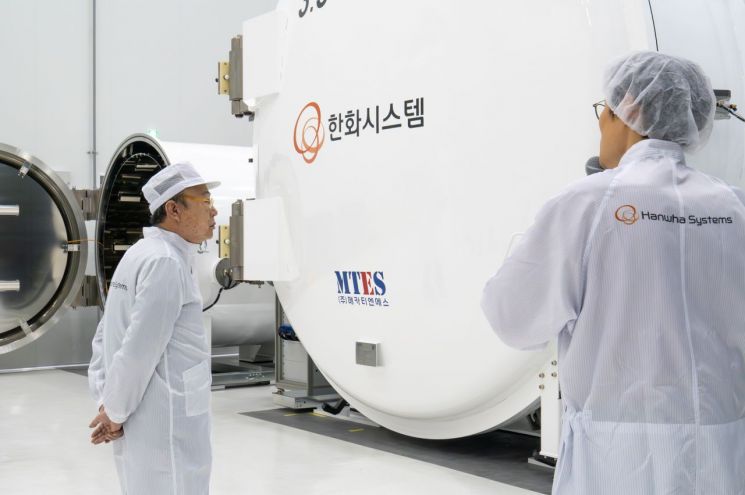 Kim Seungyeon, Chairman of Hanwha Group, is inspecting the space environment test facility at Hanwha Systems Jeju Space Center on the 8th. Hanwha
On this day, Chairman Kim donned a cleanroom suit and inspected the inside of the cleanroom. The facility is equipped with a space environment test site that simulates vacuum conditions, extreme cold at minus 180 degrees Celsius, and extreme heat at 150 degrees Celsius, as well as a high-power electromagnetic wave testing facility. Afterwards, he had lunch with executives and employees, listening to feedback from the field.
Chairman Kim stated, "Our dream of launching satellites with our own capabilities has become reality with the successful fourth launch of Nuriho," adding, "By developing the lunar lander propulsion system following the lunar orbiter, Hanwha has established itself as a leading company in South Korea's private space industry." He continued, "The value of Hanwha's business lies in our satellites observing climate change, safeguarding security, and contributing to human life."
Chairman Kim described the Jeju Space Center as "both the present and future of Hanwha's dream toward space." He added, "Together with the space cluster regions such as Goheung County and Suncheon City in Jeollanam-do and Changwon City in Gyeongsangnam-do, let us transform into the forward base of South Korea's space industry. Every drop of your sweat will serve as the foundation for elevating South Korea into one of the world's top five space powers."
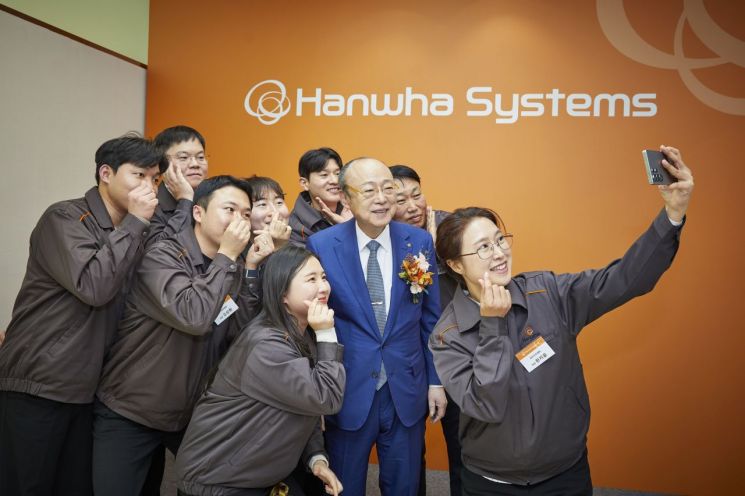 Kim Seungyeon, Chairman of Hanwha Group, is taking a selfie with the executives and employees of Hanwha Systems Jeju Space Center. Hanwha
Vice Chairman Kim, together with Chairman Kim, examined a model of an ultra-low orbit, ultra-high-resolution synthetic aperture radar (SAR) satellite capable of 15-centimeter resolution, and discussed next-generation satellite technology and global space industry trends. According to the company, Chairman Kim's vision of a "Hanwha-led space industry," which he has nurtured since the 1980s, has been realized in concrete terms through Vice Chairman Kim. In 2021, Vice Chairman Kim launched the "Space Hub," the control tower for the space business, and established an engineer-centered organization. It was also at this time that the structure was set, with Hanwha Aerospace responsible for launch vehicles and Hanwha Systems for satellites.
The Jeju Space Center is the result of this strategy. Built on a 30,000-square-meter site, equivalent to four soccer fields, with a total floor area of 11,400 square meters, the center can produce up to eight satellites per month and 100 satellites per year. Starting this year, the center will begin full-scale mass production of SAR satellites for Earth observation.
Hanwha Systems, having succeeded in launching a 1-meter class SAR satellite, is now developing satellites with 50-centimeter and 25-centimeter resolutions. The company is also preparing next-generation satellites capable of identifying 15-centimeter objects from ultra-low orbits below 400 kilometers above the ground. Hanwha is simultaneously building a value chain centered on Jeju, covering satellite development, production, launch, control, and artificial intelligence-based image analysis.
© The Asia Business Daily(www.asiae.co.kr). All rights reserved.
![Clutching a Stolen Dior Bag, Saying "I Hate Being Poor but Real"... The Grotesque Con of a "Human Knockoff" [Slate]](https://cwcontent.asiae.co.kr/asiaresize/183/2026021902243444107_1771435474.jpg)
















