Dobong and Nowon Also See Double-Digit Rebound
The auction price ratio for Seoul apartments (the ratio of the winning bid to the appraised value) has reached its highest level in three and a half years. Not only the Gangnam area but also major non-Gangnam districts such as Yangcheon-gu and Seongdong-gu have driven this upward trend. Outlying areas that had been stagnant, such as Nowon-gu and Dobong-gu, also managed to rebound.
According to the "December 2025 Auction Trend Report" released by Gigi Auction, a company specializing in auction and public sale data, on January 8, the auction price ratio for Seoul apartments stood at 102.9%, up 1.5 percentage points from the previous month (101.4%). This is the highest figure in three and a half years since June 2022 (110.0%).
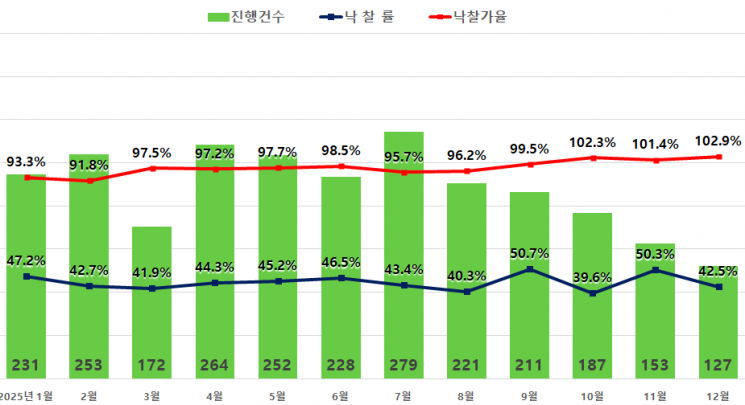
By district, Yangcheon-gu recorded the highest ratio at 122.0%, followed by Seongdong-gu at 120.5% and Gangdong-gu at 117.3%. Dobong-gu and Nowon-gu, which had previously shown weakness, also rebounded, recording 92.7% and 90.8% respectively-an increase of 16.7 percentage points and 6.2 percentage points from the previous month.
However, the number of Seoul apartment auctions in progress was 127, marking a decline for five consecutive months since July (279 cases). The successful bid rate (the ratio of winning bids to auctions in progress) also fell by 7.8 percentage points to 42.5% from 50.3% the previous month, and the average number of bidders per auction decreased to 6.7 from 7.3.
In Gyeonggi Province, Bundang-gu in Seongnam City continued its strong performance. The auction price ratio in Bundang-gu rose for three consecutive months, from 105.6% in October to 113.7% in November and 115.8% in December. The overall auction price ratio in Gyeonggi Province also increased by 0.9 percentage points to 87.5% from 86.6% the previous month. The number of auctions in progress was 753, up 21% from 624 the previous month, and the average number of bidders per auction rose from 6.4 to 7.7. Gigi Auction analyzed that "bidders have concentrated on large-scale and mid- to low-priced apartments in non-regulated areas, where loan restrictions are relatively less stringent."
In contrast, Incheon showed a downward trend. The auction price ratio dropped by 2.8 percentage points to 77.3% from 80.1% the previous month. The low auction price ratio in Michuhol-gu, where the proportion of homes affected by rental fraud is high, dragged down the overall figure for Incheon. The number of auctions in progress was 372, a 23% decrease from 480 the previous month, and both the successful bid rate (32.8%) and the average number of bidders (5.1) also declined.
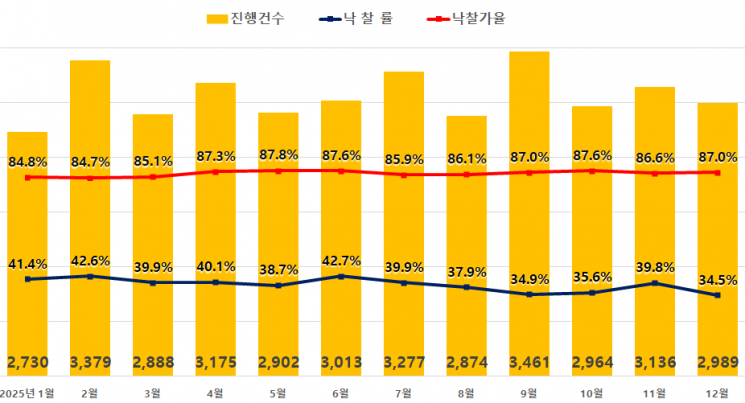
In the national apartment auction market, the successful bid rate fell while the auction price ratio saw a slight increase. Out of 2,989 auctions in progress, the successful bid rate was 34.5%, down 5.3 percentage points from 39.8% the previous month and marking the lowest level of the year. The sharp decline in successful bid rates in some provincial cities such as Daejeon and Daegu contributed to this result. The auction price ratio rose by 0.4 percentage points to 87.0% from 86.6% the previous month, and the average number of bidders increased from 7.0 to 7.8.
The five major metropolitan cities outside the capital generally showed signs of recovery. Daegu (83.1%), Gwangju (83.9%), and Busan (82.8%) all recovered to above the 80% level. Daejeon recorded a yearly high at 86.2%, and Ulsan, while slightly down at 91.9%, maintained a rate above 90% for the third consecutive month.
Among the eight provinces outside the metropolitan area, Chungnam surpassed the 80% mark for the first time in four months, reaching 80.7%. Chungbuk (89.1%) and Jeonbuk (89.8%) also rose by more than 4 percentage points each. In contrast, Gyeongnam (77.3%) and Gyeongbuk (77.1%) both fell by more than 6 percentage points, reflecting sluggish performance.
© The Asia Business Daily(www.asiae.co.kr). All rights reserved.
![Clutching a Stolen Dior Bag, Saying "I Hate Being Poor but Real"... The Grotesque Con of a "Human Knockoff" [Slate]](https://cwcontent.asiae.co.kr/asiaresize/183/2026021902243444107_1771435474.jpg)
















