Investor Day Held in Yeouido, Seoul on January 7
Oscotec, which last year signed the largest technology transfer deal for a single pipeline in Korea, is accelerating its research and development (R&D) efforts for its “next Leclaza.” Oscotec developed the non-small cell lung cancer treatment Leclaza (ingredient: Lazertinib) and last year transferred the Alzheimer’s disease treatment candidate ADEL-Y01 to Sanofi in a deal worth approximately 1.5 trillion won.
On the afternoon of January 7, Oscotec held its “2026 Investor Day” in Yeouido, Seoul, where it unveiled its future vision and R&D strategy. The event featured a panel discussion with Taeyoung Yoon, CEO of Oscotec; Dongjun Shin, Chief Financial Officer (CFO); Youngshin Kwak, Director of the Research Institute; and Jongseong Go, CEO of Genosco.
Targeting the Fibrosis Market, Leveraging Leclaza and ADEL-Y01
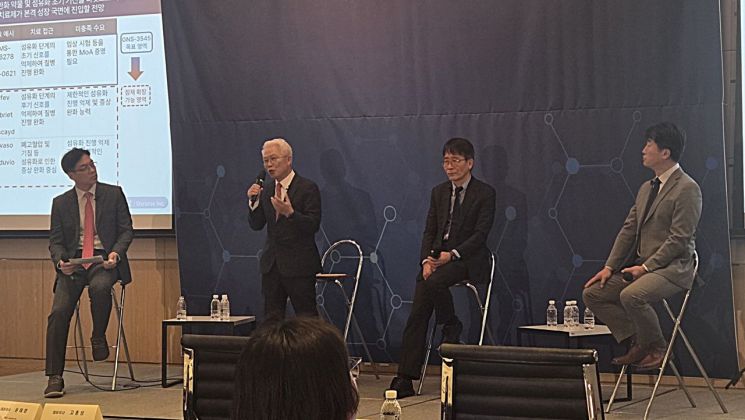 At the Oscotec Investor Day event held on the 7th at the Federation of Korean Industries building in Yeouido, Seoul, Dongjun Shin, CFO of Oscotec (from left), Jongseong Go, CEO of Genosco, Taeyoung Yoon, CEO of Oscotec, and Youngshin Kwak, Director of the Oscotec Research Institute, are having a panel discussion. Photo by Donghoon Jung
Leclaza is the first Korean anticancer drug to receive approval from the U.S. Food and Drug Administration (FDA). The company emphasized that this achievement has enabled it to accumulate global new drug development capabilities and networks. With the recent joint development success of ADEL-Y01, which was transferred to global pharmaceutical company Sanofi for a total of 1.5 trillion won, the industry has been watching closely to see which pipeline Oscotec will reinvest its secured cash into, aiming to build a “follow-up track record.”
Jongseong Go, CEO of Genosco (Oscotec’s U.S. subsidiary) and the original developer of Leclaza, said, “Compared to the competing non-small cell lung cancer drug Tagrisso, the combination therapy with Lazertinib has shown superior clinical results in terms of survival and resistance. With the launch of Rybrevant SC (subcutaneous injection formulation), I believe that no other compound can replace the Lazertinib combination therapy.” The company’s classification of its ultra-short-term pipeline as “commercialization and cash generation” is based on the judgment that Lazertinib royalties and milestone payments will be the key sources of future R&D funding.
The core of Oscotec’s short-term growth strategy presented at the event was its fibrosis pipeline. The company highlighted GNS-3545 (currently in Phase 1 clinical trials) for idiopathic pulmonary fibrosis (IPF) and OCT-648, a first-in-class (FIC) targeted therapy for renal fibrosis (in preclinical development). GNS-3545 works by inhibiting the ROCK2 signaling pathway, and Oscotec submitted an IND application to the U.S. FDA for Phase 1 clinical trials in September last year. CEO Go stated, “GNS-3545 demonstrated a strong anti-fibrotic effect even at significantly lower doses compared to competing drugs. Despite only being at the Phase 1 entry stage, there is significant interest from major global pharmaceutical companies.” He added, “Although the number of IPF patients is not large, it is a high-value market with limited treatment options. If successful, this product could generate tremendous leverage.” Oscotec disclosed that it is currently in discussions aiming for a technology transfer next year, making the “timeline” for short-term achievements more concrete.
OCT-648, currently in the preclinical stage, was also introduced as a key asset in the fibrosis lineup. OCT-648 is designed to inhibit fibrosis by blocking the process in which fibrotic genes aggregate in the nucleus. The company explained that in animal models, higher doses resulted in decreased fibrosis markers. Youngshin Kwak, Director (Vice President) of the Oscotec Research Institute, said, “All pathways of renal failure ultimately lead to fibrosis. OCT-648, which blocks the nuclear aggregation of genes in the early stages of fibrosis, will have its first data presented at the World Congress of Nephrology this March.” He added, “We are targeting both clinical entry and global technology transfer next year.”
Next-Generation Anticancer and DAC Therapies: “First-in-Class Value Is High”
Oscotec also announced a long-term strategy to shift the R&D focus to oncology after achieving tangible results in its fibrosis pipeline. The core keywords are “resistance” and “safety.” Existing anticancer drugs often face repeated issues of acquired resistance, even when targets are changed or drugs are switched, quickly exhausting treatment options. The anti-resistance anticancer drugs proposed by the company are designed to block the fundamental causes of resistance through combination therapy, thereby enhancing drug efficacy and extending survival. Oscotec is currently developing four anti-resistance anticancer projects-OCT-598 and ONC1~3-all targeting solid tumors. The company aims for technology transfer after 2028. The strategy is to transfer technology between the preclinical and Phase 1 clinical stages for rapid monetization, then reinvest the proceeds into new projects to maintain speed.
CEO Yoon stated, “First-in-class new drugs with completely novel mechanisms are highly valued by global pharmaceutical companies. Rather than simply replacing existing therapies, the ability to expand the treatment paradigm through combination therapy offers significant industrial appeal.” He also noted, “If sufficient data is secured, early technology export is possible even at the preclinical or early clinical stages,” mentioning performance targets through 2030.
DAC (Degrader-Antibody Conjugate) was also presented as a next-generation asset (candidate) targeting achievements after 2028. DAC is a modality that combines the concepts of ADC (Antibody-Drug Conjugate) and TPD (Targeted Protein Degrader). The strategy is to evolve the platform to increase tumor selectivity and reduce side effects. Oscotec has three DAC pipeline candidates and is considering a model where technology transfer occurs between the preclinical and IND (Investigational New Drug) application stages, with partners conducting Phase 1-3 clinical trials.
© The Asia Business Daily(www.asiae.co.kr). All rights reserved.
![Clutching a Stolen Dior Bag, Saying "I Hate Being Poor but Real"... The Grotesque Con of a "Human Knockoff" [Slate]](https://cwcontent.asiae.co.kr/asiaresize/183/2026021902243444107_1771435474.jpg)
















