Report on Workforce Projections at Second HMPDC Meeting
"Essential and Public Healthcare Strengthening and Educational Conditions Must Be Considered"
Jung Eun-kyung, Minister of Health and Welfare, stated regarding the scale of physician workforce supply, including the 2027 medical school enrollment quota, "While respecting the results of the projections, we will make policy decisions by considering the strengthening of essential and public healthcare in local areas, educational conditions, and above all, the right to life and health of the people."
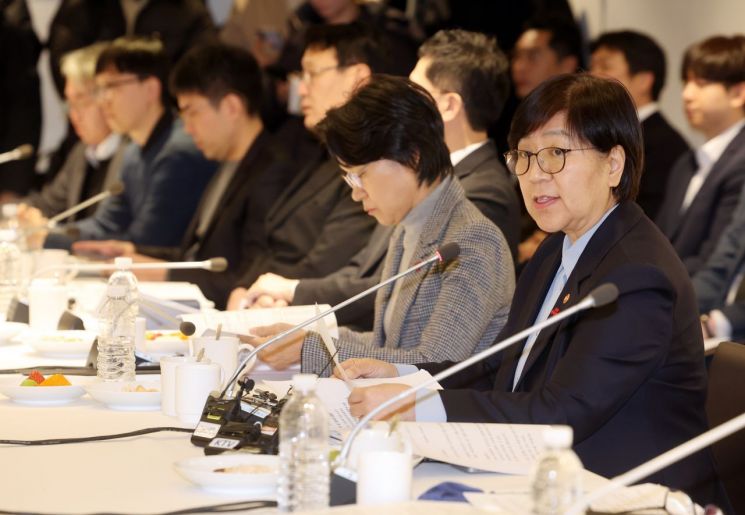 Jung Eun-kyung, Minister of Health and Welfare, is speaking at the 2nd Health and Medical Policy Deliberation Committee held on the 6th at Dalgabbi in Jung-gu, Seoul. Photo by Yonhap News
In her opening remarks at the Health and Medical Policy Deliberation Committee (HMPDC) meeting held on the 6th, Minister Jung said, "The Physician Workforce Supply Projection Committee (the Projection Committee) collectively recognized that, from a legal perspective, it is difficult for mid- to long-term workforce projections to fully predict future healthcare utilization patterns, technological advancements, and changes in working conditions. Therefore, the committee derived its results based on the most up-to-date data currently observable and on assumptions that could be agreed upon among experts." She added, "While the Projection Committee's discussions, which are centered on data and scientific methodology, and the HMPDC's policy discussions, which focus on representatives of both demand and supply sides, are complementary, I believe there are differences between them."
She further emphasized, "The issue of the physician workforce scale is a critical matter that affects the right to life and health of the people through local, essential, and public healthcare services, and thus requires careful policy consideration and judgment."
Minister Jung explained that, based on the basic premise of respecting the results of the Projection Committee, the following will be used as criteria for discussion: ▲Improvement of access to local, essential, and public healthcare ▲Population structure, technology, and working environment ▲Changes in health and medical policies ▲Medical school educational conditions and quality ▲Predictability and frequency of projections. She requested that the committee members "responsibly present and discuss your opinions under the shared goal of strengthening essential and public healthcare in local areas and advancing the healthcare system."
The HMPDC plans to hold weekly meetings throughout this month, based on the projection results reported at today's meeting, to discuss the scale of the increase, and to reach a conclusion before the Lunar New Year holiday next month. Minister Jung explained, "Today's report on the workforce supply projections marks the starting point for in-depth discussions within the HMPDC regarding the scale and direction of physician training," and added, "We plan to continue discussions on the specific scale and direction of medical school enrollment quotas."
Previously, the Projection Committee estimated, based on healthcare utilization calculated from the number of outpatient and inpatient days per person and changes in population structure, that in 2035, ten years from now, there will be a shortage of 1,535 to 4,923 physicians, and in 2040, fifteen years from now, a shortage of 5,704 to 11,136 physicians.
© The Asia Business Daily(www.asiae.co.kr). All rights reserved.
![Clutching a Stolen Dior Bag, Saying "I Hate Being Poor but Real"... The Grotesque Con of a "Human Knockoff" [Slate]](https://cwcontent.asiae.co.kr/asiaresize/183/2026021902243444107_1771435474.jpg)















