Governor Kim Stresses Launch of "First Unified Metropolitan Government"
"We Will Align with the Restructuring of the National Growth Map Centered on Regions"
Highlights "Economy and Jobs" as the Greatest Benefits of Administrative Integration
President Lee to Host Luncheon with Gwangju and Jeonnam Lawmakers on the 9th
"Jeonnam Administrative Integration Roadmap" Expected to Be Discussed
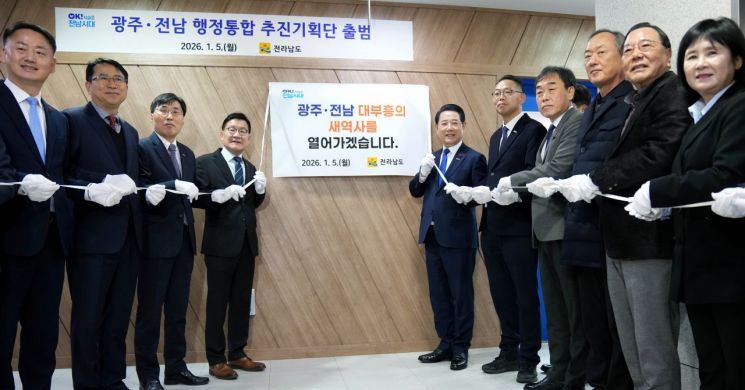
Kim Young-rok, Governor of South Jeolla Province, has expressed a strong commitment to the launch of the "Republic of Korea's First Unified Gwangju-Jeonnam Metropolitan Government" scheduled for July. He once again emphasized that administrative integration is the key prerequisite for the "Great Revival of Gwangju and Jeonnam."
On January 5, ahead of the unveiling ceremony for the "Gwangju-Jeonnam Administrative Integration Promotion Planning Group," Governor Kim outlined the direction for the launch of the "Republic of Korea's First Unified Metropolitan Government" in a public statement.
◇ The First Step Toward Gwangju-Jeonnam Integration
Governor Kim stated, "Although discussions on administrative integration between Gwangju and Jeonnam took place in the fall of 2021, at that time, due to the lack of a firm commitment from the central government to support integration, local concerns and opposition could not be overcome, and the process inevitably stalled. However, the situation is now completely different. The Lee Jaemyung administration has promised unprecedented support and assistance, on a whole new level from the past."
This is interpreted as a signal that he intends to align with the Lee Jaemyung administration's strong will to restructure the national growth map from a single capital-centric system to a 'five major regions and three special zones.' According to the South Jeolla Provincial Government, the central government has expressed its intention to grant the unified government a status equivalent to that of Seoul Metropolitan Government.
◇ Rising Expectations for Economic Revitalization
Governor Kim identified "the economy and jobs" as the greatest benefits of administrative integration.
He stated, "By establishing the RE100 National Industrial Complex, attracting large-scale semiconductor industries, and developing the southern semiconductor belt as a core axis, we will foster Gwangju and Jeonnam as hubs for AI and energy." Through this, he aims to create a structure in which local youth can find quality jobs without having to move to the capital region.
Through administrative integration, the goal is to make Gwangju and Jeonnam a "second growth hub" capable of competing with the capital region.
◇ Accelerating Administrative Integration
Governor Kim said, "We will actively pursue the swift passage of the Gwangju-Jeonnam Administrative Integration Special Act through joint sponsorship by National Assembly members from both regions. At the same time, we will thoroughly gather opinions from the city and provincial councils, as well as all sectors of society, to create the optimal integration plan together."
He added, "We will elect a unified head of the new government through the local elections on June 3, and on July 1, we will mark the historic beginning of the 3.2 million-strong Gwangju-Jeonnam administrative integration."
This move is seen as breaking away from the traditional framework of the Gwangju Mayor and South Jeolla Governor, aligning with the Lee Jaemyung administration's core policy of ushering in an "era of region-led growth."
To this end, the Gwangju-Jeonnam Administrative Integration Promotion Planning Group began preliminary preparations for enacting the Administrative Integration Special Act from its official launch day, with the goal of passing the special act in the National Assembly in February.
◇ If Successful, a 'National Model'; If Failed, a 'Political Burden'
Some observers believe that the success or failure of the Gwangju-Jeonnam administrative integration could significantly impact the future landscape of domestic politics.
If the integration is successfully established, this momentum is likely to spread to other regions. In this case, the Lee Jaemyung administration could firmly establish itself as the government that ushered in the "era of region-led growth."
On the other hand, if local resistance intensifies during the integration process, or if institutional design is inadequate and confusion arises, it could become a political liability for the administration early in its term.
This is why the Gwangju-Jeonnam administrative integration is seen as a watershed moment that will test both the current government's administrative capabilities and political leadership.
Meanwhile, President Lee Jaemyung plans to invite Kang Gi-jung, Mayor of Gwangju, Kim Young-rok, Governor of South Jeolla Province, and 18 National Assembly members from the Gwangju and Jeonnam regions affiliated with the Democratic Party of Korea to the Blue House for a luncheon meeting on January 9. During this meeting, they are expected to coordinate opinions on the "Gwangju-Jeonnam Administrative Integration Roadmap," which centers on electing a unified head of the new government in the local elections on June 3 and officially launching the unified local government on July 1.
An official from South Jeolla Province stated, "There is more interest than ever in whether Gwangju and Jeonnam will be reorganized into a single political and economic community," adding, "The government's will is strong, and since both regions are aligned on administrative integration, we expect positive results."
© The Asia Business Daily(www.asiae.co.kr). All rights reserved.
![Clutching a Stolen Dior Bag, Saying "I Hate Being Poor but Real"... The Grotesque Con of a "Human Knockoff" [Slate]](https://cwcontent.asiae.co.kr/asiaresize/183/2026021902243444107_1771435474.jpg)















