Mayor Oh Se-hoon's Key Agenda Last Year
Ordinance and Rule Amendments Streamline Framework
Includes Provisions on Regulatory Sandbox
The Seoul Metropolitan Government will continue its "war on regulations" this year. Since the beginning of last year, when Seoul Mayor Oh Se-hoon raised "deregulation" as a key municipal agenda, the city has been working to overhaul regulations. This time, the rules have been further strengthened, including specifying the mayor's duty to improve regulations in the ordinance itself.
On January 5, the Seoul Metropolitan Government announced that it had reviewed and approved 83 ordinances and 16 rules, including these changes, at the 19th Ordinance and Rule Review Committee held on December 29 of last year. The amendments include the "Ordinance on the Establishment and Operation of the Regulatory Reform Committee" and the "Enforcement Rules for the Ordinance on the Establishment and Operation of the Regulatory Reform Committee," both of which contain provisions related to regulatory reform.
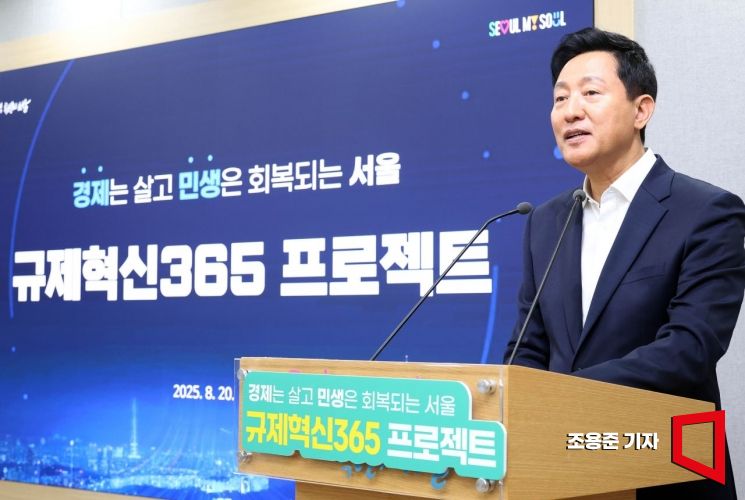 Seoul Mayor Oh Se-hoon is holding a press briefing on the 'Regulatory Innovation 365 Project' at the Seoul City Hall briefing room in Jung-gu, Seoul on August 20, 2025. Photo by Jo Yongjun
The most significant change is that the name of the ordinance has been changed to the "Seoul Metropolitan Government Basic Ordinance on Regulatory Reform." While the previous ordinance mainly focused on the operation of the Regulatory Reform Committee, the new "Basic Ordinance" now includes declarative provisions such as the mayor's duty regarding regulations. According to the legislative notice, Article 3 of the revised ordinance, titled "Duties of the Mayor," stipulates that "the mayor must promote ongoing regulatory innovation that citizens and businesses can feel in their daily lives" and "the mayor must improve administrative services that cause inconvenience in citizens' daily lives or in economic and social activities, in addition to ordinances and rules."
Channels for external participation in regulatory reform have also been expanded. A new "gathering opinions" provision has been added to guarantee citizens' right to know and stakeholders' rights when new regulations are introduced or existing ones are strengthened. This means that citizens' opinions must be sought through public hearings, legislative notices, and other methods. In addition, a new provision allows any citizen, organization, or public official to request the abolition or improvement of existing regulations.
For the first time in the country, the ordinance also provides a legal basis for introducing a regulatory sandbox at the local government level. This so-called "Seoul-style Livelihood Regulation Sandbox" aims to apply regulations more flexibly and dynamically in new industries. A city official explained, "There were previously no ordinance or rule provisions regarding sandboxes, but now regulations have been established for the first time. If a company wants to experiment with a new industry but is blocked by ordinances or rules, it can apply for a sandbox, and after review, will be allowed to conduct demonstrations for a certain period or within a designated area."
In addition, new provisions related to regulatory impact analysis have been introduced in the enforcement rules. The new "Evaluation Factors for Regulatory Impact Analysis" provision requires that quantifiable data be prioritized in regulatory impact analysis and that the analysis report be prepared in accordance with guidelines established by the mayor. Another new provision, "Self-Review of Regulatory Impact Analysis," stipulates that the heads of relevant offices, headquarters, and bureaus, together with external experts, must conduct an internal review of the validity of regulations and prepare an opinion statement based on the results.
With these ordinance and rule amendments, the regulatory reform framework that Mayor Oh has pursued over the past year has been systematically established. Previously, Mayor Oh first introduced the keyword "deregulation" at the start of last year. In his New Year's address at the time, he stated, "With the determination to cut regulatory authority in half, we will launch a full-scale 'war on regulations,'" and added, "We must go beyond regulatory reform and begin full-scale deregulation." This was not just a declaration; related administrative actions were also actively pursued. The city held a 100-day intensive regulatory reporting campaign to hear directly from the public and also collected ideas from city officials on unnecessary regulations. Seoul became the first local government to establish a dedicated Regulatory Innovation Planning Office, which identified and improved 161 regulations.
© The Asia Business Daily(www.asiae.co.kr). All rights reserved.
![Clutching a Stolen Dior Bag, Saying "I Hate Being Poor but Real"... The Grotesque Con of a "Human Knockoff" [Slate]](https://cwcontent.asiae.co.kr/asiaresize/183/2026021902243444107_1771435474.jpg)















