Korea Transportation Safety Authority to Add KNCAP Evaluation Items in 2026
Driver Monitoring and Post-Collision Battery Safety Assessment
This year, the government has decided to include a driver monitoring system in the Korean New Car Assessment Program (KNCAP). The evaluation will detect drowsy driving by using sensors to determine if the driver's gaze is directed somewhere other than forward or if their eyes are closed for a certain period. The safety of electric vehicle batteries against external impacts will also be assessed.
According to the Korea Transportation Safety Authority, this year’s KNCAP evaluation will assign up to 2.0 points based on the operation of the driver state monitoring system. If the driver turns their head or if their eyes or upper body move, it is considered prolonged inattention, and if the system alerts the driver, 0.3 points are awarded for each scenario, up to a total of 0.9 points. If the driver closes their eyes or fails to respond to warnings, indicating fatigue, the system issues a warning and receives 1.0 point. An additional 0.1 point is given for the deactivation test.
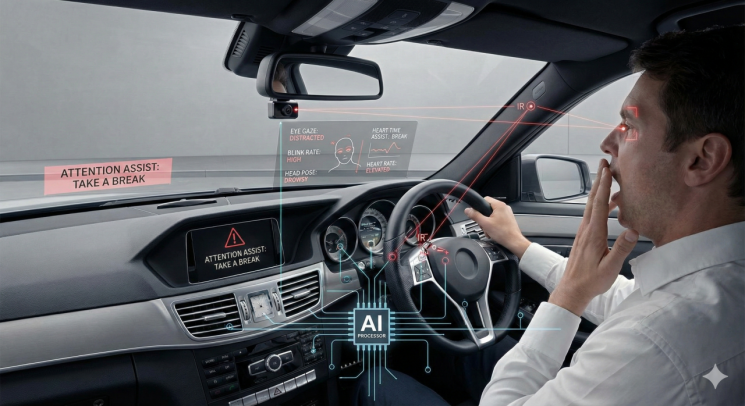 Driver state monitoring system expressed by Gemini. It detects the driver's condition through cameras and sensors, and if it determines that attention is needed, it provides audiovisual stimuli and vibrations.
Cameras and other sensors can detect whether the driver's gaze is directed somewhere other than forward or if their eyes are closed. Prolonged inattention is defined as the driver shifting their gaze to places unrelated to driving, such as the floor, while fatigue assumes the driver closes their eyes or does not respond to repeated warnings. The test is conducted while driving straight at a constant speed below 80 km/h. For prolonged inattention, adaptive cruise control systems will be used for evaluation, reflecting domestic conditions.
Along with driver monitoring, a new post-collision traction battery (battery) safety test for electric vehicles will be introduced this year. The test simulates external impact scenarios that may commonly occur during everyday driving, such as hitting a curb.
The vehicle is driven at 30-40 km/h over an object 250 mm high, after which the battery is observed for 60 minutes to check for any issues. The battery is then subjected to a submersion test. In addition to the battery management system (BMS) functional safety protection feature, a new evaluation specific to electric vehicles has been added. In a previous electric vehicle fire incident in an apartment parking lot in Cheongna, Incheon, post-accident investigations found evidence of external battery impact.
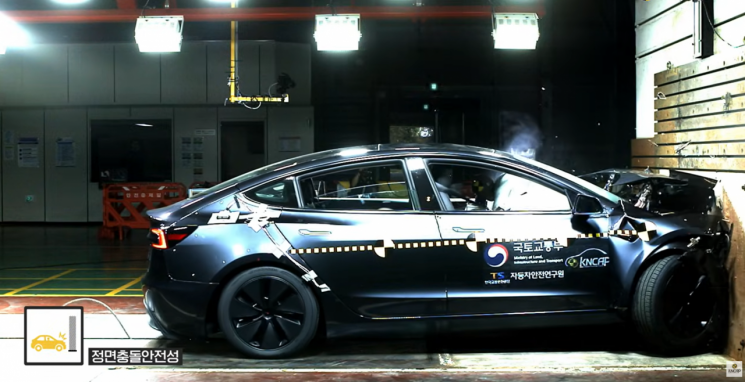 Tesla Model 3, which was included in last year's new car safety evaluation. Examining frontal collision safety. New Car Safety Evaluation Website
KNCAP evaluations are conducted by the Automobile Safety Research Institute under the Korea Transportation Safety Authority, using a variety of equipment. Evaluation items include collision safety, pedestrian safety, and accident prevention safety. These are not mandatory requirements for automakers or importers.
However, since a public institution scientifically and thoroughly evaluates vehicle safety and assigns scores, the program is highly credible. Major automotive countries such as Europe, the United States, Japan, and China each have their own standards. Automakers do not participate in the evaluation; instead, the research institute independently purchases and tests the vehicles.
Pedestrian safety devices such as rear cameras and sensors, daytime running lights, and tire pressure monitoring systems have been proven effective through the new car safety evaluation, and their installation has subsequently become mandatory for some or all vehicle models. The automatic emergency braking system, which detects vehicles and pedestrians ahead and stops the vehicle just before a collision, is currently only mandatory for certain vehicle types such as large trucks and buses. However, because it receives a high score in KNCAP, it is now standard in most new vehicles. The driver state monitoring system, which will be evaluated starting this year, is expected to become even more useful with the advancement of autonomous driving, and has been mandatory for new cars in Europe since 2024.
© The Asia Business Daily(www.asiae.co.kr). All rights reserved.
![Clutching a Stolen Dior Bag, Saying "I Hate Being Poor but Real"... The Grotesque Con of a "Human Knockoff" [Slate]](https://cwcontent.asiae.co.kr/asiaresize/183/2026021902243444107_1771435474.jpg)
















