KDCA Publishes "2025 Tobacco Harm Planning Report"
Harmful Substances Detected in Urine and Blood... Lung Cancer Risk Up to 1.4 Times Higher
Need for a "Completely Smoke-Free Indoor Policy" Beyond Expanding Non-Smoking Zones
It has been analyzed that 'secondhand smoke,' which non-smokers are unknowingly exposed to in their daily lives, is a cause of various fatal diseases, including lung cancer. In particular, the report raised concerns not only about secondhand smoke from inhaling cigarette smoke but also about the dangers of thirdhand smoke, which involves exposure to harmful substances left on a smoker's clothes or skin.

On the 31st, the Korea Disease Control and Prevention Agency (KDCA) announced the publication of the "2025 Tobacco Harm Planning Report: Secondhand Smoke" to prevent the harms of secondhand smoke and to establish scientific grounds for regulatory measures.
This report systematically examined secondhand smoke occurring in various environments such as homes, workplaces, and public spaces. It also included an analysis of exposure patterns to aerosols produced by emerging tobacco products, such as e-liquid and heated tobacco products, which have seen a recent increase in users.
According to the report, nicotine, ultrafine particles, and even Group 1 carcinogens such as tobacco-specific nitrosamines (TSNAs) and volatile organic compounds were detected in various indoor environments, including homes and inside vehicles. Furthermore, biomarker analyses of urine and blood revealed that the actual level of secondhand smoke exposure accumulated in the body was higher than the level recognized through surveys. This suggests that many non-smokers are exposed to harmful tobacco substances in their everyday lives without realizing it.
The report also warned that secondhand smoke increases the incidence of various cancers, including lung cancer, head and neck cancer, and cervical cancer. According to a meta-analysis conducted overseas, the risk of developing lung cancer due to secondhand smoke exposure can rise by up to approximately 1.4 times, and a dose-response relationship was observed, meaning that the longer the exposure, the greater the risk.
In addition to cancer, associations were found with stroke, ischemic heart disease, chronic obstructive pulmonary disease (COPD), and even depression. In particular, pregnant women exposed to secondhand smoke face increased risks of stillbirth, premature birth, and low birth weight, necessitating special caution.
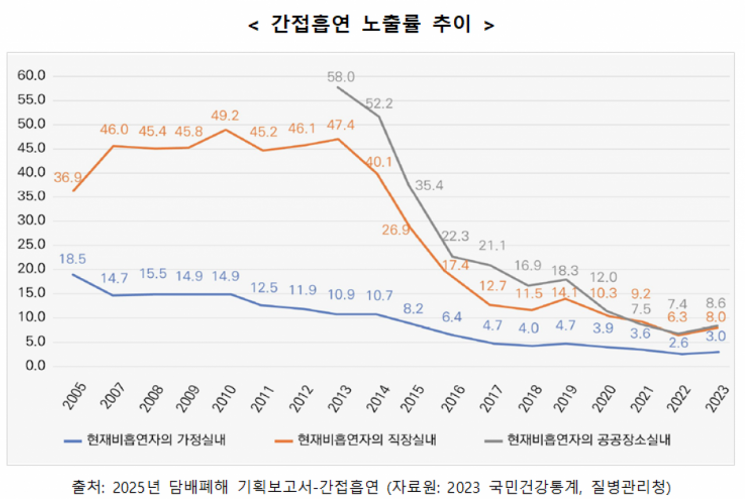
Currently, countries such as Spain and Ireland are enforcing strict regulations that prohibit the establishment of separate smoking areas in indoor public places or workplaces. As a result, improvements in indoor air quality and reductions in the incidence and mortality rates of cardiovascular diseases have been demonstrated. While Korea is also gradually expanding non-smoking zones, the report pointed out that a 'completely smoke-free indoor policy,' which does not allow separate smoking areas or rooms, is necessary for indoor smoking bans to be truly effective.
Im Seungkwan, Commissioner of the Korea Disease Control and Prevention Agency, stated, "Smoking is not just a personal choice; it can also threaten the health of those around you," adding, "We hope this report will raise awareness about secondhand smoke and be actively utilized to strengthen related regulatory policies."
The 2025 Tobacco Harm Planning Report can be viewed or downloaded from the KDCA website.
© The Asia Business Daily(www.asiae.co.kr). All rights reserved.
![Clutching a Stolen Dior Bag, Saying "I Hate Being Poor but Real"... The Grotesque Con of a "Human Knockoff" [Slate]](https://cwcontent.asiae.co.kr/asiaresize/183/2026021902243444107_1771435474.jpg)
















