Broadcasting Media and Communications Commission Releases Results of "2024 Broadcasting Industry Survey"
Total Industry Sales Reach 18.8 Trillion Won, Down 0.7% Year-on-Year
Number of Employees Drops by 2.3%, with Terrestrial Broadcasters Seeing the Largest Decrease
Content Production Costs Rise, While Exports Fall by 8.4%
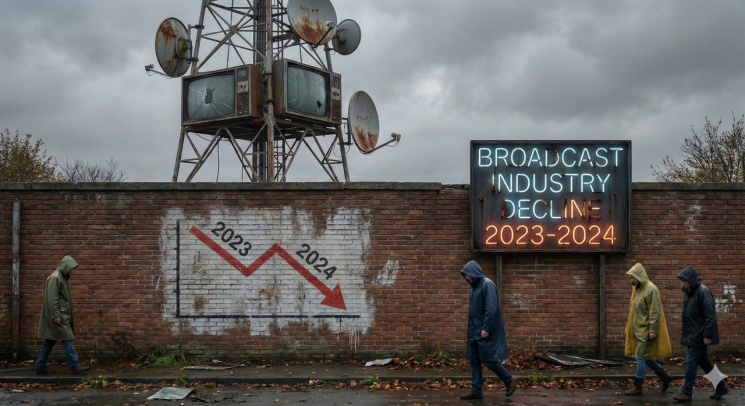 According to the results of the "2024 Broadcasting Industry Survey" on the 31st, domestic broadcasting industry sales declined for the second consecutive year, totaling 18.832 trillion won. Image by Gemini Production
The domestic broadcasting industry experienced negative growth for the second consecutive year amid sluggish advertising and a downturn in traditional media.
The Broadcasting Media and Communications Commission announced on the 31st the results of the "2024 Broadcasting Industry Survey," stating that total domestic broadcasting industry sales last year amounted to 18.832 trillion won, a 0.7% decrease compared to the previous year. Broadcasting industry sales declined for the first time ever in 2023 and continued to fall for a second year. The Broadcasting Industry Survey is a nationally approved annual statistical survey targeting broadcasting operators, comprehensively covering sales, subscribers, production costs, trade, and workforce status.
The decline in broadcasting advertising revenue was particularly notable. In 2024, broadcasting advertising revenue was 2.3073 trillion won, down 7.4% from the previous year, with advertising sales decreasing across almost all operator groups, including terrestrial broadcasters, program providers, IPTV, and satellite broadcasting. Terrestrial broadcasting advertising revenue was recorded at 835.7 billion won, a 9.9% decrease year-on-year.
By operator, only IPTV and IPTV content providers (IPTV CP) saw sales growth. IPTV sales increased by 1.4% to 5.0783 trillion won, while IPTV CP sales rose by 3.1% to 926.3 billion won. In contrast, terrestrial broadcasting (-5.4%), comprehensive cable broadcasting (-2.9%), and satellite broadcasting (-3.6%) all posted declines in sales.
Total pay TV sales amounted to 7.2361 trillion won, showing a slight increase, but the growth rate was only 0.05%, indicating a virtual stagnation. The pay TV sales growth rate, which was 8.0% in 2018, has slowed each year, dropping to near zero this year.
The number of pay TV subscribers also showed signs of stagnation. As of the end of 2024, there were 36.32 million pay TV subscriber households, with the increase rate over the previous year at only 0.04%. IPTV subscribers increased by 1.8% to 21.35 million households, but comprehensive cable broadcasting (-2.3%) and satellite broadcasting (-2.5%) subscribers decreased.
Spending on broadcasting program production and acquisition continued to rise. In 2024, production and acquisition costs for broadcasting programs reached 4.0732 trillion won, a 2.5% increase compared to the previous year. Production costs rose, while acquisition costs declined.
On the other hand, broadcasting program exports fell by 8.4% to 611.58 million US dollars. While exports by terrestrial broadcasters and IPTV CPs decreased, program provider (PP) exports saw a slight increase. The main export destination was overseas OTT platforms, accounting for 71.3% of total exports, with Japan and the United States being the largest markets by country.
The number of employees in the broadcasting industry was 37,427, a decrease of 872 people (2.3%) compared to the previous year. In particular, the number of terrestrial broadcasting employees fell by 4.5%, marking the largest drop. Most operator groups, including PP and IPTV CP, experienced workforce reductions.
© The Asia Business Daily(www.asiae.co.kr). All rights reserved.
![Clutching a Stolen Dior Bag, Saying "I Hate Being Poor but Real"... The Grotesque Con of a "Human Knockoff" [Slate]](https://cwcontent.asiae.co.kr/asiaresize/183/2026021902243444107_1771435474.jpg)















