Reuters Cites Anonymous Sources
Applications Rejected If Requirements Not Met
"Ultimate Goal Is 100% Use of Domestic Equipment"
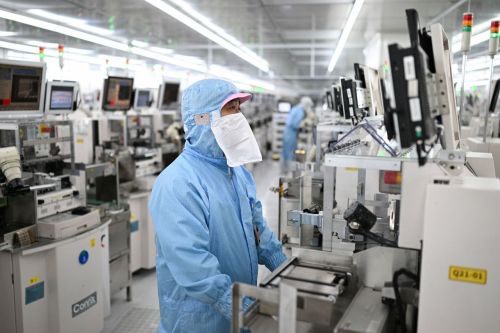 Technicians are inspecting semiconductor process equipment at a semiconductor manufacturing plant in Suqian, Jiangsu Province, eastern China. Photo by AFP Yonhap News
The Chinese government is reportedly requiring domestic semiconductor companies to prove that more than 50% of the equipment used in new or expanded factories is domestically produced.
Reuters reported on December 30 (local time), citing three sources familiar with the matter, that the Chinese government, which is pursuing independence in its semiconductor supply chain, is implementing this policy.
Although this regulation has not been officially codified in documents, it is currently being enforced in the semiconductor industry. One source said, "The authorities actually prefer a much higher percentage than 50%," adding, "Ultimately, the goal is to use 100% domestically produced equipment."
Applications that do not meet the standards required by the authorities are generally rejected. However, depending on supply constraints, the authorities may grant some flexibility. For advanced process lines where domestic equipment is insufficient, certain relaxed regulations are applied.
This regulation requiring at least 50% use of domestic products is interpreted as being even stricter than the United States' advanced artificial intelligence (AI) semiconductor chip regulations, as it applies to a broader range of cases. Previously, President Xi Jinping has been pushing for supply chain independence by moving away from foreign technology, and this policy direction has been reinforced since the United States restricted AI chip exports to China in 2023.
Reuters pointed out, "While U.S. export controls are limited to the sale of cutting-edge equipment, this policy pressures Chinese companies to choose domestic equipment even in areas where equipment from the United States, Japan, South Korea, and Europe is still available for purchase."
In addition, the Chinese government has been fostering the semiconductor supply chain by creating the so-called "Big Fund" and investing hundreds of billions of yuan. In 2024, it launched the third phase, securing 344 billion yuan (about 71 trillion won) in funding. Reuters also reported last month that the Chinese government ordered data centers receiving any amount of state funding to stop using foreign AI chips.
The Chinese government’s efforts toward supply chain independence appear to have achieved some results. This year, state-affiliated institutions placed orders for 421 units of domestically produced lithography equipment and components, totaling approximately 850 million yuan (about 180 billion won), according to the report.
Individual companies have also seen tangible results. Naura and AMEC are reportedly testing equipment on some of SMIC’s 7nm advanced process lines, which are operated by the Chinese semiconductor foundry company SMIC. Their performance has also improved, with Naura and AMEC’s sales in the first half of the year surging by 30% and 44%, respectively, compared to the same period last year.
For the time being, the Chinese government’s aggressive drive for semiconductor self-sufficiency is expected to continue. The latest report from the international semiconductor equipment and materials association (SEMI) projects that China will remain the world’s largest buyer of semiconductor equipment at least through 2027. SEMI explained that China, which is competing with the United States for semiconductor supremacy, is expected to continue investing in related facilities for the foreseeable future in pursuit of technological independence.
© The Asia Business Daily(www.asiae.co.kr). All rights reserved.
![Clutching a Stolen Dior Bag, Saying "I Hate Being Poor but Real"... The Grotesque Con of a "Human Knockoff" [Slate]](https://cwcontent.asiae.co.kr/asiaresize/183/2026021902243444107_1771435474.jpg)















