77 Companies Listed, Public Offering Size Up 15% Year-on-Year
Stricter Lock-Up Commitments Sharpen Company Differentiation
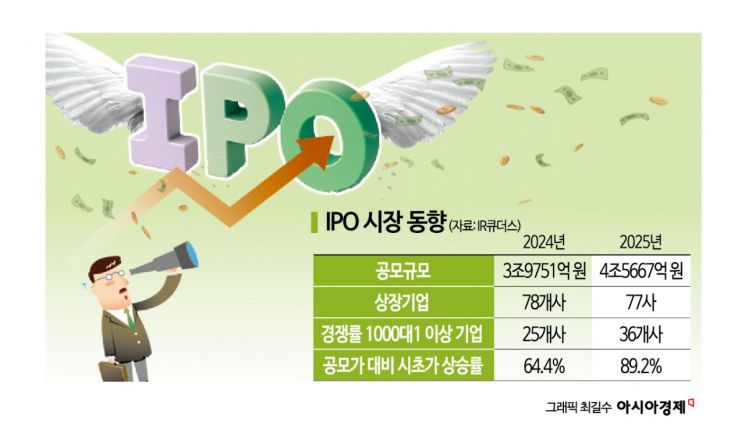
In 2025, the domestic initial public offering (IPO) market showed a clear recovery in both offering size and overall performance indicators. In particular, analysts noted that the introduction of the mandatory lock-up commitment system has intensified the process of distinguishing between strong and weak companies.
According to the Korea Exchange and IR Qdus on December 30, a total of 77 companies went public this year, with 7 listing on KOSPI and 70 on KOSDAQ. While the number of listings was similar to the previous year (78 companies), the total amount raised through public offerings increased by 14.9% to 4.5667 trillion won, compared to 3.9751 trillion won the previous year.
Among these, 67 companies set their offering prices at or above the upper end of the desired price band during demand forecasting, two more than the previous year. While the numerical increase was limited, there was a significant qualitative shift. The average institutional investor lock-up commitment ratio this year was 18.8%, up 12.3 percentage points from the previous year's average of 6.5%. Notably, after improvements to the demand forecasting system, the average commitment ratio surpassed 40%, indicating that these regulatory changes have had a direct impact on the market.
Competition ratios were also strong. The proportion of companies with an institutional demand forecast competition ratio exceeding 1,000 to 1 reached 46.8%. The number of companies meeting this criterion increased by 44.4%, from 25 last year to 36 this year. General subscription competition ratios also remained high, with 37 companies recording ratios of 1,000 to 1 or higher.
Looking at the details, the top ranks in institutional demand forecast competition ratios were dominated by bio, robotics, and advanced manufacturing companies. GFC Life Science recorded the highest competition ratio at 1,443.7 to 1, followed by Now Robotics (1,395.0 to 1), MD Device (1,366.7 to 1), Wonil TNI (1,312.2 to 1), and Samjin Food (1,303.9 to 1). In general subscriptions, Samjin Food posted the highest competition ratio at 3,224.8 to 1, with Aromatica, Nota, Innotech, and Intocell also ranking high.
The average initial price increase rate compared to the offering price was 89.2%, up 24.8 percentage points from the previous year's 64.4%. Of the 77 newly listed companies, 69 (or 89.6%) saw their opening prices exceed the offering price, a marked improvement from last year's 79.5%. Curiosis, Aimed Bio, and Algenomics drew attention as their initial prices rose 300% above the offering price, while Innotech and Green Optics also posted more than double the increase.
This year, the IPO market was particularly characterized by a more pronounced separation between companies due to the strengthening of the lock-up commitment system. Since July, the Financial Services Commission has implemented a priority allocation system for mandatory holding commitments. Under this system, institutional investors who commit to holding shares for a certain period are given priority in share allocation.
Since the introduction of the priority allocation system, 13 out of 23 newly listed companies had a lock-up commitment ratio exceeding 40%. In contrast, 7 companies had a commitment ratio below 20%, and some recorded single-digit ratios. In terms of stock performance, there were three cases where the share price fell below the offering price within 15 days of listing, all of which were companies with low commitment ratios.
The market expects this trend to become even more pronounced in next year's IPO market. As market participants respond more actively to regulatory changes, the gap in lock-up commitment ratios and listing performance among individual stocks is likely to widen.
An IR Qdus official stated, "2025 was a year when the effects of regulatory improvements were confirmed in the numbers," adding, "In 2026, polarization based on the lock-up commitment ratio and company fundamentals will become even more evident, with both blockbuster IPOs and selective investment trends intensifying simultaneously."
© The Asia Business Daily(www.asiae.co.kr). All rights reserved.
![Clutching a Stolen Dior Bag, Saying "I Hate Being Poor but Real"... The Grotesque Con of a "Human Knockoff" [Slate]](https://cwcontent.asiae.co.kr/asiaresize/183/2026021902243444107_1771435474.jpg)















