Satellite Imagery Analysis of Nuclear Facilities
"Enhanced Nuclear Warhead Production Capacity"
As projections suggest that China's nuclear warhead stockpile will exceed 1,000 by 2030, The Washington Post (WP) reported on December 28 (local time) that China has begun expanding its nuclear warhead production facilities.
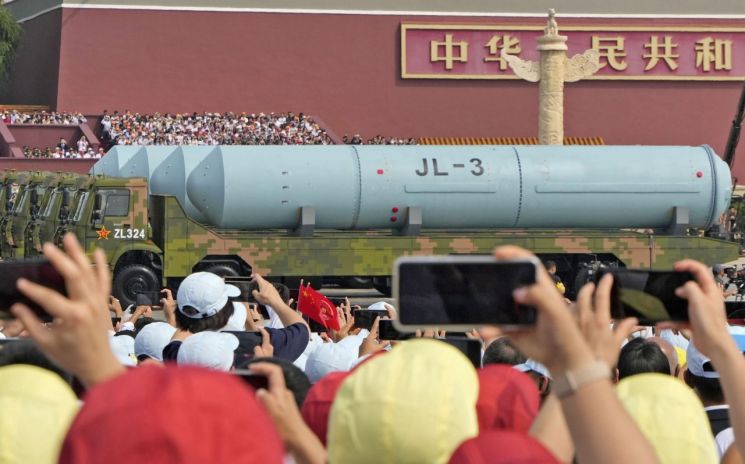 The JL-3 submarine-launched ballistic missile (SLBM) unveiled at the large-scale military parade commemorating the 80th anniversary of Victory Day held at Tiananmen Square in Beijing, China, on September 3 (local time). Photo by Yonhap News
According to satellite image analyses by the Austrian nonprofit security think tank Open Nuclear Network (ONN) and the UK-based Verification Research, Training and Information Centre (VERTIC), a massive expansion has taken place over the past five years at a nuclear warhead-related production complex in the mountainous region near Pingtong, Sichuan Province. The Pingtong complex is the only publicly confirmed facility among those linked to China’s “plutonium pit” production. The nuclear warheads believed to be under construction in China are structured by processing plutonium, a fissile material, into a spherical form known as a “pit” and encasing it in conventional high explosives. When these explosives detonate, they strongly compress the core of fissile material, triggering a chain reaction that results in a nuclear explosion and the release of immense energy.
Another facility, located in a remote area of Zitong, Sichuan Province, has also reportedly undergone significant expansion since 2019. This site is believed to be a key hub for producing the high-explosive components necessary to detonate the pits. At the Zitong complex, a large security wall and what appears to be a new storage area have been under construction since around 2021. Additionally, new land development for further facility construction has been observed since approximately 2023.
At the Lop Nur nuclear test site in the Xinjiang Uyghur Autonomous Region, new underground tunnels and large vertical shafts have reportedly been constructed in recent years, raising the possibility that China is preparing to resume nuclear testing. Renny Babiaz, a nuclear weapons expert who participated in the analysis, stated, “All the changes we have identified indicate significant investment in these areas. Taken together, this suggests that China’s nuclear warhead production capabilities for its nuclear program have improved.”
Experts believe that while it will be difficult for China to match the United States’ estimated 3,700 nuclear warheads in the near future, the expansion of these nuclear facilities indicates that China is preparing for a full-scale arms race. WP also reported that China has recently defined a “launch-on-warning” system as an essential element of national security across both nuclear and conventional conflicts in its military publications. This means China is preparing its nuclear brigades to conduct preemptive nuclear strikes as soon as signs of an enemy attack are detected.
The U.S. Department of Defense also assessed in its recently released “2025 China Military Power Report” that China has steadily modernized its military capabilities and has now reached a level where it can directly threaten the U.S. mainland. The Department of Defense projected that while China’s nuclear warhead stockpile remained in the low 600s last year, it is expected to possess more than 1,000 nuclear warheads by 2030.
© The Asia Business Daily(www.asiae.co.kr). All rights reserved.
![Clutching a Stolen Dior Bag, Saying "I Hate Being Poor but Real"... The Grotesque Con of a "Human Knockoff" [Slate]](https://cwcontent.asiae.co.kr/asiaresize/183/2026021902243444107_1771435474.jpg)
















