WSJ Reports
Companies Take a Wait-and-See Approach Instead of Expanding Workforce...
Low Hiring and Low Turnover
The Wall Street Journal (WSJ) reported on the 28th (local time) that, despite robust economic growth, U.S. companies are expected to take a cautious approach to new hiring next year due to economic uncertainty and the spread of artificial intelligence (AI).
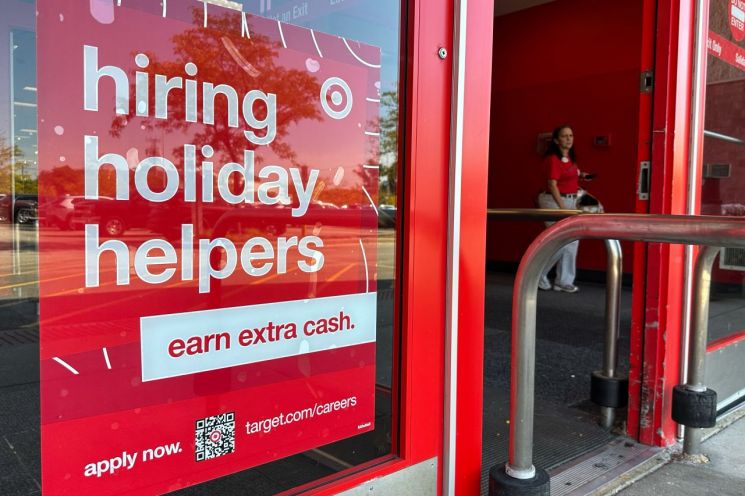 A job posting is displayed at a retail store in Arlington Heights, Illinois, USA. Photo by AP Yonhap News
According to the newspaper, a survey conducted among participants at a CEO conference hosted by the Yale School of Management in Manhattan, New York this month found that 66% of executives plan to either reduce their workforce or maintain current staffing levels in 2026. Only one-third of executives responded that they are planning new hires.
The hesitation among companies to hire new employees is rooted in the belief that advances in AI technology will allow them to improve work efficiency and productivity with their existing workforce. In addition, uncertainty about future economic trends caused by external factors such as tariff policies is also cited as influencing companies' conservative personnel strategies.
The U.S. labor market is not experiencing a sharp downturn, but it is showing signs of gradual slowdown. The unemployment rate rose from 4.4% in September to 4.6% in November, reaching its highest level in four years and two months since September 2021. While jobs have increased this year in the healthcare and education sectors, major companies such as Amazon, Verizon, Target, and UPS have reduced office staff in recent months, heightening anxiety among workers.
Christopher Waller, a Fed Governor and one of the candidates for the next chair of the Federal Reserve, stated, "The current U.S. labor market is essentially showing near-zero employment growth. This can hardly be considered a healthy labor market." He added, "I am hearing from CEOs of companies across the country that they are postponing hiring until they can determine which jobs AI might replace."
In this climate, job switching among workers has also dropped significantly. At IBM, the voluntary turnover rate is now below 2%, the lowest in 30 years. This is a sharp decline from the typical level of about 7%, and the company explains that this naturally leads to a decrease in new hiring.
However, some predict that if economic growth continues, companies will inevitably have to expand their workforce. The U.S. economy has shown a stronger-than-expected recovery, recording an annualized growth rate of 4.3% in the third quarter compared to the previous quarter.
WSJ reported, "The management strategy for companies next year will be 'do not hire,'" adding, "Companies are aiming to delegate more work to technology through 2026, and all workers are suffering from job insecurity."
© The Asia Business Daily(www.asiae.co.kr). All rights reserved.
![Clutching a Stolen Dior Bag, Saying "I Hate Being Poor but Real"... The Grotesque Con of a "Human Knockoff" [Slate]](https://cwcontent.asiae.co.kr/asiaresize/183/2026021902243444107_1771435474.jpg)















