Penguin Hunting Thrives After Puma Extinction
A recent study has found that pumas living in Patagonia are indiscriminately hunting penguins, leading to changes in their behavioral patterns. Traditionally, these large felines preyed on grazing mammals in the region, but now they have begun to target the flightless Magellanic penguin.
A research team from the University of California, Berkeley recently published their findings in the latest issue of the Proceedings of the Royal Society B: Biological Sciences, reporting that as pumas in Patagonia have started hunting penguins, their interactions and behaviors toward one another have also changed.
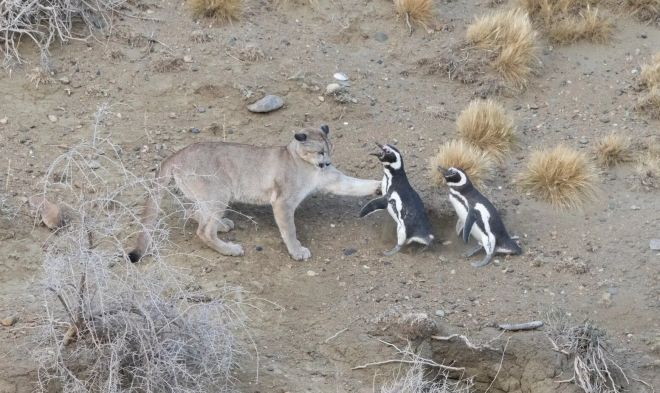
Dr. Mitchell Serota and his colleagues attached GPS collars to 14 adult pumas inhabiting Monte Leon National Park in Argentina, observing population density, movement patterns, and interactions among the animals.
Pumas began to be hunted on a large scale after European settlers started raising sheep along the Patagonian coast, as they were seen as a threat to livestock. As a result, pumas disappeared from areas such as Monte Leon in Argentina for several decades.
However, after the area was designated a national park in 2004 and hunting was banned, pumas gradually began to return. When they came back after nearly 100 years, they found a new 'neighbor'-the flightless Magellanic penguin.
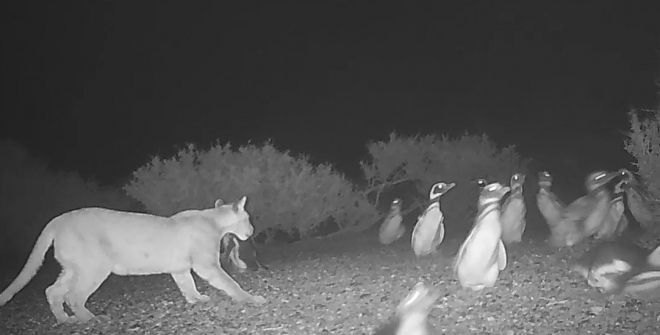
Magellanic penguins spend most of their lives at sea, but remain on land from September through April during the breeding season. In Monte Leon National Park, more than 40,000 pairs of penguins nest along about two kilometers of coastline. For pumas, this creates a situation in which prey is densely concentrated in a small area for a limited period of time.
Emiliano Donadio, a co-author of the study and a researcher at the Rewilding Argentina Foundation, stated, "When rewilding begins, returning species encounter an ecosystem that is somewhat different from what they knew a century ago, but they quickly adapt to the new environment."
The researchers also observed differences in behavioral patterns between pumas that hunt penguins and those that prefer other prey. Pumas that hunted penguins had smaller ranges and interacted with one another much more frequently. Typically, pumas are known as solitary hunters, covering wide territories alone and exhibiting territorial behavior.
Dr. Mitchell Serota explained, "There were 254 recorded encounters between two pumas that hunted penguins, compared to only four encounters between two pumas that did not hunt penguins." He added, "This is because with abundant prey, there is less need for competition, which could also alter the existing food chain."
Regardless of the presence of penguins, the puma population density was about 13 individuals per 100 square kilometers, similar to other regions. However, their patterns of spatial sharing differed. Solitary pumas were more likely to share space with others near penguin habitats and showed lower frequencies of aggression. Dr. Serota explained, "This indicates that the presence of penguins is a key factor influencing how pumas utilize space."
© The Asia Business Daily(www.asiae.co.kr). All rights reserved.
![Clutching a Stolen Dior Bag, Saying "I Hate Being Poor but Real"... The Grotesque Con of a "Human Knockoff" [Slate]](https://cwcontent.asiae.co.kr/asiaresize/183/2026021902243444107_1771435474.jpg)

















