Budget Savings of 8.7 Billion Won Achieved
Through Waste Sorting and Recycling
Gapyeong County in Gyeonggi Province announced on December 26 that it has completed the disposal of approximately 67,000 tons of disaster waste generated by the heavy rains in July, achieving a budget savings of 8.7 billion won.
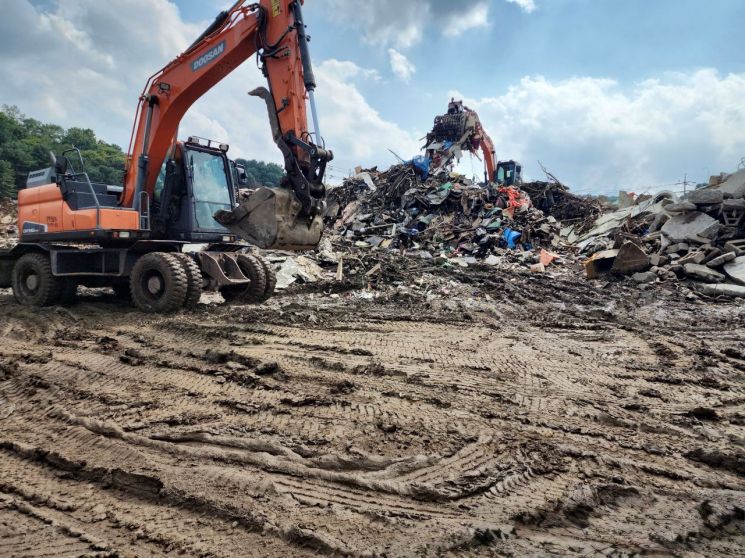 Gapyeong County has completed the disposal of approximately 67,000 tons of disaster waste generated by the heavy rains in July, achieving a budget savings of 8.7 billion won. Provided by Gapyeong County
According to the county, the total amount of disaster waste generated throughout Gapyeong County due to the recent heavy rains reached 67,990 tons. This figure far exceeds the initial estimate of 32,000 tons that was entered into the disaster management system immediately after the disaster.
The county determined that the four existing transfer stations would not be sufficient to handle the rapidly increasing inflow of waste. Therefore, by cooperating with related organizations such as military units, towns and villages, and the forestry cooperative, it secured 18 additional temporary transfer stations. This allowed for the distribution of collection routes and the establishment of a system to quickly process the continuously incoming waste on site.
In particular, the county anticipated that processing all the disaster waste as mixed waste would cost more than 13 billion won. To minimize the county's financial burden, which would exceed the 5 billion won in national funding, the county focused its administrative resources on sorting the waste by type and recycling.
By working with the forestry cooperative to systematically separate timber, soil, branches, and other waste, the county was able to use approximately 12,000 tons of recyclable timber as fuel for a combined heat and power plant. This resulted in a budget savings of about 8.7 billion won.
In addition, the county actively sorted mixed scrap metal, selling 73 tons and generating about 23 million won in non-tax revenue. For 170 tons of waste panels that could not be sold, the county arranged for free disposal to reduce additional processing costs. With the free support of a grapple loader from the Korea Environment Corporation, equipment rental costs were reduced and the response speed to civil complaints was significantly improved.
A county official stated, "Based on the on-site challenges identified during the disaster waste disposal process, we have continuously proposed institutional improvements to the Ministry of Environment. As a result, in November, the standards for operating temporary transfer stations were made more flexible to suit on-site conditions through the revision of the 'Disaster Waste Safety Management Guidelines.'"
© The Asia Business Daily(www.asiae.co.kr). All rights reserved.
![Clutching a Stolen Dior Bag, Saying "I Hate Being Poor but Real"... The Grotesque Con of a "Human Knockoff" [Slate]](https://cwcontent.asiae.co.kr/asiaresize/183/2026021902243444107_1771435474.jpg)















