Successful Acceleration and Deceleration of a 1-Ton Vehicle on a 400-Meter Test Track
Potential Expansion to Hyperloop and Space Launch Technologies
Chinese researchers have set a new world speed record for the same type of platform by reaching 700 km/h in just two seconds during a magnetic levitation test. This achievement is being seen as a sign of China's growing presence in the competition for ultra-high-speed maglev and hyperloop technologies.
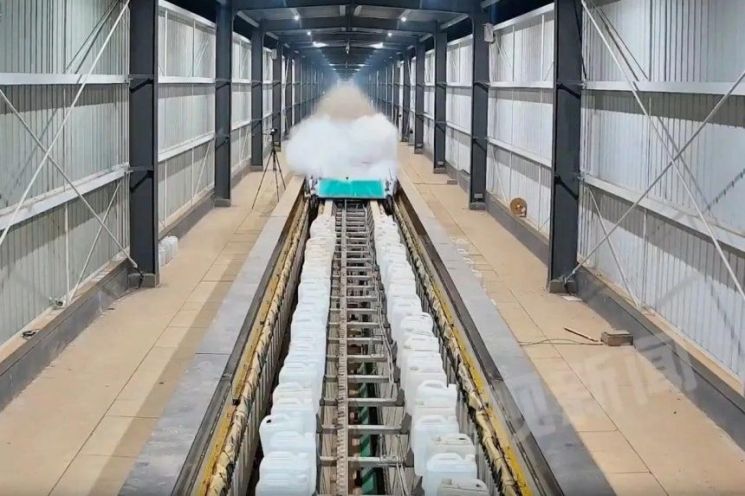 Chinese researchers have successfully reached a record speed of 700 km/h in a magnetic levitation technology test. SCMP
On December 25, China Central Television (CCTV) and the Hong Kong-based South China Morning Post (SCMP) reported that the maglev research team at the National University of Defense Technology in China successfully accelerated a 1-ton test vehicle to 700 km/h in just two seconds on a 400-meter test track, and then safely brought it to a stop.
CCTV emphasized that this record is the highest speed ever achieved on a maglev test platform of this type, calling it "the world's fastest superconducting maglev test speed." The released footage captured the vehicle speeding across the maglev track in an instant, leaving a mist-like trail behind.
The research team stated that they have overcome major technical challenges, including ultra-high-speed electromagnetic propulsion, electric levitation and guidance technology, instantaneous high-power energy storage and conversion, and high magnetic field superconducting magnets. CCTV added that this demonstrates China has entered the global top tier in the field of ultra-high-speed magnetic levitation.
Unlike conventional trains that use wheels on tracks, maglev trains minimize physical contact with the track, resulting in almost no friction resistance, which makes them advantageous for ultra-high-speed travel. This achievement is also seen as opening up new possibilities for the development of hyperloop technology, which aims to operate at speeds over 1,000 km/h inside vacuum tubes.
Additionally, there are expectations that such acceleration technology could be utilized in the aerospace sector. If applied to rocket launch assistance and ground testing, it could reduce fuel consumption and lower costs.
© The Asia Business Daily(www.asiae.co.kr). All rights reserved.
![Clutching a Stolen Dior Bag, Saying "I Hate Being Poor but Real"... The Grotesque Con of a "Human Knockoff" [Slate]](https://cwcontent.asiae.co.kr/asiaresize/183/2026021902243444107_1771435474.jpg)















