Bringing Everyday Robots to Life with Ingenious Ideas
Automated Robots for Washing Hair and Bathing
Seamless Drone Delivery of Goods
With the advancement of artificial intelligence (AI), robots that replace human tasks are appearing in everyday life. Although these robots do not resemble humans, they are attracting attention with their ingenious designs and concepts, handling bothersome tasks such as shampooing and showering with ease.
Shampooing for Just 3,700 Won per Session... Up to 100 Customers Flock to Chinese Shampoo Robot
In China, a powerhouse in robotics, unique stores featuring robots that wash your hair are popping up across the country. According to local media such as the Guangzhou Daily, a new AI shampoo specialty store recently opened in Guangzhou. The store is equipped with a robot that automates shampooing, scalp massage, and cleaning all at once.
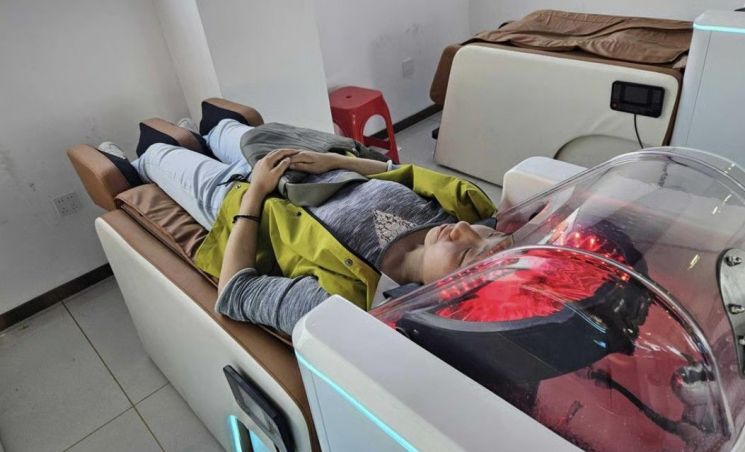 Robot installed at a Chinese artificial intelligence (AI) shampoo specialty store. Screenshot from SCMP website
The capsule-shaped robot is designed to fit perfectly to the human head and uses internal infrared sensors to detect the shape of the user's head. Users can choose from three water pressure modes-mild, medium, or strong-and select either "long hair mode" or "short hair mode" depending on hair length. Once activated, the machine performs two shampoo cycles and one treatment within 13 minutes.
The service is very affordable, priced at 19 yuan (about 3,900 won). As the machine replaces human labor, labor costs have decreased, giving the store a competitive edge in pricing. According to reports, one AI shampoo shop in Guangzhou operates with just three staff members and five machines, and during peak seasons, it serves more than 100 customers a day.
'Human Washing Machine' That Analyzes Physical Condition with AI
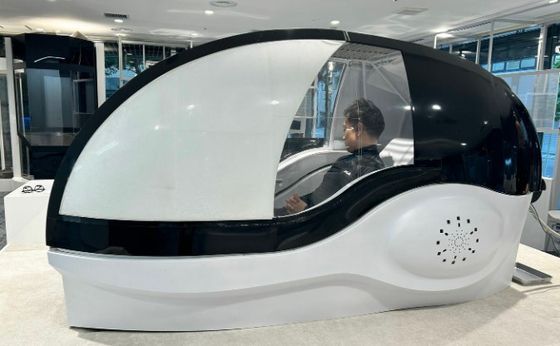
While China has introduced robots that wash your hair, Japan has a company that has made the "human washing machine" a reality. According to the Japanese weekly magazine Shukan Bunshun on December 22 (local time), Japanese electronics manufacturer Science unveiled an automatic human washing machine robot last month.
Customers simply lie down on the backrest inside the streamlined robot capsule. Then, the words "Filling Water" appear on the screen, and hot water sprays out from a nozzle at the feet. The hot water rises to just below the chest of the customer lying down.
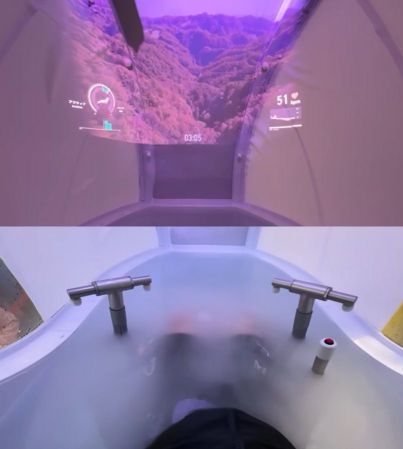 Inside view of a human washing machine. After a screen (above) showing the physical condition appears, hot water sprays out. Capture from Nikkei YouTube video
Next, in the cleansing phase, "microbubbles"-tiny bubbles-are generated to remove impurities attached to the skin. This method is similar to how hot water removes dirt from laundry, and the media even compared it to "soaking laundry." After the shower, the water is drained, and a powerful airflow dries the entire body. The entire process is completed in just 15 minutes.
The sensor installed on the backrest collects and analyzes data such as the user's electrocardiogram and autonomic nervous system throughout the bathing process. Based on this data, the AI plays videos or music that provide a sense of relaxation. The product is priced at 60 million yen (about 558 million won), and each unit is custom-made. Several luxury hotels in Japan, including the Dotonbori Crystal Hotel in Osaka and the Ikebukuro Salon, have decided to introduce and use this robot.
Drone Delivery Company Deploys Droids via Zipline
There are also startups that have brought robotic delivery to life by incorporating simple yet ingenious ideas. Zipline, a drone delivery company founded in the United States in 2014, currently provides drone parcel delivery services not only in African countries such as Rwanda and Nigeria, but also in developed countries including the United States.
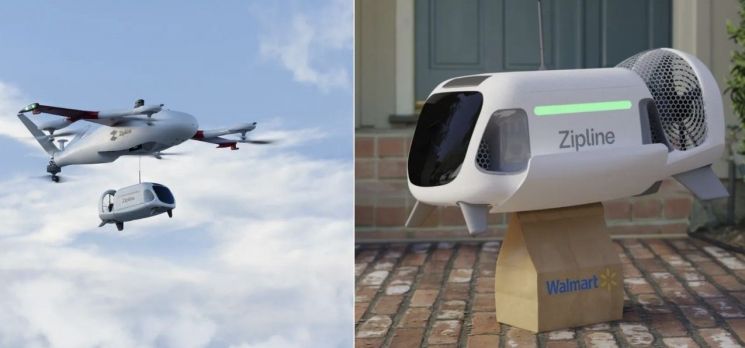 Zipline can deliver packages without landing by deploying a small droid robot mounted on the drone. The drone in flight (left) and the droid. Zipline
Previously, e-commerce giants such as Amazon attempted to deliver packages to homes using drones, but various practical issues, including regulations, hindered large-scale expansion. Residents also complained about the noise and dust generated every time the drones took off and landed.
True to its name, Zipline solved this problem by utilizing a "zipline." Instead of landing at the delivery site, Zipline drones lower a small robot called a "droid" from an altitude of 100 meters. The droid, developed by Zipline for parcel transportation, is connected to the main drone by a sturdy cable (zipline), and its altitude can be adjusted by unwinding or retracting the cable.
Zipline's corporate value is currently estimated at 4.2 billion dollars (about 6 trillion won). Last month, the company signed a contract worth 150 million dollars (about 217 billion won) with the U.S. State Department to deliver essential medical supplies such as vaccines and antibiotics to remote areas around the world.
© The Asia Business Daily(www.asiae.co.kr). All rights reserved.
![Clutching a Stolen Dior Bag, Saying "I Hate Being Poor but Real"... The Grotesque Con of a "Human Knockoff" [Slate]](https://cwcontent.asiae.co.kr/asiaresize/183/2026021902243444107_1771435474.jpg)

















