Mammoth-Scale Team, Lackluster Results
Investigation Sparks Controversy Over Fairness
The special prosecutor team led by Min Jungki, which has been investigating all allegations related to First Lady Kim Keonhee, is transitioning to the prosecution maintenance phase after 180 days of investigation. Despite being a large-scale special investigation with significant manpower, critics argue that the team focused on peripheral cases rather than addressing core allegations such as the Deutsche Motors stock manipulation. As the investigation draws to a close, legal experts point out that what the special prosecutor leaves behind is not a conclusion, but rather an "unsolved case list."
According to the legal community on December 26, the only allegation directly involving Kim is the Deutsche Motors stock manipulation case. Other incidents, such as Kim receiving luxury bags, necklaces, watches, and gold turtles, are considered tangential issues rather than the main case.
At the beginning of the investigation, the special prosecutor team achieved results by securing Kim's custody on charges including Deutsche Motors stock manipulation and arresting high-profile figures such as Han Hakja, President of the Unification Church, and Kwon Seongdong, a lawmaker from the People Power Party, who were at the center of "government-business collusion" allegations. However, after that, major issues such as suspicions of stock investments using undisclosed information by Min's special prosecutor team surfaced, and despite having a massive team of 140 people, the investigation produced lackluster results.
The special prosecutor team reviewed all 16 cases specified by the special prosecutor law but failed to deliver any significant outcomes. In particular, the team did not investigate allegations that the Unification Church provided "financial support" not only to People Power Party officials but also to members of the Democratic Party. As a result, a situation has arisen where a new "Unification Church special prosecutor" must be launched.
Although the Kim Keonhee Special Prosecutor Act stipulates that the team may investigate "related criminal acts" identified during the investigation process, the special prosecutor team determined on its own that these were not within its investigative scope. Only after the issue became controversial did they belatedly transfer the case to the National Investigation Headquarters.
A lawyer who previously served as deputy chief prosecutor commented, "It is questionable why the special prosecutor team, which conducted peripheral investigations throughout the period, turned a blind eye to the major suspicions. While the suspect's statements cannot be taken at face value, if they had at least conducted basic verification, these matters could have been formally investigated."
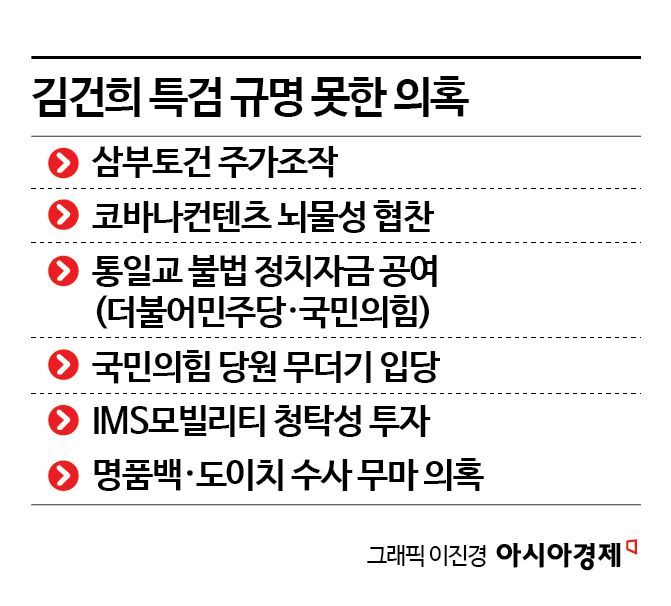
Unresolved issues that the special prosecutor team failed to address during the investigation period include: ▲allegations that Kim was involved in Sambo Construction stock manipulation; ▲bribery-like sponsorships to Covana Contents; ▲illegal political funding from the Unification Church (to both the Democratic Party and the People Power Party); ▲the mass enrollment of People Power Party members; ▲solicitation-related investments in IMS Mobility; and ▲allegations of attempts to cover up investigations into luxury bags and Deutsche Motors. These cases, which remain unsolved, were ones the special prosecutor team had initially expressed confidence in proving, but ultimately they were either transferred to other investigative agencies or left incomplete.
Among them, the "allegations of covering up investigations into luxury bags and Deutsche Motors" became controversial for fairness, as the special prosecutor team only began investigating as the probe was about to end. Despite the case being handled over four years by both the Moon Jae-in and Yoon Suk Yeol administrations, it is known that key figures in the initial investigation command, such as Lee Sungyun (then head of the Seoul Central District Prosecutors' Office, now a Democratic Party lawmaker), Kim Taehun (then the fourth deputy chief prosecutor, now head of the Seoul Southern District Prosecutors' Office), and Jung Yonghwan (then head of the Anti-Corruption Division 2, now deputy chief prosecutor at the Seoul High Prosecutors' Office), were excluded from the investigation targets.
A member of the special prosecutor team stated, "The non-indictment of Kim is itself an investigative subject," adding, "While not concluding the case could be seen as dereliction of duty, it is difficult to resolve within the given timeframe."
© The Asia Business Daily(www.asiae.co.kr). All rights reserved.
![Clutching a Stolen Dior Bag, Saying "I Hate Being Poor but Real"... The Grotesque Con of a "Human Knockoff" [Slate]](https://cwcontent.asiae.co.kr/asiaresize/183/2026021902243444107_1771435474.jpg)















