Hanwha Philly Shipyard Holds Executive Briefing
Officially Announces Mid- to Long-Term Goal to Build Nuclear Submarines Beyond Commercial and Military Vessels
U.S. Nuclear Submarine Target: Two Per Year, But Actual Output Only 1.2
Anderson: "Expa
On the afternoon of the 22nd (local time), at Hanwha Philly Shipyard located in Navy Yard, Philadelphia, Pennsylvania, the construction of a national security multipurpose vessel was in full swing at Dock No. 4, which measures 330 meters in length and 45 meters in width. Right behind it, container ship construction was taking place simultaneously. Just five months ago, only one ship could be built at a time in a single dock, but now productivity has improved to the point where one and a half ships can be built side by side. As part of the Korea-U.S. shipbuilding cooperation project 'MASGA,' Hanwha plans to invest about 5 billion dollars (approximately 7.2 trillion won) starting next year to dramatically expand its annual shipbuilding capacity from the current 1 to 1.5 ships to as many as 20 ships.
Marking the first anniversary of Hanwha Philly Shipyard, which has emerged as a symbol of Korea-U.S. shipbuilding cooperation, Hanwha has officially announced its mid-to-long-term goal to secure capabilities not only in building commercial and naval vessels but also in constructing nuclear-powered submarines for the U.S. Navy.
 On the 22nd (local time), shipbuilding work was underway at Hanwha Philly Shipyard located in Navy Yard, Philadelphia, Pennsylvania, USA. Photo by Kwon Haeyoung
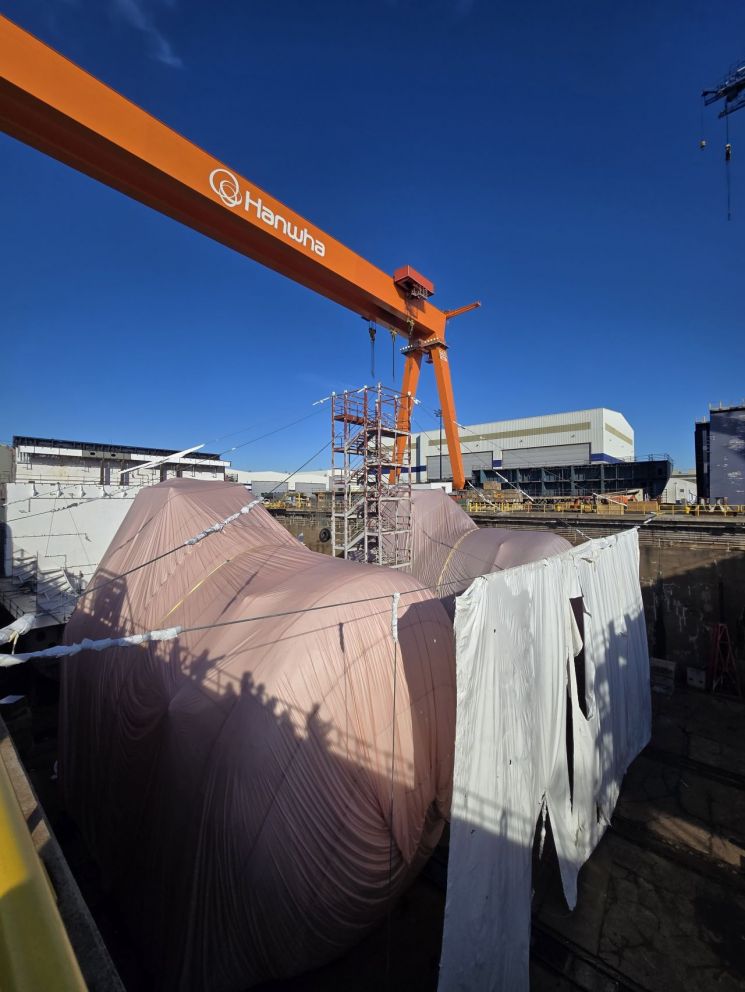 On the 22nd (local time), shipbuilding work was underway at Hanwha Philly Shipyard located in Navy Yard, Philadelphia, Pennsylvania, USA. Photo by Haeyoung Kwon
"Establishing U.S. Nuclear Submarine Construction Capabilities at Philly Shipyard"
Tom Anderson, President of Hanwha Defense USA Shipbuilding Division and a former U.S. Navy admiral, stated at a media executive briefing held on the 22nd, "Based on the already proven design of the Virginia-class submarine, we can significantly reduce the time and effort required," outlining plans to establish U.S. Navy nuclear submarine construction infrastructure. The briefing was also attended by David Kim, CEO of Hanwha Philly Shipyard, and Alex Wong, Chief Strategy Officer (CSO) of Hanwha Group Global.
The Virginia-class nuclear submarine is a proven vessel that the U.S. Navy has operated and built for many years. Anderson explained that by utilizing the existing design without developing a new one, production volume can be increased in a short period of time. He added, "Specialized personnel for the Virginia-class nuclear submarine will be recruited within the U.S., and skilled Korean workers with extensive submarine construction experience will also be deployed on site." He also noted that Philly Shipyard is geographically close to the two shipyards currently building Virginia-class submarines in Connecticut and Virginia, which is advantageous for collaboration and the transportation of parts and modules.
 On the 22nd (local time), Tom Anderson, President of Hanwha Defense USA Shipbuilding Division (left), and Alex Wong, Chief Strategy Officer (CSO) of Hanwha Group Global, participated in a media briefing at Hanwha's Philippine shipyard and made remarks. Philadelphia=Photo by Kwon Haeyoung
The background behind Hanwha proposing Philly Shipyard as a base for nuclear submarine production lies in the structural bottleneck of U.S. nuclear submarine manufacturing. The United States aims to secure 66 Virginia-class submarines by 2054, but only 24 are currently in service. To meet this goal, about two submarines need to be built annually, but actual production is only about 1.2 per year. In addition, the security alliance between the U.S., U.K., and Australia (AUKUS) requires the U.S. to support Australia with 3 to 5 submarines, and delays in maintaining existing vessels further compound the issue, raising concerns about a power gap in the 2030s. In this context, Philly Shipyard is emerging as an alternative base that could help ease the bottleneck in U.S. nuclear submarine production. Recently, U.S. President Donald Trump mentioned Hanwha directly when referring to the U.S. Navy's next-generation frigate construction plan, which is interpreted as a sign of the growing strategic value of Philly Shipyard.
Step-by-Step Expansion Through Simultaneous Construction of Commercial and Naval Vessels..."Supporting the Strengthening of Allied Nuclear Submarine Capabilities"
CSO Alex Wong stated, "Nuclear submarines are the most strategically superior means among existing maritime forces," adding, "The United States is strongly committed to strengthening not only its own nuclear submarine capabilities but also those of its allies." Referring to the AUKUS agreement launched in September 2021, he explained, "It is a cooperative framework for expanding allied nuclear submarine capabilities and jointly developing new designs," and suggested that nuclear submarines built at Philly Shipyard could even be considered for export to global allies. He further stated, "Once preparations at the government level are in place, Philly Shipyard will be able to carry out nuclear submarine construction capabilities."
With the Korean government announcing plans to develop nuclear submarine hulls and reactors within the next ten years, President Trump has mentioned that nuclear submarines should be built at Hanwha Philly Shipyard. In response, Hanwha explained, "We are pursuing a two-track strategy, with Korean nuclear submarines being built at Hanwha Ocean's Geoje facility and U.S. nuclear submarines at Hanwha Philly Shipyard."
However, there are still significant hurdles to overcome before Philly Shipyard can fully embark on nuclear submarine construction. Currently, there are only two nuclear submarine shipyards in the U.S., and securing dedicated docks and specialized personnel are considered essential prerequisites. Hanwha plans to shorten construction timelines and improve efficiency through phased workforce expansion, facility investment, and leveraging the Korean shipbuilding supply chain.
CEO David Kim stated, "We will expand our military shipbuilding capabilities, including naval vessels, based on the competitiveness we have accumulated in the commercial ship sector." The plan is to accumulate technology and personnel by building commercial and naval vessels simultaneously, then expand into nuclear submarine construction capabilities.
In the process of building nuclear submarines, the reactor compartment related to nuclear fuel will be directly provided and managed by the U.S. government.
A Hanwha representative emphasized, "If nuclear submarine construction at Philly Shipyard becomes a reality, it will serve as an opportunity to accelerate the introduction of Korean nuclear submarines and technological self-reliance through the integration of domestic shipbuilding partners into the supply chain and the accumulation of technology."
© The Asia Business Daily(www.asiae.co.kr). All rights reserved.
![Clutching a Stolen Dior Bag, Saying "I Hate Being Poor but Real"... The Grotesque Con of a "Human Knockoff" [Slate]](https://cwcontent.asiae.co.kr/asiaresize/183/2026021902243444107_1771435474.jpg)

















