Maestro S800 Tops $100,000 Segment in China
Surpasses Panamera and S-Class
The premium sedan "Maestro S800" (Chinese name: Zunjie) unveiled by Huawei is shaking up the landscape of China's luxury car market. The model has made its presence felt by taking the top spot in sales in the high-end sedan market priced above $100,000, a segment long dominated by foreign luxury brands.
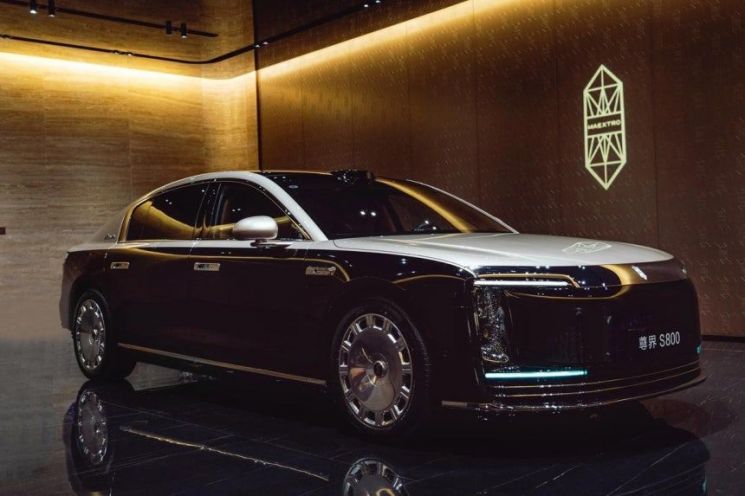
According to Bloomberg News on December 24 (local time), the Maestro S800 has surpassed the Porsche Panamera and Mercedes-Benz S-Class to claim the number one spot in sales among vehicles priced over $100,000 (approximately 146 million won) in China.
Since its launch in May, the Maestro S800 has maintained its lead over all competitors in the $100,000-plus price range since September. Notably, last month, the number of Maestro S800 units delivered exceeded the combined sales of the Porsche Panamera and BMW 7 Series.
Bloomberg assessed that the Maestro S800 has disrupted the Chinese luxury car market, which had been dominated by foreign brands. The report also analyzed this as an example of global automakers increasingly losing ground to local brands in China, the world’s largest automobile market.
The main factor behind the Maestro S800’s success is its "price competitiveness." The Maestro S800 starts at 708,000 yuan (147 million won), with the highest-end model priced at 1.02 million yuan (212 million won). In contrast, the starting price of the Panamera in China is 1.1 million yuan (229 million won), meaning the top-tier Maestro S800 is nearly 20 million won cheaper than the base Panamera.
Additionally, Huawei designed both the exterior and the vehicle’s internal electronic systems, equipping the Maestro S800 with L3-level autonomous driving features that meet the Society of Automotive Engineers' conditional autonomy standards, as well as an all-around collision prevention system. Based on Harmony OS, the smart features support remote parking and charging via smartphone.
Bloomberg analyzed that the Maestro S800 has shaken up a market previously centered on foreign brands by offering ride quality comparable to Rolls-Royce or Bentley, while keeping prices lower.
Until now, Chinese automakers had struggled to break through the dominance of foreign brands in the luxury sedan market. While BYD launched the luxury SUV "U8," its sales performance remained limited.
Zhu Weilong, founder of consulting firm Zhineng Auto, commented, "The changing demands of Chinese consumers and their pride in domestic brands are reshaping the luxury car market. This case is a manifestation of national pride and signals a major trend toward the premiumization of Chinese brands."
However, he added, "It remains to be seen whether Huawei and its partners can maintain the necessary investment and pace for long-term success in the premium market. We need to watch how long the current momentum can last."
© The Asia Business Daily(www.asiae.co.kr). All rights reserved.
![Clutching a Stolen Dior Bag, Saying "I Hate Being Poor but Real"... The Grotesque Con of a "Human Knockoff" [Slate]](https://cwcontent.asiae.co.kr/asiaresize/183/2026021902243444107_1771435474.jpg)
















