Searching 'Coupang Withdrawal' on Google
Displays "Membership Withdrawal Completed" Screen
Attributed to Google's Crawling Policy
#A 40-something office worker, identified as Mr. Park, recently searched for "Coupang Withdrawal" in the Google search bar due to growing anxiety over the Coupang personal information leak incident. Upon accessing the "Membership Withdrawal" page linked to the Coupang site, a message appeared stating, "Coupang membership withdrawal has been completed. Thank you for using our service." Mr. Park mistakenly believed he had successfully withdrawn after seeing this screen. However, he was still registered as a Coupang member. Mr. Park expressed his frustration, saying, "Isn't Coupang trying to use tricks to prevent people from withdrawing?"
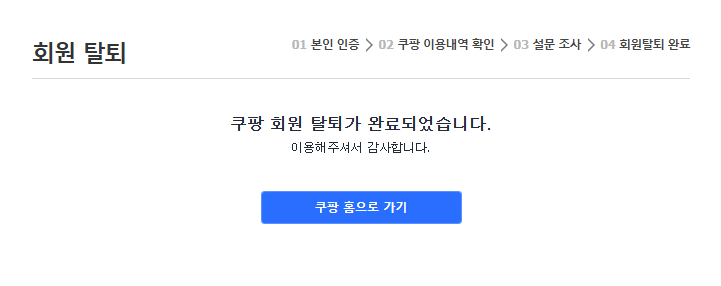 The screen that appears after accessing the Coupang "Membership Withdrawal" link displayed when searching for "Coupang Withdrawal" in the Google search bar. Screenshot of the Google screen.
As complaints continue to mount regarding the complicated Coupang membership withdrawal process, concerns have been raised that searching for withdrawal methods on some search engines may directly lead users to a "withdrawal completed" screen, causing confusion among consumers.
According to the retail industry on December 25, searching for "Withdraw from Coupang" in the Google search bar brings up a Coupang site titled "Membership Withdrawal." Clicking on this link does not provide instructions or guidance on the withdrawal process; instead, it displays a message stating, "Coupang membership withdrawal has been completed." This same screen appears even when users are automatically logged in.
This situation is reportedly due to Google's crawling policy. Google's crawling policy involves automatically browsing the internet, reading web pages, and displaying the collected pages in search results. Coupang's membership withdrawal process consists of four steps: identity verification, reviewing Coupang usage history, completing a survey, and finalizing the withdrawal. It is assumed that the final step page has been exposed in search results.
In contrast, competing e-commerce platforms such as Kurly and SSG.com redirect users to guidance pages when "withdrawal" is searched for on search engines. For example, searching for "Kurly withdrawal" in the Google search bar leads to the terms of use and privacy policy pages at the top, where users can check the withdrawal procedure. SSG.com connects users to the frequently asked questions page of its customer center, providing instructions on how to withdraw.
However, entering "Coupang withdrawal" in the Naver search bar displays the "Coupang Terms of Use" page at the top of the results.
Since the personal information leak incident, the number of consumers seeking to withdraw from Coupang has increased. Posts sharing withdrawal methods and procedures, as well as reviews about the complicated process, are being circulated on social networking services (SNS). The Coupang membership withdrawal process requires users to go through "verifying member information → entering password → clicking the withdrawal button → re-entering password."
Meanwhile, the Fair Trade Commission is investigating whether Coupang has used so-called "dark patterns" to make withdrawal difficult. Dark patterns refer to intentionally complicated procedures designed to induce consumers to abandon their attempt to withdraw.
© The Asia Business Daily(www.asiae.co.kr). All rights reserved.
![Clutching a Stolen Dior Bag, Saying "I Hate Being Poor but Real"... The Grotesque Con of a "Human Knockoff" [Slate]](https://cwcontent.asiae.co.kr/asiaresize/183/2026021902243444107_1771435474.jpg)















