"Reviewing Policies to Strengthen Deterrence and Response Capabilities"
Takaichi States in Yomiuri Interview
Also Reaffirms Push to Revise Three Major Security Documents
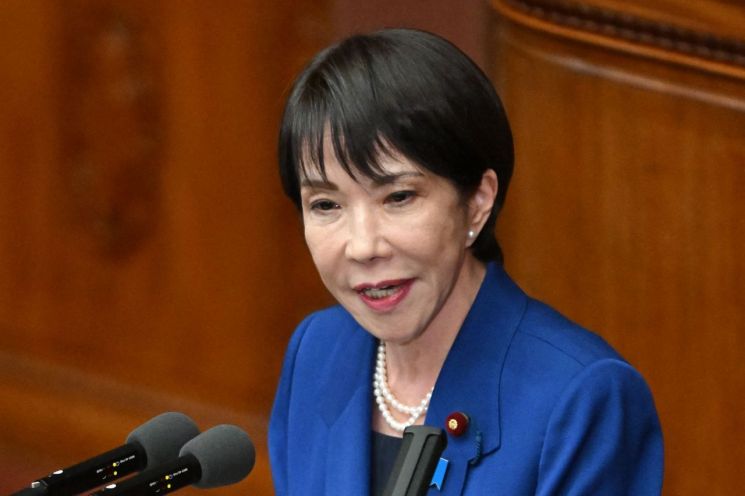
Amid escalating tensions between China and Japan, Japanese Prime Minister Sanae Takaichi stated regarding the possibility of introducing nuclear-powered submarines, "We will consider policies to strengthen deterrence and response capabilities without excluding any options."
The Yomiuri Shimbun reported on the 24th that Prime Minister Takaichi made these remarks in an interview with the newspaper. This was her first individual media interview since taking office, and it is effectively the first time she has hinted at the possibility of Japan possessing nuclear-powered submarines.
The ruling Liberal Democratic Party and its coalition partner, the Japan Innovation Party, had previously agreed to acquire submarines equipped with vertical launch systems (VLS) utilizing next-generation propulsion. Defense Minister Shinjiro Koizumi has also expressed a positive stance on the introduction of nuclear-powered submarines.
Prime Minister Takaichi, regarding foreigner policy, stated, "We will distinguish this from xenophobia, but will respond firmly to illegal activities." She also emphasized that the active fiscal policy "does not mean irresponsible government bond issuance or tax cuts." She avoided making specific comments about the possibility of an early general election.
Regarding relations with China, she said, "Our policy of building a constructive and stable relationship remains unchanged." However, since her recent remarks about a "Taiwan contingency," China has continued to impose pressure through measures affecting tourism, student exchanges, and cultural interactions.
Prime Minister Takaichi also reaffirmed her intention to pursue revisions to the three key national security documents (National Security Strategy, National Defense Strategy, and Defense Buildup Program) next year, citing the changed security environment. She stated, "The security environment is changing significantly," and emphasized the need for early revisions, saying, "It is necessary to strengthen Japan's sustained combat capabilities based on our own independent judgment."
Additionally, in an interview published in the Nikkei newspaper on the same day, she stressed that the active fiscal policy should not be interpreted as "irresponsible government bond issuance or tax cuts," in response to claims that it is driving up market interest rates and contributing to the depreciation of the yen.
In another interview with the Nikkei newspaper the previous day, Prime Minister Takaichi also avoided specific comments regarding the possibility of an early general election following the dissolution of the House of Representatives, stating, "What we are desperately working on right now is the execution of the supplementary budget. We are focusing on ensuring that the public feels the effects of the economic measures."
As the approval rating for the Takaichi Cabinet remains unusually high, there have been reports that some within the Liberal Democratic Party are raising the possibility of an early dissolution of the House of Representatives (the lower house).
© The Asia Business Daily(www.asiae.co.kr). All rights reserved.
![Clutching a Stolen Dior Bag, Saying "I Hate Being Poor but Real"... The Grotesque Con of a "Human Knockoff" [Slate]](https://cwcontent.asiae.co.kr/asiaresize/183/2026021902243444107_1771435474.jpg)















