Although the won-dollar exchange rate has surpassed the 1,480 won level and remains high, experts have assessed that the direct impact of this elevated exchange rate on consumer prices and the broader real economy is limited.
According to the Capital Market Research Institute on December 24, Kang Hyunju, Senior Research Fellow at the Macroeconomic and Finance Division, stated in the recently released report, "Background of the Recent Weakening of the Won and Assessment of Its Macroeconomic Impact," that "the recent rise in the exchange rate is the result of a combination of structural factors, such as increased overseas securities investment due to aging and low growth, and cyclical factors, including yen correlation and the artificial intelligence (AI) investment boom."
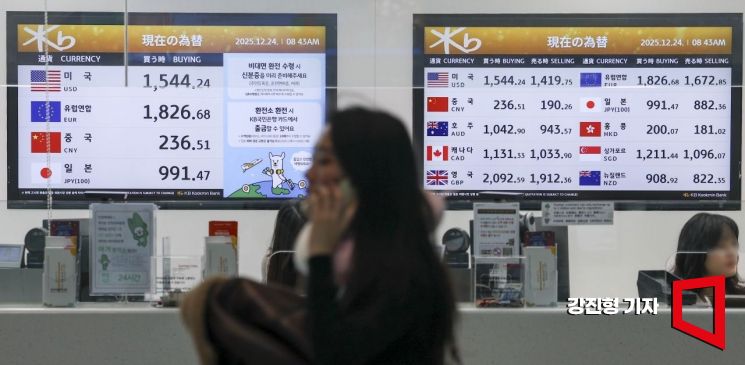 The won-dollar exchange rate surpassed 1,480 won, showing the highest level since April 9, when the U.S. tariff shock occurred (1,487.6 won). On the 24th, the dollar purchase price was displayed at the currency exchange booth in Terminal 2 of Incheon International Airport. 2025.12.24 Photo by Kang Jinhyung
First, Senior Research Fellow Kang noted, "Despite various concerns about the high exchange rate, recent external soundness indicators remain stable," highlighting that there have been no unusual signs in external creditworthiness indicators such as Korea's CDS premium or foreign capital flows. From September to November, foreign securities investment recorded an average net inflow of 4.7 billion dollars per month, while the CDS premium on foreign currency bonds remained stable in the low 20 basis point range.
She explained, "This is related not only to the solid fundamentals of the Korean economy, but also to the substantial accumulation of net foreign assets (NFA) as a result of increased overseas investment, which has been identified as a driver of the exchange rate rise." She added, "A large NFA means there is a significant buffer, as foreign assets can be liquidated to secure foreign currency liquidity if needed." She also analyzed that the recent remarks by Bank of Korea Governor Rhee Changyong-who stated that, unlike in the past when exchange rates above 1,400 won would trigger concerns about financial stability, there is currently no instability in the foreign exchange market-should be understood in this context.
The report also assessed that the direct impact of the exchange rate rise on consumer prices is limited. Based on the Bank of Korea’s analysis that a 1% increase in the dollar-won exchange rate raises consumer prices by about 0.03 percentage points, Senior Research Fellow Kang estimated, "Assuming the average exchange rate in 2025 rises by about 4% compared to the previous year (based on the average rate of 1,420 won through December 12), the direct impact on the consumer price inflation rate would be about 0.1 percentage points."
She continued, "The prevailing outlook is that global commodity prices, including international oil prices, will stabilize downward in the future, which will help ease inflationary pressures, and a decline in oil prices could offset much of the domestic inflationary pressure stemming from the exchange rate rise by reducing import prices."
Furthermore, although the export-promoting effect of a higher exchange rate has weakened compared to the past, Senior Research Fellow Kang noted that there is still room for the exchange rate to serve as a buffer for exports and the current account balance in terms of price competitiveness. She emphasized, "In times of significant uncertainty in the trade environment, as we are seeing now, a higher exchange rate can partially offset the loss of price competitiveness caused by US tariff increases, thereby helping to ease downward pressure on exports."
Accordingly, Senior Research Fellow Kang concluded, "With greater external buffers such as the accumulation of net foreign assets and the limited pass-through of exchange rate fluctuations to prices, the likelihood of a high exchange rate causing immediate and widespread shocks to the real economy is lower than during previous financial crises. Ultimately, what matters more than the level of the exchange rate itself is the speed of change."
She added that while it is important to avoid simplistic interpretations of the exchange rate level, it is necessary to monitor the impact of increased volatility, cost burdens on vulnerable sectors, and changes in overseas investment flows on foreign exchange supply and demand and the financial market in a balanced manner.
The report also included analyses from global investment banks suggesting that the cyclical factors driving the recent exchange rate rise may gradually subside. According to Reuters, the median forecast of global investment banks for the dollar-won exchange rate at the end of 2026 is 1,418.5 won, which is lower than the current level.
Senior Research Fellow Kang explained, "Factors favorable to the won include the Federal Reserve's interest rate cuts, the Bank of Japan's gradual normalization in contrast, capital inflows following the inclusion of Korean bonds in the World Government Bond Index (WGBI), and the recovery of the domestic economy."
However, she pointed out, "As these forecasts suggest, even if cyclical factors subside, the extent of downward adjustment in the exchange rate may be limited as long as structural factors such as increased overseas securities investment persist." She continued, "The exchange rate path is likely to be determined by cyclical factors such as interest rate expectations, risk appetite, and correlation with other currencies, operating on top of an elevated base level set by structural factors."
Meanwhile, on this day in the Seoul foreign exchange market, the won-dollar exchange rate opened at 1,484.9 won, threatening to reach a yearly high, but plunged to the 1,450 won range following verbal intervention by the foreign exchange authorities.
© The Asia Business Daily(www.asiae.co.kr). All rights reserved.
![Clutching a Stolen Dior Bag, Saying "I Hate Being Poor but Real"... The Grotesque Con of a "Human Knockoff" [Slate]](https://cwcontent.asiae.co.kr/asiaresize/183/2026021902243444107_1771435474.jpg)















