Bessent: "Setting a Range Like 1.5?2.5% Instead of a Single 2%"
Mentions Possible Linkage Between Fiscal and Monetary Policy
Scott Bessent, U.S. Secretary of the Treasury, stated that there should be a review of the current central bank's 2% inflation target after inflation has stably returned to the 2% level.
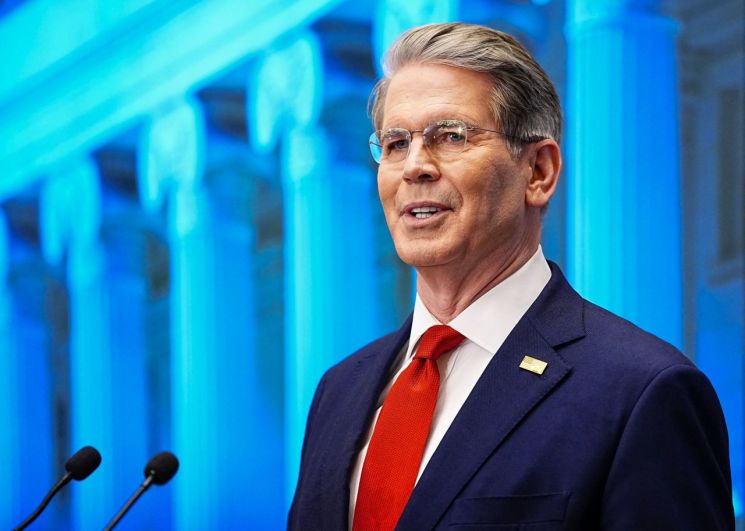
In an interview on the All-In Podcast released on the 22nd (local time), Secretary Bessent said, "If we return to the figure of '2,' then we can discuss whether it would be wiser to set a range at that point."
He suggested setting the inflation target as a range, such as 1.5-2.5% or 1-3%, instead of a single figure of 2%, presenting it as a potential alternative and stressing that "a very active discussion is needed."
The Federal Reserve has officially adopted the 2% inflation target since 2012, which is a standard commonly used by the central banks of major advanced economies.
Regarding this, Secretary Bessent pointed out that "maintaining a target defined down to the decimal point is unrealistic." However, he drew a clear line by stating that adjusting the target while inflation is above the goal could send the wrong signal that "the standard will always be raised whenever it is exceeded," emphasizing that related discussions should begin only after the target level has been reached.
Secretary Bessent also addressed concerns about the credibility of the inflation target, as well as the recent burden of perceived prices on households.
He said, "Until we reach the target and maintain that credibility, it is very difficult to re-anchor inflation expectations," adding, "The government recognizes that the American people are suffering due to prices."
He attributed the recent high inflation to the previous Joe Biden administration, and cited falling rents as one of the reasons for the recent easing of inflation. He also claimed that an increase in illegal immigration was a cause of rising rents.
Regarding the possibility that the November Consumer Price Index (CPI) was distorted due to statistical collection issues from the federal government shutdown (temporary suspension of government work), he assessed that "the figures were quite accurate." While some items, such as energy prices, increased, he explained that real-time indicators already show a downward trend. The CPI for November, announced on the 18th, rose 2.7% year-on-year, with the growth rate slowing from the previous figure of 3.0% in September.
He also mentioned the potential linkage between fiscal policy and monetary policy.
Secretary Bessent cited the example of Germany before the introduction of the euro, noting that the Bundesbank, Germany's central bank at the time, lowered interest rates on the condition of the government's commitment to fiscal discipline. He added, "If fiscal deficits can be stabilized or reduced, it will contribute to lower inflation rates," and that this could serve as grounds for justifying an environment of lower interest rates.
© The Asia Business Daily(www.asiae.co.kr). All rights reserved.
![Clutching a Stolen Dior Bag, Saying "I Hate Being Poor but Real"... The Grotesque Con of a "Human Knockoff" [Slate]](https://cwcontent.asiae.co.kr/asiaresize/183/2026021902243444107_1771435474.jpg)















