"Reverse Discrimination Against Domestic Companies...
Korean Firms Will Be Placed at a Disadvantage"
The domestic IT industry has voiced concerns regarding the "Act on the Fairness of Online Platform Intermediary Transactions" (Onple Act), which is being promoted primarily by the ruling party. In addition to worries that the Onple Act could result in dual regulation, there are concerns that it may hinder innovation within the platform industry.
Taeo Kim, Professor of Law at Changwon University, argued at a roundtable hosted by the Korea Internet Corporations Association on the 23rd, "The Onple Act could undermine the dynamism and innovative capacity of the platform market, ultimately causing adverse effects for consumers as well."
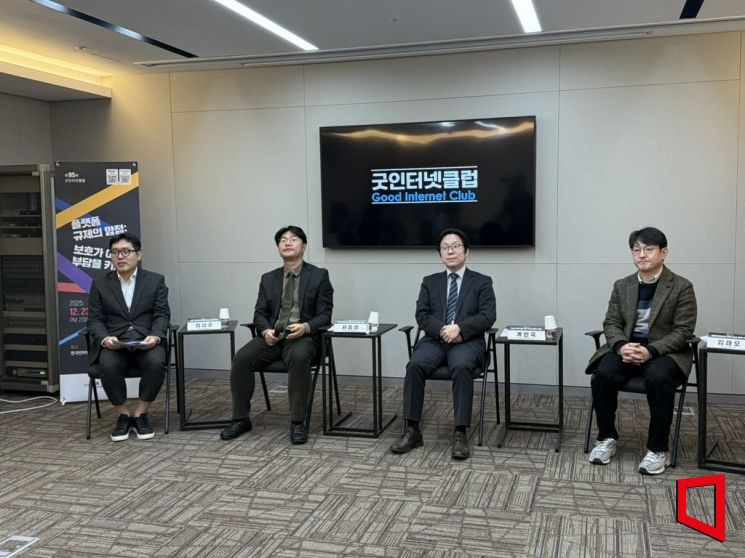 On the afternoon of the 23rd, participants are discussing at the roundtable titled "The Pitfalls of Platform Regulation: Increasing Burden Instead of Protection," held at the Korea Internet Corporations Association in Seocho-gu, Seoul. Professors Sangjun Kim from Ewha Womans University Department of Business Administration, Jonghee Seo from Yonsei University Law School, Inguk Gye from Korea University Department of Government Administration, and Taeo Kim from Changwon University Department of Law. (From left) Photo by Myunghwan Lee
The roundtable, hosted by the Korea Internet Corporations Association, was held under the theme "The Pitfalls of Platform Regulation: Increasing Burden Instead of Protection," and featured participants sharing their views on the unified Onple Act proposal.
Previously, lawmakers from the Democratic Party of Korea on the National Assembly's Political Affairs Committee introduced the unified Onple Act proposal on December 9. This proposal consolidates 16 Onple Act bills currently pending in the National Assembly into a single bill. It applies to platform companies with annual sales of at least 10 billion won or with partner sellers whose annual sales exceed 100 billion won. The bill requires that eight items, including commission rates and the basis for their imposition, be specified in intermediary transaction contracts, and sets the settlement period for sales proceeds at 20 days from the expiration date of the withdrawal period.
Professor Kim pointed out that the Onple Act could serve as a "dual regulatory" factor for domestic platform companies, noting that there are already laws, such as the Monopoly Regulation and Fair Trade Act, that address platform monopolies. He stated, "Much of the regulation can already be enforced under existing laws, and there are already accumulated cases of actual enforcement. Enacting a special law under these circumstances risks only increasing overlapping regulations and causing confusion in the legal system."
There were also criticisms that the bill imposes uniform regulatory measures without considering the distinct characteristics of each platform. Sangjun Kim, Professor of Business Administration at Ewha Womans University, said, "Unlike traditional organized industries, the platform industry is difficult to predict in terms of scale and conduct," expressing concern that "systems designed for traditional industries will result in outcomes contrary to the intended regulatory goals."
Some argued that the Onple Act could also hinder domestic platform companies in their competition with global big tech firms. Global big tech companies, which often have servers overseas, are difficult to regulate due to the lack of access to their operational information and concerns about trade friction. As a result, domestic companies, which maintain headquarters and servers in Korea and pay corporate taxes properly, could find themselves in an unfair competitive environment due to the Onple Act.
Professor Taeo Kim noted, "There is a high possibility that, in practice, the Onple Act will result in imbalanced regulatory burdens between domestic and global companies," adding, "This will create a reverse discrimination issue for domestic platforms and put Korean platforms at a disadvantage in competition with global big tech firms."
There were also comments suggesting that the Onple Act could become an obstacle from a trade perspective. In fact, the Office of the United States Trade Representative (USTR) canceled the Korea-US Free Trade Agreement (KORUS FTA) Joint Committee implementation meeting scheduled for the 18th (local time), and foreign media reported that the US government is dissatisfied with the Korean government for not honoring agreements. The reason cited is that Korea's platform regulatory legislation discriminates against American companies.
Inguk Gye, Professor at the Graduate School of Public Administration at Korea University, explained, "Global trade risks arise from differences in the nature of competition laws between the United States and Korea," and added, "The US position is to apply the law only after a problem has occurred."
© The Asia Business Daily(www.asiae.co.kr). All rights reserved.
![Clutching a Stolen Dior Bag, Saying "I Hate Being Poor but Real"... The Grotesque Con of a "Human Knockoff" [Slate]](https://cwcontent.asiae.co.kr/asiaresize/183/2026021902243444107_1771435474.jpg)















