A new Director General for Rural Income and Energy Policy will be established within the Ministry of Agriculture, Food and Rural Affairs to oversee work related to basic income for rural and fishing villages. Through this initiative, the ministry plans to accelerate the implementation of key government policies, including pilot projects for basic income in rural and fishing communities at risk of depopulation, the creation of solar income villages to promote the spread of renewable energy in rural areas, and the institutionalization of agrivoltaics.
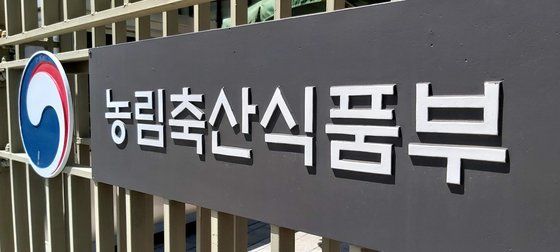
The Ministry of Agriculture, Food and Rural Affairs announced on December 23 that the 'Partial Amendment to the Organization of the Ministry of Agriculture, Food and Rural Affairs and Its Affiliated Agencies,' which centers on these measures, was approved at a Cabinet meeting.
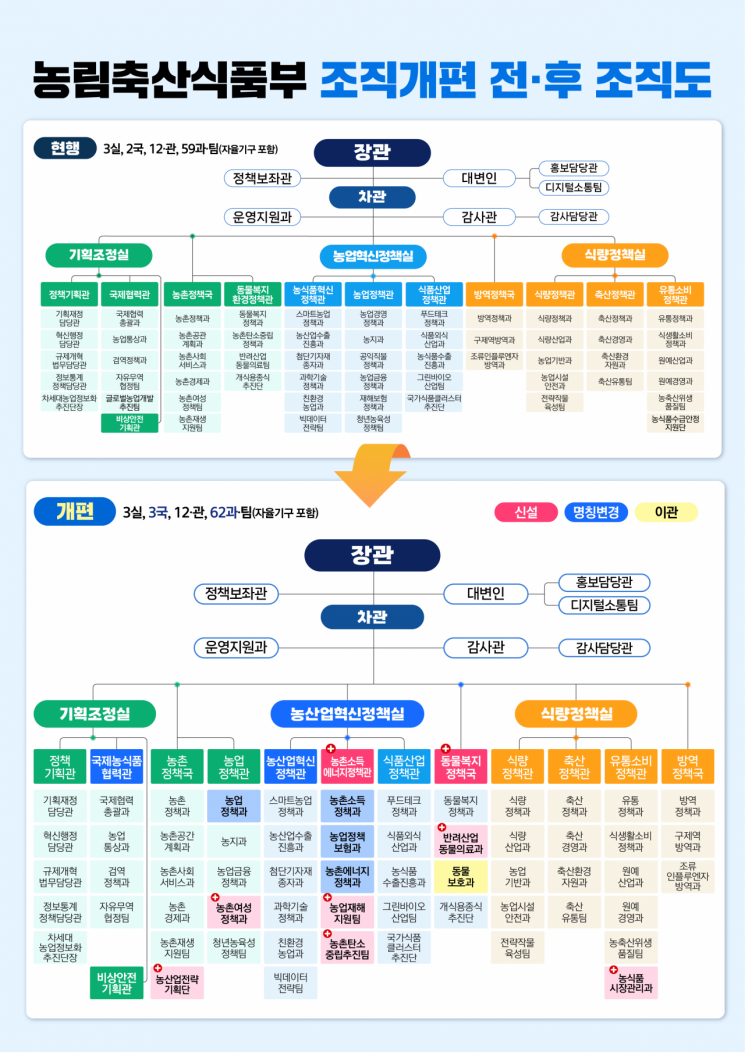
With this organizational restructuring, the ministry will establish one new directorate, replace and establish one new bureau (or directorate), and add 21 new positions. As a result, the organizational structure will expand from three offices, two bureaus and 12 directorates, and 59 divisions/teams, to three offices, three bureaus and 12 directorates, and 62 divisions/teams. This marks the largest organizational restructuring in about three years, following the establishment of the Quarantine Policy Bureau in 2017 and the Animal Welfare and Environment Policy Directorate in 2022.
The new Director General for Rural Income and Energy Policy will take over the existing Public Benefit Direct Payment Policy Division, Disaster Insurance Policy Division, and Rural Carbon Neutral Policy Division, which will be renamed as the Rural Income Policy Division, Agricultural Policy Insurance Division, and Rural Energy Policy Division, respectively. Additionally, two new teams-the Agricultural Disaster Support Team and the Rural Carbon Neutral Promotion Team-will be established and expanded as part of this restructuring.
The Animal Welfare and Environment Policy Directorate will be replaced and reorganized as the Animal Welfare Policy Bureau. This move aims to further strengthen animal welfare policies and enhance the competitiveness of the rapidly growing companion animal industry. In addition to fostering the companion animal industry, the ministry will respond proactively to the surging demand for animal medical services by formalizing and establishing the Companion Animal Medical Division, which was previously a team under the Animal Welfare Policy Bureau.
In addition, the Animal Protection Division of the Animal and Plant Quarantine Agency, an affiliated agency of the ministry, will be integrated into the ministry's headquarters. This is intended to unify the development, implementation, and management of animal protection and welfare policies, and to establish a foundation for expanding the scope of animal welfare policies from companion animals to non-companion animals, such as laboratory, service, and farm animals.
A new Rural Women Policy Division will also be established to promote gender equality in rural areas. Through this restructuring, the ministry aims to strengthen functions related to the development and welfare of female farmers and the creation of a gender-equal culture in rural communities. This will also enable proactive responses to new policy demands from women in agriculture. By transferring responsibility for youth farmers and rural workforce from the Rural Policy Bureau to the Agricultural Policy Bureau, the ministry expects to focus its capabilities on developing agricultural manpower and strengthening policies for female farmers.
Additionally, the ministry will establish the Agro-Industry Strategic Planning Task Force and the Agri-Food Market Management Division as autonomous units. These are temporary, division-level organizations that ministries can create independently.
The ministry has also reorganized department names, such as changing the Agricultural Innovation Policy Office to the Agro-Industry Innovation Policy Office. To clarify the expanded scope of work, which now encompasses both upstream and downstream agricultural industries (including agricultural materials, machinery, processing, distribution, and services), the Agricultural Innovation Policy Office and the Agricultural Innovation Policy Bureau will be renamed the Agro-Industry Innovation Policy Office and the Agro-Industry Innovation Policy Bureau, respectively. The Agri-Food Officials Training Institute, an affiliated agency, will be renamed the Agri-Food Human Resources Development Institute to strengthen its role in cultivating talent in the agri-food sector.
Kim Jeongju, Director of Policy Planning at the ministry, stated, "This restructuring provides a primary foundation for focusing organizational capabilities on key areas by strengthening personnel and establishing dedicated functions to implement the new government's policy agenda. We will do our utmost to deliver tangible results that can be felt by the public and farmers at an early stage and to drive a major transformation in agricultural policy."
© The Asia Business Daily(www.asiae.co.kr). All rights reserved.
![Clutching a Stolen Dior Bag, Saying "I Hate Being Poor but Real"... The Grotesque Con of a "Human Knockoff" [Slate]](https://cwcontent.asiae.co.kr/asiaresize/183/2026021902243444107_1771435474.jpg)
















