Ministry of Culture, Sports and Tourism Releases Results of the 2025 Survey on the Consciousness and Values of Koreans
For the First Time, "A Country with Mature Democracy" Ranks as the Top Vision for Korea's Future
According to the Ministry of Culture, Sports and Tourism's "Survey on the Consciousness and Values of Koreans," for the first time, Korean citizens expressed a preference for a "country with mature democracy" over a "country that is economically affluent." This result is interpreted as reflecting the heightened public desire for democracy following the December 3 Martial Law incident last year.
On December 23, the Ministry of Culture, Sports and Tourism announced the results of the "2025 Survey on the Consciousness and Values of Koreans," conducted by KSTAT Research with a sample of 6,180 men and women nationwide. This survey was first launched in 1996 and has been conducted every three years since 2013, making this the ninth edition.
The results showed that when asked about the desired future for Korea, "a country with mature democracy" (31.9%) surpassed "a country that is economically affluent" (28.2%). Since the first survey in 1996, the top answer had always been "a country that is economically affluent," making this the first time "a country with mature democracy" ranked first.
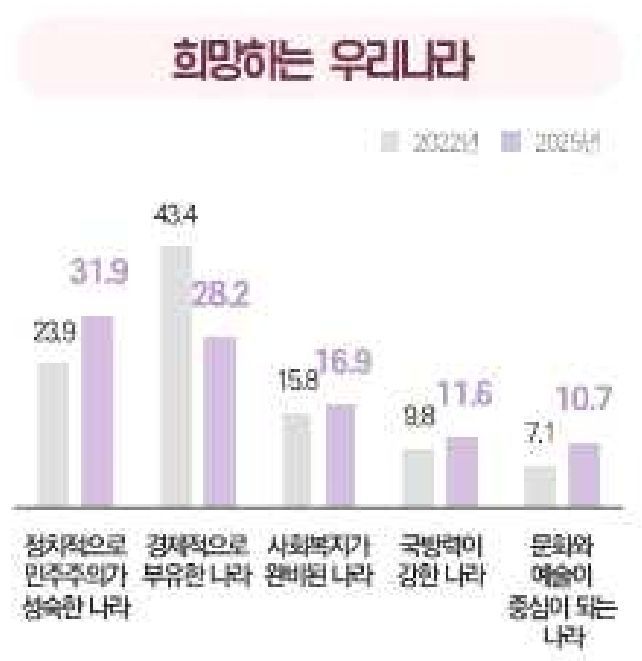
The Ministry of Culture, Sports and Tourism stated, "The most notable finding in this survey is that the public chose 'a country with mature democracy' as the most desired future for Korea," adding, "This seems to stem from a sense of urgency regarding the importance of mature democracy, experienced during the recent crisis of democracy."
46.9% of respondents said that Korea's level of democracy is high, more than double the 21.8% who said it is low.
The proportion of people who considered themselves to be middle class or above increased by 18.1 percentage points compared to the 2022 survey. 43.7% of Koreans responded that they are "middle class," and 16.8% said they are "above middle class," meaning that 60.5% of respondents perceived themselves as "middle class or above." In the 2022 survey, 36.1% identified as "middle class," and 6.3% as "above middle class."
On the other hand, overall "happiness" as perceived by Koreans declined from 65.0% in 2022 to 51.9% this year. "Life satisfaction" also dropped from 63.1% to 52.9%.
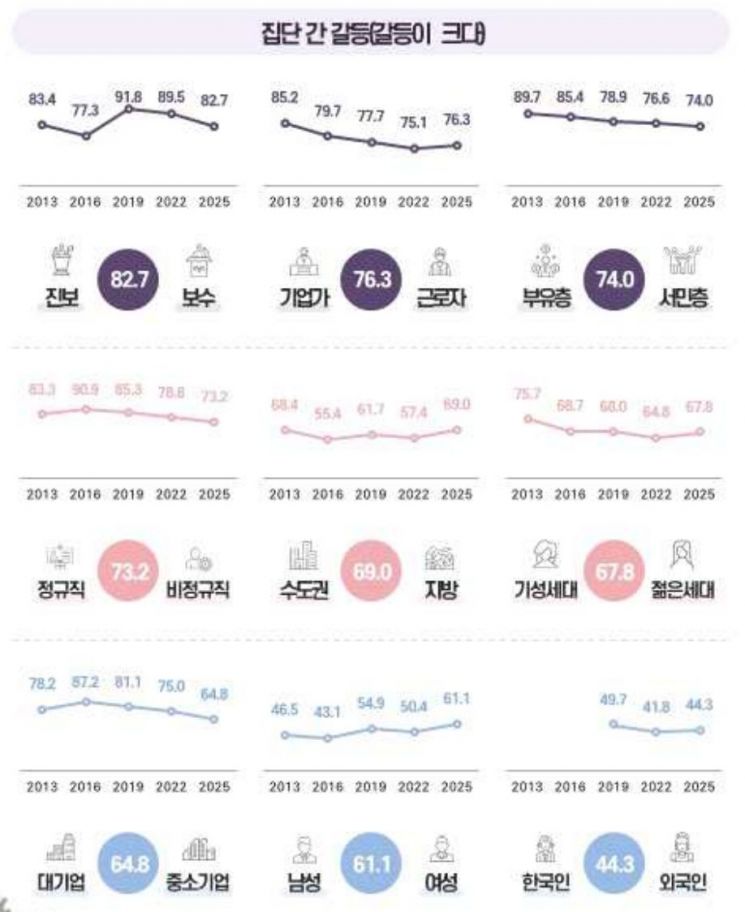
When asked about social conflicts, 82.7% of respondents said the biggest conflict was between "progressives and conservatives." This was followed by "entrepreneurs and workers" (76.3%), and "the wealthy and the working class" (74%).
The proportion of people who said conflicts between the Seoul metropolitan area and other regions are significant rose by 11.6 percentage points, from 57.4% in 2022 to 69.0% this year. Those who said conflicts between men and women are significant also increased by 10.7 percentage points, from 50.4% to 61.1%. The percentage who said there is significant conflict between "older and younger generations" rose by 3 percentage points to 67.8% compared to 2022.
When asked about the most urgent issues to address, income inequality ranked highest at 23.2%, followed by jobs at 22.9%, and real estate/housing issues at 13.2%. The issue of income inequality increased from 20% in the 2022 survey to 23.2% this year, overtaking jobs (which were the top issue at 29% in 2022).
55.2% of Koreans reported using generative artificial intelligence (AI), with an average daily usage of 3.3 times. Among those who do not use AI (44.8%), 51.7% cited "not knowing how to use it" as the main reason.
Regarding the impact of AI on employment, concerns were clear that AI would replace human labor and "worsen job imbalances" (64.3%). At the same time, there were expectations that AI could "improve work efficiency," leading to "shorter working hours and the need to share jobs" (51.8%). Thus, both concerns and expectations about AI coexist.
When choosing a spouse, Koreans considered "personality" (69.3%) most important, followed by "wealth" (11.2%) and "family background" (6.9%). The proportion who said "occupation (future prospects)" is important dropped by 7.9 percentage points, from 13.7% in 2022 to 5.8% in 2025.
50.9% of Koreans believe that the retirement age should be extended beyond the current level, and 23.1% said the mandatory retirement system should be abolished, meaning that 74% of respondents were positive about extending the retirement age. In contrast, those who said the retirement age should remain unchanged dropped sharply from 46.8% in 2022 to 15.7% this year.
66% of respondents said multiculturalism "helps secure the workforce," and 61.3% said it "has significant positive effects, such as strengthening social inclusion." 56.5% said multiculturalism "does not weaken national cohesion," and 58.2% disagreed with the statement that "pride in a single ethnic heritage is diminished."
Koreans tended to prioritize individual freedom and corporate autonomy, with 32.1% agreeing that "individual freedom should take precedence over social order," and 48.5% saying "government regulations on businesses should be relaxed." Additionally, 61.8% agreed that "income differences should reflect effort," 48.9% said "competition advances society," and 42.2% said "there should be special educational environments for outstanding students," indicating a strong emphasis on individual effort and achievement.
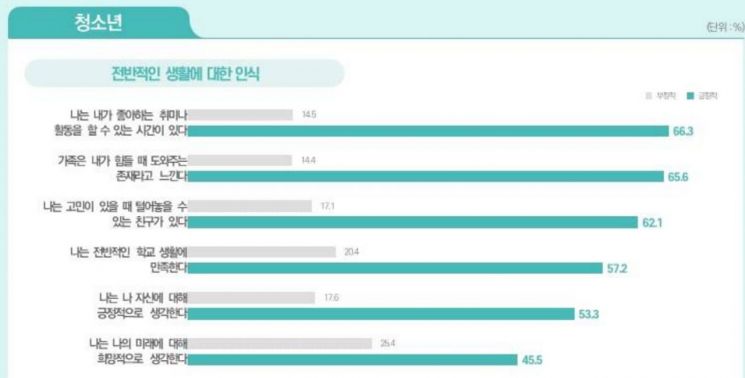
This year's survey included, for the first time, teenagers as respondents and conducted a separate survey of foreigners residing in Korea.
Among teenagers, 66.3% said they "have time to enjoy hobbies or activities they like," and 65.6% said they "feel their family helps them when they are struggling," reflecting generally positive perceptions. When asked whether they "think positively about the future," 45.5% gave a positive response, while 25.4% gave a negative response.
In the first survey of foreigners who have lived in Korea for more than two years, 55.9% said they are generally "happy" with life in Korea, and 56.1% said they are "satisfied" with their lives. Compared to Koreans, foreigners living in Korea reported higher levels of happiness (51.9%) and satisfaction (52.9%).
43.7% of foreigners said they had experienced discrimination in Korea, with "country of origin" being the most common reason at 52.9%. Only 22% said they had ever requested improvements when they experienced discrimination. A striking 78% had not made such requests, with the most common reason (42.2%) being the belief that "nothing would change even if they asked."
A policy official from the Ministry of Culture, Sports and Tourism stated, "The Survey on the Consciousness and Values of Koreans is an important reference for government policy-making," adding, "Starting in 2026, we plan to conduct the survey annually to support government policies based on data."
© The Asia Business Daily(www.asiae.co.kr). All rights reserved.
![Clutching a Stolen Dior Bag, Saying "I Hate Being Poor but Real"... The Grotesque Con of a "Human Knockoff" [Slate]](https://cwcontent.asiae.co.kr/asiaresize/183/2026021902243444107_1771435474.jpg)

















