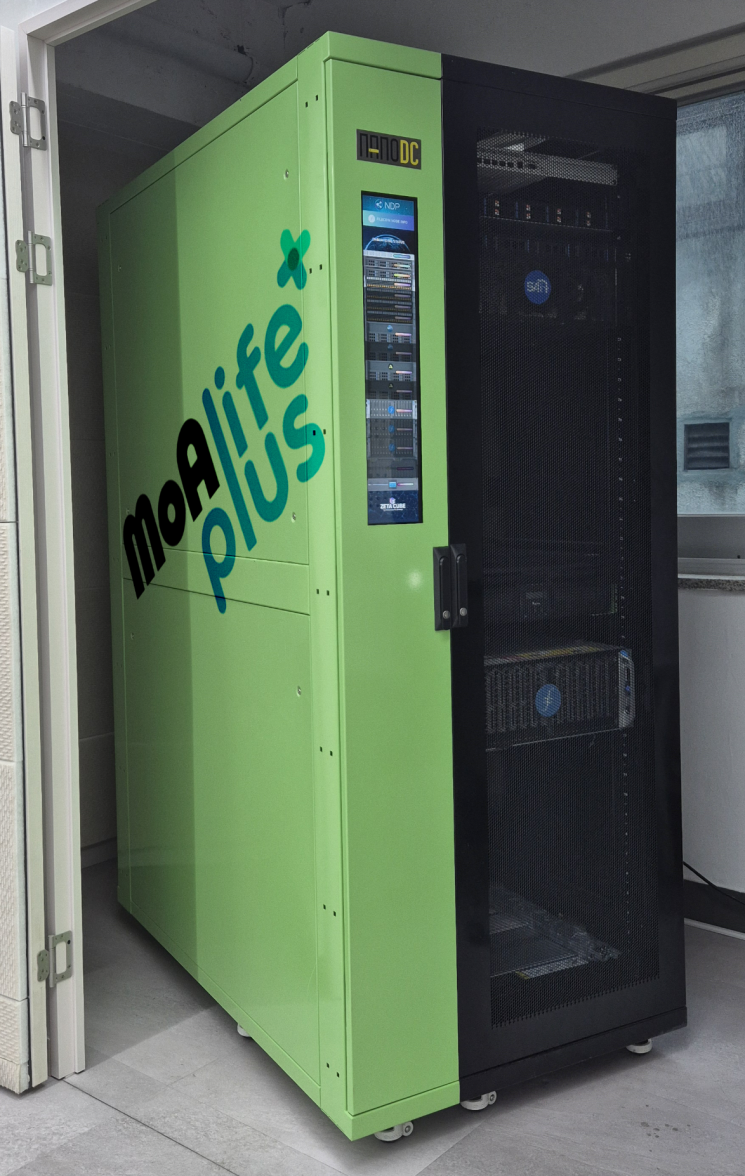
The AI industry has entered yet another turning point. As Physical AI is rapidly spreading beyond generative AI, the standards for AI infrastructure are also being swiftly redefined. This is because, in environments where AI decisions are immediately translated into actions by robots, equipment, cities, and public sites, the limitations of the traditional large-scale cloud-centric structure are becoming increasingly apparent. Amid these changes, MoaLifePlus officially announced on December 23 that it has launched the service and sales of its AI data server.
The AI data server introduced by MoaLifePlus is not just a simple computing device. It is an on-site AI infrastructure designed to enable the construction of a micro AI data center with just a single server set. Installed directly at locations where data is generated-such as schools, local governments, public institutions, and within companies-it collects, analyzes, and processes data on-site without transferring it externally. This structure is considered a prerequisite for reducing both latency and data transfer costs in Physical AI environments where real-time response is essential.
The company describes this server as "the PC of the AI era." Just as the computing environment shifted from massive mainframes to PCs, decentralizing computation and data from the center to the field, the Physical AI era is now at a similar inflection point, moving from ultra-large data center-centric structures to on-site micro data centers. If large-scale clouds are like 'central power plants,' this AI data server is akin to a substation that enables power to be used directly on-site.
The requirements for Physical AI are clearly different from those of traditional digital AI. In robot control, automated facility operations, public safety systems, and smart city infrastructure, real-time performance, stability, and on-site independence are critical. Communication delays or unstable connections with the cloud can immediately lead to accidents or operational disruptions, while high-cost structures have also been obstacles to industry expansion. For this reason, the Physical AI industry is seeing on-site completion of AI computation and data processing, combined with cost efficiency, emerge as essential elements of infrastructure.
MoaLifePlus’s AI data server reflects these needs by being designed not as an infrastructure that merely consumes data, but as one that generates and immediately executes data. Data generated at bio research institutes, manufacturing sites, educational institutions, and public administrative systems is automatically refined, labeled, and de-identified, transforming it into purposeful industrial data. At the same time, the results of AI decisions are linked with robots, sensors, and equipment control systems, providing a foundation for these decisions to result in real-world physical actions.
This structure also creates a new division of roles with large-scale cloud systems. While global clouds continue to function as vast 'oceans of knowledge' storing immense training data and models, in areas where Physical AI operates, on-site micro data centers become the 'starting point of action.' Raw data remains on-site, and only the patterns, statistics, and feature information required for AI training are selectively utilized. This is seen as a practical solution that maintains data sovereignty while keeping pace with technological advancement.
This direction is considered to be closely aligned with the current AI policy stance of South Korea. The government has recently shifted its strategy from viewing AI as merely a software industry to promoting 'on-site AI' that integrates with real industries such as manufacturing, public services, urban management, safety, and bio sectors. At the same time, there is a strong emphasis on domestic storage of public and industrial data, data sovereignty, and compliance with security and regulations. As a result, there is a clear trend favoring domestic and on-site distributed AI infrastructure over reliance on overseas large-scale cloud systems.
In this context, MoaLifePlus’s micro AI data center-based AI data server is interpreted as a technological realization of the direction pursued by national AI policy. By being installed within public institutions, local governments, educational sites, and industrial facilities, data remains on-site and within the country, while AI focuses on solving real problems and execution. Industry observers have described this as "a rare case where policy, industry, and technology trends converge simultaneously."
The market sees this structure as particularly competitive in bio and healthcare, manufacturing and smart factories, education and public sectors, and smart city fields. These industries are representative Physical AI domains where data sensitivity and regulatory intensity are high, and AI decisions directly translate into physical outcomes. The analysis that lower dependence on central clouds actually increases AI utilization is also gaining traction.
With the launch of its AI data server service and sales, MoaLifePlus aims to expand its AI infrastructure business beyond simple hardware supply to become a core execution infrastructure for the Physical AI era. An industry official commented, "Competitiveness in the Physical AI era is not about owning larger data centers, but about how quickly and safely AI can be executed on-site. MoaLifePlus’s AI data server is a practical alternative that meets those requirements."
© The Asia Business Daily(www.asiae.co.kr). All rights reserved.
![Clutching a Stolen Dior Bag, Saying "I Hate Being Poor but Real"... The Grotesque Con of a "Human Knockoff" [Slate]](https://cwcontent.asiae.co.kr/asiaresize/183/2026021902243444107_1771435474.jpg)















