2nd Mutual Finance Policy Council Held
PF Loan Limit Set at 20% of Total Loans
110% Risk Weight Applied to Real Estate Loans in Net Capital Ratio Calculation
Soundness Management Measures Announced for Central Federations and Cooperatives
Financial authorities will strengthen real estate and construction loan regulations for mutual finance institutions to the level applied to savings banks. The risk weight for real estate-related loans will be significantly increased when calculating the net capital ratio, a key indicator of soundness for mutual finance institutions. The intention is to encourage these institutions to improve their loan portfolios and expand credit supply to local communities and low-income individuals. In addition, new measures focusing on soundness management by central federations and cooperatives have been introduced.
On December 22, the Financial Services Commission held the '2nd Mutual Finance Policy Council' chaired by Vice Chairman Kwon Daeyoung and announced these institutional improvement measures. The commission stated, "These measures are aimed at enhancing the risk management capabilities and loss absorption capacity of central federations and cooperatives, providing incentives to shift lending practices from real estate collateral-based loans to those focused on local communities and low-income individuals, and improving cooperative governance and internal control systems."
New PF Loan Regulations and Focus on Soundness Management Announced
Financial authorities will tighten regulations to address the concentration of real estate and collateral-based lending among mutual finance cooperatives. A new project financing (PF) loan cap will be introduced, limiting PF loans to 20% of total loans. Furthermore, mutual finance institutions will be prohibited from having the combined total of PF, real estate, and construction loans exceed 50% of their total loans. A risk weight of 110% will also be applied to real estate and construction loans when calculating the net capital ratio. Authorities may take prompt corrective action if a financial institution shows signs of potential insolvency based on capital adequacy indicators. By increasing the regulatory burden on real estate-related loans in the net capital ratio calculation, the intention is to promote healthier asset composition among cooperatives.
For joint loans related to large-scale real estate development, requirements such as mandatory prior review by the central federation will be strengthened. Model guidelines for PF project viability assessments will be established to systematize PF risk management. In addition, standards for estimating the recoverable value of distressed assets will be revised to facilitate the resolution of long-term unresolved non-performing PF projects.
However, as part of the soundness enhancement measures, the planned increase in loan loss reserve ratios for real estate and construction loans will be deferred. Previously, mutual finance institutions were required to raise their loan loss reserve ratios for real estate and construction loans from 120% to 130% by December 31, but this deadline has been postponed to March 31 of next year. Vice Chairman Kwon Daeyoung explained, "There were concerns that raising the reserve ratio could restrict financial supply to local communities, low-income individuals, and small business owners. In consideration of industry requests to defer the increase, an additional three months has been granted as the final implementation period."
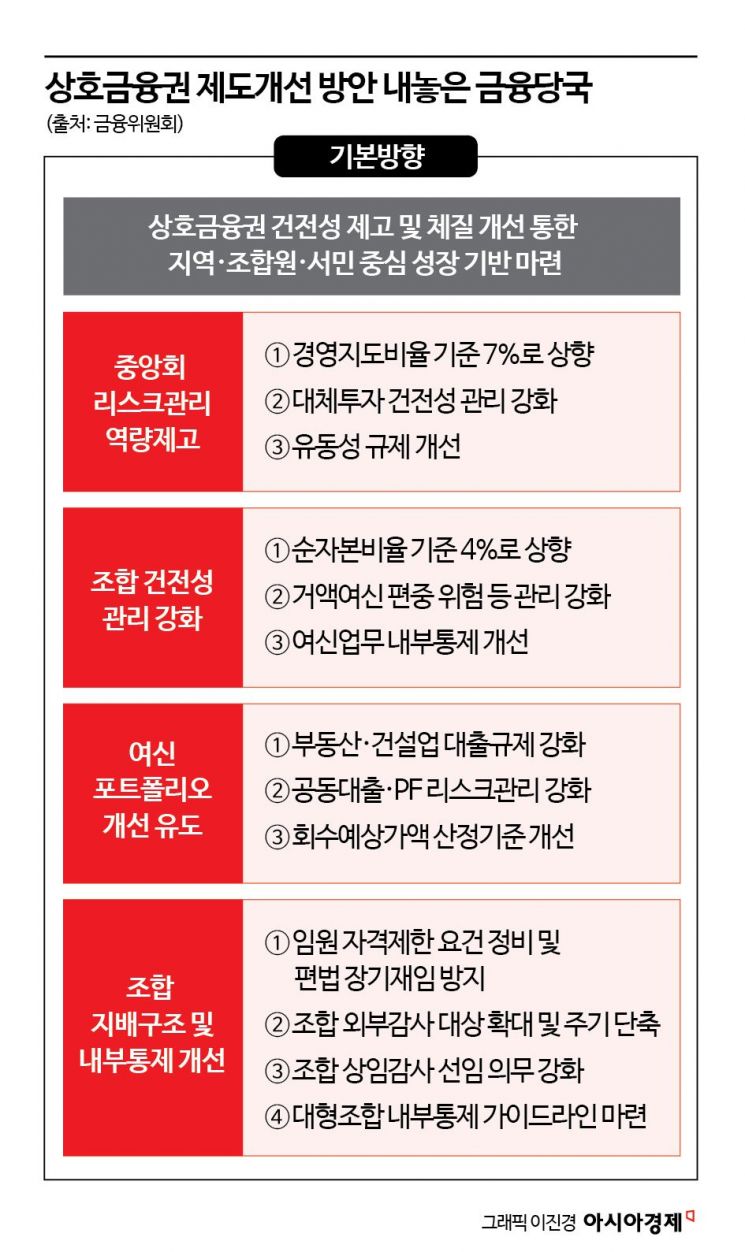
The Financial Services Commission also announced measures to enhance the risk management capabilities of central federations. The management guidance ratio (capital adequacy ratio) for central federations will be gradually raised to 7%, matching the level required of savings banks. Central federations will also be required to classify the soundness of alternative investments such as real estate funds, and new approval procedures and limits will be established.
Through these improvements, the commission aims to strengthen the soundness management and loss absorption capacity of individual cooperatives. The minimum net capital ratio for credit unions, fisheries cooperatives, and forestry cooperatives will be gradually raised to 4%, and the 'management improvement order' system will be introduced to credit unions, aligning them with other mutual finance institutions. The 'large exposure limit regulation' will be legislated to prevent excessive lending to specific borrowers, and the entire internal control system for lending operations will be reinforced by managing loan processes electronically to prevent improper or fraudulent loans.
Additionally, to prevent misconduct by cooperative heads and strengthen executive oversight, improvements will be made to cooperative governance and internal control systems. Qualification requirements for executives will be tightened to the level stipulated in the "Act on Corporate Governance of Financial Companies," establishing safeguards against improper long-term tenure by cooperative heads. Existing requirements for external audits and the appointment of standing auditors will be further strengthened, and major principles from the "Financial Consumer Protection Act" will be incorporated into internal regulations to provide stronger protection for mutual finance institution users.
Authorities and Related Agencies: "Stable Management of Delinquency Rates and Expansion of Social Solidarity Finance Supply"
Meanwhile, financial authorities reviewed the soundness and liquidity status of each mutual finance institution. The review found that due to the downturn in the real estate market, delinquency rates and profitability in the mutual finance sector have deteriorated. Authorities plan to manage delinquency rates stably through the sale of non-performing assets by the end of this year. For social solidarity finance, which provides funding to social enterprises and cooperatives, efforts will be made to expand supply, as performance has been sluggish.
Vice Chairman Kwon Daeyoung stated, "These institutional improvement measures require significant structural reforms in the mutual finance sector and demand a considerable level of responsibility and burden from cooperatives and central federations. However, they are essential for the stability of the financial system and the sustainable development of the mutual finance sector. Each cooperative should faithfully implement the additional loan loss reserves within the extended period, and central federations should thoroughly monitor and support the implementation status of each cooperative to ensure the measures are carried out without disruption."
© The Asia Business Daily(www.asiae.co.kr). All rights reserved.
![Clutching a Stolen Dior Bag, Saying "I Hate Being Poor but Real"... The Grotesque Con of a "Human Knockoff" [Slate]](https://cwcontent.asiae.co.kr/asiaresize/183/2026021902243444107_1771435474.jpg)
















