Climate Companion Card Expands with Various Discount Passes
Monthly Transportation Costs Reduced by 30,000 Won... Increased Use of Public Transit
Linked with Government's Everyone's Card... "Virtuous Welfare Cycle"
The Climate Companion Card, a metropolitan area unlimited public transportation integrated commuter pass, has surpassed 17 million cumulative top-ups just two years after its launch. On average, 720,000 people use the card daily, which is 1.5 times higher than the initial goal of 500,000 users.
According to the Seoul Metropolitan Government on December 22, the average daily number of transportation card transactions in areas where the Climate Companion Card is available increased by 4.0%, from 9.88 million to 10.27 million, after the card's introduction. In contrast, areas where the card is not available saw only a 2.2% increase, from 5.97 million to 6.11 million transactions.
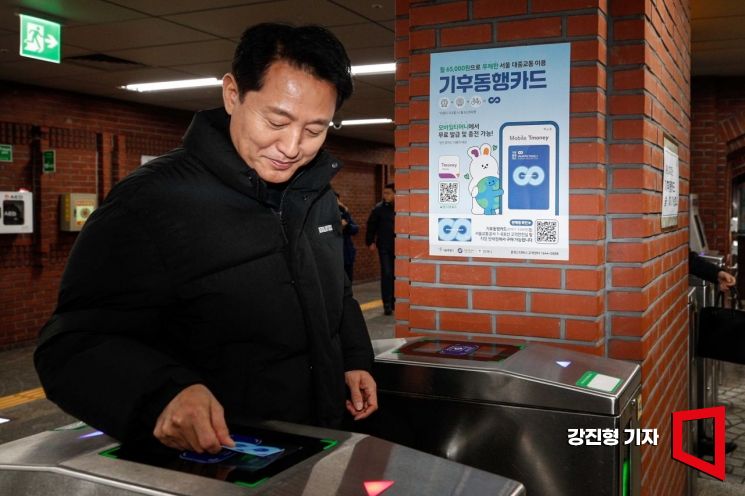 Seoul Mayor Oh Sehoon is visiting City Hall Station in Jung-gu, Seoul, using the Climate Companion Card to ride the subway. Photo by Kang Jin-hyung
User satisfaction has been reported as high. In a survey conducted by the Seoul Institute in October with 5,068 Climate Companion Card users, 92.9% of respondents said they were satisfied (very satisfied or satisfied) with the card. Additionally, 90.1% evaluated the policy positively (very positive or positive). Notably, respondents' weekly use of public transportation increased by approximately 2.26 times, while their use of private cars decreased by about 0.68 times, confirming the card's effectiveness in reducing carbon emissions and helping to prevent the climate crisis.
More than half of all users (57.1%) are using the youth discount pass, indicating that the card plays a significant role in transportation welfare for young people. In fact, the average usage rate of the Climate Companion Card at general stations is 18.5%, but usage rates are much higher at subway stations near university districts and youth commercial areas, such as Hanyang University Station (31.7%), Korea University Station (27.2%), and Dongdaemun History & Culture Park Station (26.5%).
The Seoul Metropolitan Government explained that the popularity of the Climate Companion Card is not only due to its unlimited rides feature, but also because of its various advantages, such as access to multiple modes of transportation and availability throughout the metropolitan area, including Seoul and its surrounding regions.
In addition to unlimited rides on the subway, buses, and village buses, users can also take advantage of unlimited access to public transportation-linked services such as Ttareungi (Seoul's bike-sharing system) and Han River buses (water transportation), for an additional fee. Furthermore, the Climate Companion Card can be used in seven regions adjacent to Seoul: Gimpo, Goyang, Gwacheon, Guri, Namyangju, Seongnam, and Hanam in Gyeonggi Province.
There are also a variety of customized discount benefits for different user groups. After launching the standard pass (62,000 won for a 30-day pass) as a pilot project, the city introduced the youth discount pass (55,000 won for a 30-day pass) and short-term passes (1, 2, 3, 5, and 7-day passes) in the same year. Since January this year, a system has been implemented to extend the youth discount period for discharged military personnel by the length of their service. In September, discount benefits were further expanded to include teenagers, families with multiple children, and low-income groups.
The Climate Companion Card is also recognized as a benchmark model for the "Everyone's Card," which the government plans to launch in January next year. Everyone's Card is a new K-Pass service that fully reimburses any amount spent above a set threshold. The Seoul Metropolitan Government plans to maintain the Climate Companion Card even after the launch of Everyone's Card, in order to ensure citizens' choice and the continuity of existing services.
Yeo Jangkwon, Director of the Seoul Metropolitan Government's Transportation Bureau, stated, "The Climate Companion Card, first introduced by Seoul, has not only shifted the paradigm of public transportation fare systems but has also expanded nationwide, signaling the start of a virtuous welfare model. Based on the achievements of the past two years, we will continue to improve our public transportation support programs."
© The Asia Business Daily(www.asiae.co.kr). All rights reserved.
![Clutching a Stolen Dior Bag, Saying "I Hate Being Poor but Real"... The Grotesque Con of a "Human Knockoff" [Slate]](https://cwcontent.asiae.co.kr/asiaresize/183/2026021902243444107_1771435474.jpg)















