Gimcheon-Gumi-East Gumi-New Airport Line
Must Be Included in the 5th National Rail Network Plan
Essential Railway Network for Gumi’s Leap as a New Airport Hinterland City
Gumi-New Airport Railway with Economic Feasibility and Policy Validity
Key to Balanced National Development
On December 22, the city of Gumi and the Gumi Chamber of Commerce and Industry held the "Policy Debate on the Establishment of Gumi-New Airport Railway Toward the New Airport Hinterland City" at the Gumi Chamber of Commerce and Industry.
The debate, hosted by the city of Gumi and organized by the Gumi Chamber of Commerce and Industry, was attended by Gumi Mayor Kim Jangho, Gumi City Council Chairman Park Gyosang, Gyeongbuk Chamber of Commerce and Industry Chairman Yoon Jaeho, as well as over 150 participants including CEOs and representatives of economic organizations. The event demonstrated the high level of interest from the local business community in the establishment of the Gumi-New Airport railway.
For the past half-century, Gumi has served as a key hub driving Korea’s industrialization, acting as the forward base of “K-Industry” centered on the national industrial complex.
Recently, Gumi has regained attention as a center for national strategic industries, with major government projects such as the semiconductor cluster and the defense industry innovation cluster being selected in succession, and its inclusion in the Southern Semiconductor Innovation Belt.
There is a growing consensus throughout the local community that the “Gimcheon-Gumi-East Gumi-New Airport” railway line, which directly connects the Gumi National Industrial Complex and the Daegu-Gyeongbuk Integrated New Airport, must be included in the 5th National Rail Network Construction Plan.
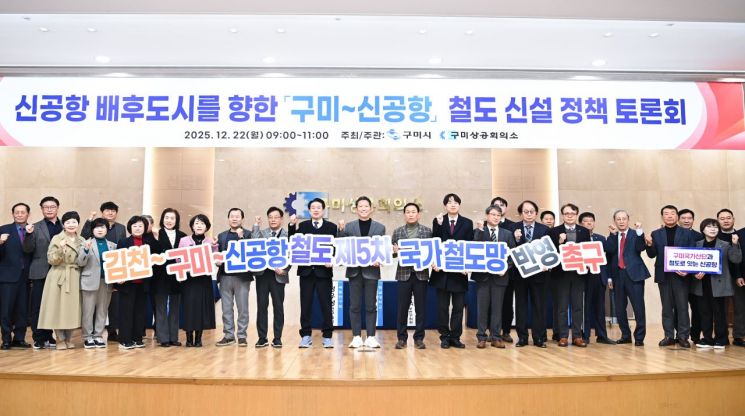 Hosted the "Policy Debate on the Establishment of Gumi?New Airport Railway toward the New Airport Hinterland City." / Provided by Gumi City Hall
Currently, Gumi is a leading industrial city, accounting for 4.5% of Korea’s total exports and 63% of Gyeongbuk’s exports.
The city is home to five national industrial complexes, 3,762 companies, and approximately 93,000 workers. However, it has not seen a new railway project in over 120 years since the opening of the Gyeongbu Line in 1905.
With the new airport being built just 10 kilometers from the national industrial complex, many point out that now is the optimal time to establish a railway network connecting industry and the airport.
The “Gimcheon-Gumi-East Gumi-New Airport” route, which Gumi is proposing for inclusion in the 5th National Rail Network Construction Plan, not only connects the existing Gyeongbu Line and the new “West Daegu-New Airport-Uiseong” line via the shortest route, but also allows the East Gumi-New Airport section to utilize the planned route, making it highly cost-effective compared to the investment required.
According to a study commissioned by the city of Gumi, the benefit-cost ratio (B/C) for this route was analyzed to be 0.922, demonstrating greater economic viability than other existing national railway projects, such as the Jungbu Inland Railway (0.58) and the Dalbit Railway (0.483).
Kim Geunwook, Associate Research Fellow at the Gyeongbuk Research Institute and the first presenter at the debate, emphasized, "For Gumi, which has great potential in air logistics, a low-cost, high-efficiency railway connecting to the new airport is not an option but a necessity," adding, "It is essential that it be included in the 5th National Rail Network Construction Plan."
Jung Woosung, Research Fellow at the Korea Research Institute for Human Settlements, highlighted the concentration of manufacturing and innovative companies in the Seoul metropolitan area, and explained, "Expanding transportation and industrial infrastructure centered on regional hub cities is key to balanced national development."
During the comprehensive discussion, chaired by Yoon Daesik, Professor Emeritus at Yeungnam University, in-depth discussions were held on the feasibility and strategies for promoting the Gumi-New Airport railway with Lee Youngwoo, Professor of Construction Systems Engineering at Daegu University; Lee Jinsun, Professor of Railway Management at Woosong University; Lee Seokhee, Policy Advisor to North Gyeongsang Province; and Shim Kyujeong, Team Leader at the Gumi Chamber of Commerce and Industry.
The panelists agreed that if Gumi, as a manufacturing-focused city, is not directly connected to the new airport by rail, there will inevitably be limitations to the growth potential of the entire Daegu-Gyeongbuk region and to balanced regional development.
Using this policy debate as a starting point, the city of Gumi plans to further promote the necessity of the Gumi-New Airport railway externally and, in conjunction with the Gumi-Gunwi expressway-which passed the preliminary feasibility study in November-accelerate the construction of transportation infrastructure that will support regional economic revitalization and balanced national development.
Yoon Jaeho, Chairman of the Gyeongbuk Chamber of Commerce and Industry, stated, "The railway connecting to the new airport is essential infrastructure that can dramatically improve logistics accessibility for Gumi companies. It is a project that the local business community has been eagerly awaiting."
Gumi Mayor Kim Jangho said, "For the Daegu-Gyeongbuk Integrated New Airport to become a growth hub for the region, a railway directly connecting it to the Gumi National Industrial Complex is essential. We will continue to consult with relevant agencies to ensure that this route is included in the 5th National Rail Network Construction Plan."
© The Asia Business Daily(www.asiae.co.kr). All rights reserved.
![Clutching a Stolen Dior Bag, Saying "I Hate Being Poor but Real"... The Grotesque Con of a "Human Knockoff" [Slate]](https://cwcontent.asiae.co.kr/asiaresize/183/2026021902243444107_1771435474.jpg)















