Jeonnam Institute of Health and Environment Conducts Korea’s First 72-Hour Greenhouse Gas Measurement in Mudflats
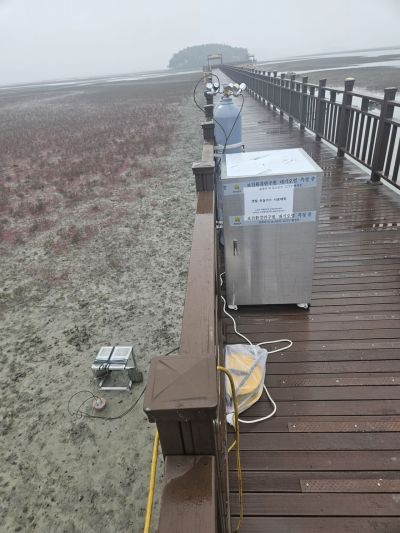
The Jeonnam Institute of Health and Environment announced that, for the first time in Korea, it conducted a continuous 72-hour measurement of carbon dioxide absorption capacity at the non-vegetated mudflat in Jido, Shinan, as part of efforts to certify it as a carbon reduction source. The results showed an estimated daily economic benefit of approximately 5.54 million won.
The Jeonnam Institute of Health and Environment conducted four studies between February and July 2025 on the carbon dioxide absorption capacity of the non-vegetated mudflat in Jido, Shinan, which is part of the Jeonnam coastal mudflats accounting for 43.8% of the nation’s mudflats. This research was carried out as a policy project for 2025, aiming to certify the mudflat as a carbon reduction source.
The distinguishing feature of this study is that, unlike previous research, it used an open dynamic chamber to measure greenhouse gas absorption and emission directly at the mudflat surface. Carbon dioxide at a constant concentration was injected into the chamber, and automated measurements were taken continuously every five minutes for 72 hours.
Long-term continuous measurement is crucial for estimating carbon absorption in mudflats because the amount of carbon absorbed from the air at the surface can vary greatly over time due to factors such as photosynthesis and microbial respiration. In particular, since respiration dominates at night, failing to account for post-sunset hours can lead to overestimation of carbon absorption. Therefore, it is essential to check both daytime and nighttime measurements.
The study found that the carbon absorption capacity of the mudflat ranged from -292 mg CO2/㎡·hr to 95 mg CO2/㎡·hr, with an average of -9 mg CO2/㎡·hr, indicating that each square meter absorbed an average of 9 mg of CO2 per hour.
Additionally, the total daily average carbon dioxide absorption for Jeonnam’s 2,443.3 km² of mudflats was calculated at 528 tons, equivalent to the emissions from approximately 55,000 passenger cars.
Based on the Korea Emissions Trading System price as of December 11 (10,500 won per ton), the daily economic benefit is estimated at about 5.54 million won.
This research provides valuable scientific evidence to support the Ministry of Oceans and Fisheries’ ongoing efforts to certify non-vegetated mudflats as blue carbon sources. The findings are expected to be used as supporting data for Jeonnam’s mudflats-the largest in the country-to be recognized as carbon reduction sources in the future.
The Jeonnam Institute of Health and Environment presented the research findings at the Korean Society for Atmospheric Environment in October and will publish them in the December issue of the society’s journal.
Yang Jeonggo, Head of Air Quality Management at the Jeonnam Institute of Health and Environment, stated, “We will continue our efforts to secure highly reliable data, including measurements of solar radiation related to microbial photosynthesis.”
© The Asia Business Daily(www.asiae.co.kr). All rights reserved.
![Clutching a Stolen Dior Bag, Saying "I Hate Being Poor but Real"... The Grotesque Con of a "Human Knockoff" [Slate]](https://cwcontent.asiae.co.kr/asiaresize/183/2026021902243444107_1771435474.jpg)















