Twice the Size of the Previous Nuclear Carrier
Resolving Fiscal Crisis and Shipyard Overload Is a Top Priority
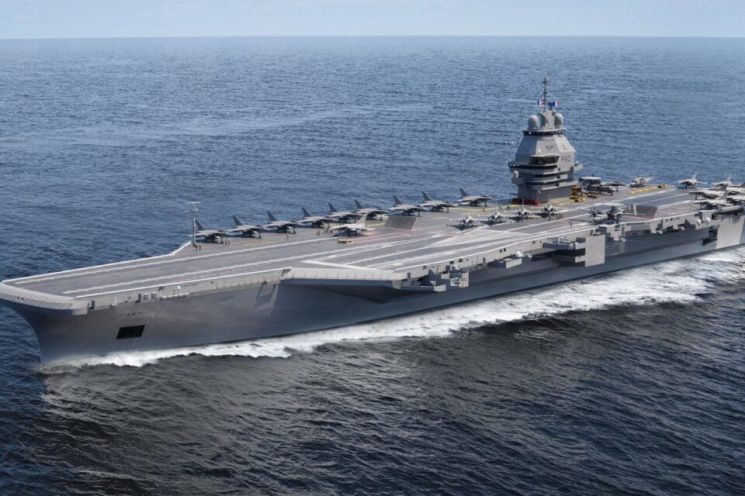 Conceptual design of the next-generation aircraft carrier (PANG) unveiled by the French state-owned shipbuilding company Naval Group. Naval Group website
The French government has announced plans to build a next-generation nuclear-powered aircraft carrier that will be twice the size of its current nuclear carrier, the Charles de Gaulle. The new carrier is planned to have a displacement of 80,000 tons, comparable to China's third aircraft carrier, the Fujian, which was recently deployed. There are high expectations that the French Navy's capabilities will be greatly enhanced, especially since the United States has agreed to transfer advanced aircraft carrier technologies. However, chronic fiscal deficits and production overload at French shipyards remain significant challenges that must be addressed.
Twice the Displacement of the Charles de Gaulle... Importing U.S. Aircraft Carrier Technology as Well
On December 21 (local time), French President Emmanuel Macron announced plans to introduce a next-generation nuclear-powered aircraft carrier by 2038 during a press conference held during his visit to the United Arab Emirates (UAE). He stated, "After thorough and comprehensive review, we have decided to introduce a new aircraft carrier," emphasizing, "In an era ruled by the logic of power, we must become stronger to possess deterrence and become a force to be feared."
According to the local media outlet France 24, the new nuclear aircraft carrier construction plan announced by President Macron is called the "Porte-Avions de Nouvelle Generation" (PANG) program. France has been reviewing this plan since 2018. The new nuclear-powered carrier will have a displacement of 80,000 tons and will be able to carry about 30 fighter jets.
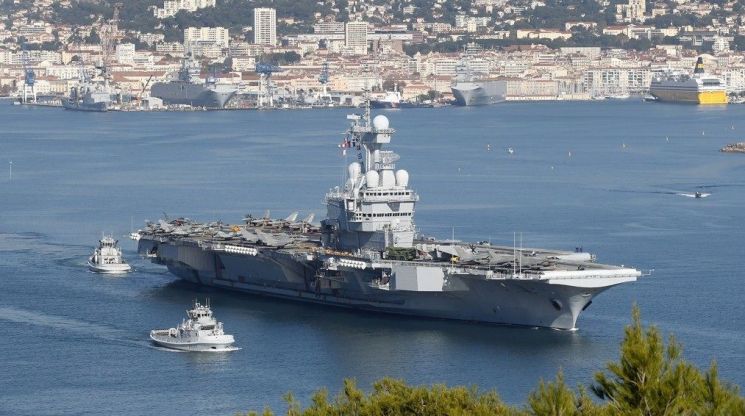
An 80,000-ton class carrier is twice the displacement of France's existing nuclear-powered carrier, the Charles de Gaulle. While it does not match the size of the U.S. Gerald R. Ford-class carriers, which have a displacement of 110,000 tons, it is comparable to China's third carrier, the Fujian, which was recently deployed. However, France 24 reported that since the Fujian is powered by conventional diesel engines and not nuclear propulsion, the French nuclear carrier is expected to surpass it in terms of output and performance.
In addition, France will import advanced aircraft carrier technology from the United States. The country plans to purchase three electromagnetic catapults and arresting wires, which are landing restraint devices, from General Atomics in the United States. The estimated cost for acquiring this technology is about $1.32 billion (approximately 2 trillion won).
Massive Construction Costs Amid Fiscal Crisis... Shipyard Overload Also a Problem
However, the French government's fiscal crisis is hampering plans for the new nuclear-powered carrier. The estimated construction cost for the new carrier, as calculated by the French government, amounts to 10.25 billion euros (about 17.74 trillion won), and there are already concerns that securing the necessary funding will not be easy.
The French government announced that last year's fiscal deficit reached 156.3 billion euros (about 270.58 trillion won). The government debt-to-GDP ratio stands at 114%, which is the third highest in the world after Japan (255%) and the United States (124%).
Previously, the French parliament had even recommended delaying the construction plan. In a report on the nuclear carrier construction plan released in June, the French Senate advised the government to postpone the project and invest in more urgent military sectors, citing the severity of the fiscal crisis. However, the French Ministry of Defense has opposed any delay in the construction timeline, leading to ongoing controversy.
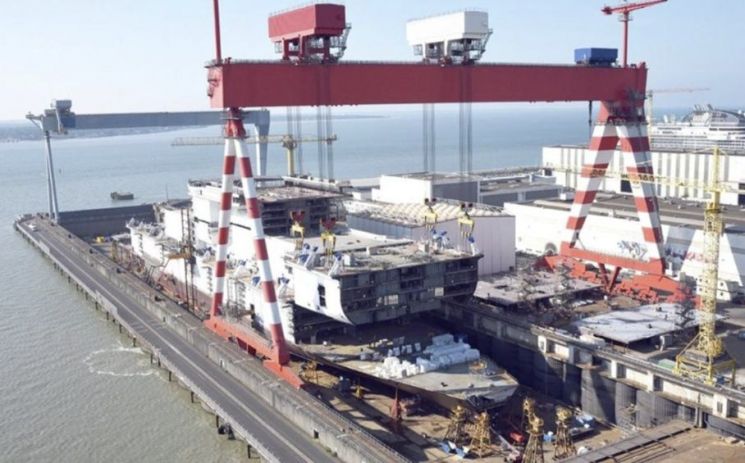
The overload at French shipyards is also a pressing issue that must be resolved. With all French shipyards already engaged in various naval enhancement projects, adding the construction of another nuclear-powered carrier will not be easy. The U.S. security journal National Security Journal (NSJ) pointed out, "French shipyards are already struggling with new submarine and frigate construction projects, so it will be difficult for them to take on such a large-scale project as a new nuclear-powered carrier." The journal also noted, "The retirement of the Charles de Gaulle is scheduled for around 2040, but it remains uncertain whether the new carrier can be completed by then."
© The Asia Business Daily(www.asiae.co.kr). All rights reserved.
![Clutching a Stolen Dior Bag, Saying "I Hate Being Poor but Real"... The Grotesque Con of a "Human Knockoff" [Slate]](https://cwcontent.asiae.co.kr/asiaresize/183/2026021902243444107_1771435474.jpg)

















