Rising Import Raw Material Costs
Increase Pressure on Processed Food and Dining-Out Prices
Due to the prolonged period of high exchange rates, import prices have surged across the board. As fluctuations in international prices have coincided with the rise in the won-dollar exchange rate, the won-converted prices of major imported food products such as coffee and beef have risen sharply over the past five years. Import prices are reflected in consumer prices with a time lag.
According to the Economic Statistics System (ECOS) of the Bank of Korea on the 21st, the import price index for coffee, with 2020 set at 100, recorded 307.12 in dollar terms and 379.71 in won terms last month.
 On the 3rd, as the morning temperature in Seoul dropped to minus 7 degrees Celsius bringing severe cold, a citizen is holding a warm coffee at Gwanghwamun Intersection in Jongno-gu, Seoul. Yonhap News Agency. Not directly related to the article.
Due to the sharp increase in international coffee prices, the import price per unit in dollars has tripled over the past five years. On top of this, the rise in the exchange rate has pushed the import price in won terms to nearly four times higher over the same period.
Beef import prices have also risen by 30% in dollar terms over the same period, but by 60.6% in won terms. Other items such as pork (30.5%), chicken (92.8%), cheese (about 90%), and fruit (30.5%) have also seen significant increases in won-based prices.
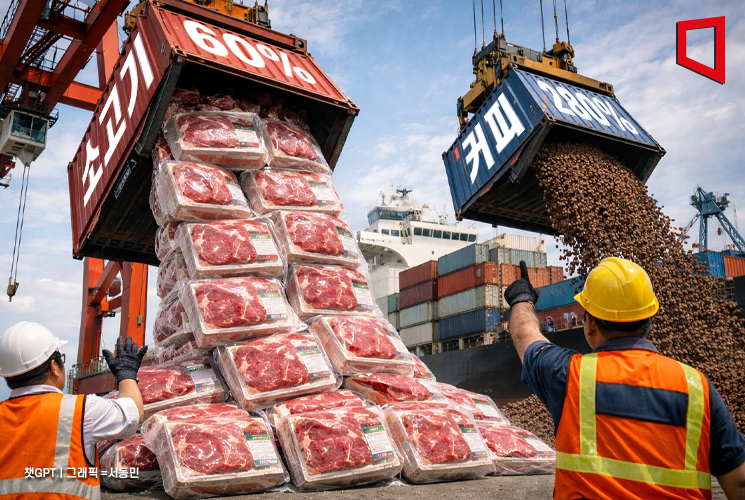
Soybeans (37.2%), corn (35.3%), and wheat (22.1%), which are mostly dependent on imports, have each risen by more than 20% in won terms. Whiskey increased by 31.5%, and wine by 20%. The price of fruit juice concentrate soared by 120.2%. Frozen vegetables rose by 82.8%, and processed nuts by 61.6%. Raw sugar, the main ingredient in sugar, also showed a high increase of 51.7%.
Narrowing the period to the past year, import prices in dollar terms have declined. However, when converted to won, prices for items such as corn, fruit, coffee, fish products, and fruit juice concentrate have actually increased. Coffee prices dropped by 1% in dollar terms compared to a year ago, but rose by 3.6% in won terms. The import price of fruit fell by 2.8% in dollar terms over the past year, but increased by 1.8% when converted to won.
By use, the import price of intermediate food products rose by 50.6% in dollar terms over the past five years, but soared by 86.2% in won terms. Raw materials such as agricultural, forestry, and fishery products increased by 21.1% in dollar terms, but by 49.7% in won terms. In particular, the rate of increase was notable for agricultural products (62.4%) and livestock products (50.8%).
Meanwhile, since September, the won-dollar exchange rate has remained above 1,400 won per dollar. As overseas investments by Korean individuals and pension funds have increased significantly, and with foreign investors selling large volumes of stocks in the Korean market in November, the high exchange rate has intensified despite a series of government measures. Analysts point out that the high exchange rate is pushing up the prices of imported raw materials, thereby increasing the burden of processed food and dining-out prices as well.
© The Asia Business Daily(www.asiae.co.kr). All rights reserved.
![Clutching a Stolen Dior Bag, Saying "I Hate Being Poor but Real"... The Grotesque Con of a "Human Knockoff" [Slate]](https://cwcontent.asiae.co.kr/asiaresize/183/2026021902243444107_1771435474.jpg)
















