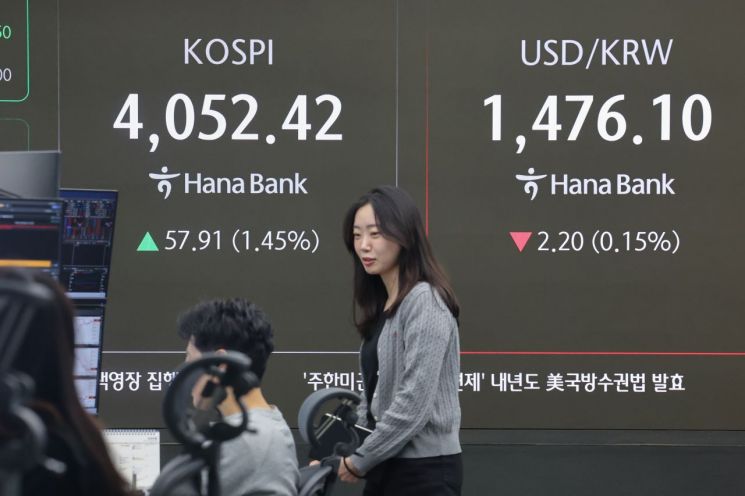
KOSPI Rises 0.8%
On the 19th, the KOSDAQ index rose by over 2% during intraday trading, reaching the 920 mark. The index appears to have been lifted by simultaneous buying from both foreign and institutional investors.
As of 2:09 p.m. that day, the KOSDAQ stood at 919.86, up 2.06% from the previous day. At one point during the session, it climbed as high as 922.10. This marks the largest intraday increase since November 28.
The upward momentum is attributed to net purchases by both foreign and institutional investors. They recorded net purchases of 140.8 billion won and 198.7 billion won, respectively. Only individual investors were net sellers, offloading 311.9 billion won.
Most of the top 10 stocks by market capitalization also showed gains. Notably, Samchundang Pharm (up 7.1%), Alteogen (up 4.7%), Legochem Biosciences (up 4.2%), Rainbow Robotics (up 3.9%), ABL Bio (up 3.2%), Peptron (up 2.5%), and Ecopro BM (up 1.4%) all rose by more than 1%. Only Aimed Bio (down 1.5%) and Ecopro (down 1.1%) declined.
In contrast, the KOSPI showed a somewhat sluggish performance. At the opening, it surged more than 1.53% from the previous day to 4,055.78, but the opening price turned out to be the session high. As of 2:14 p.m., the index was at 4,029.17, up 0.86% from the previous day.
Foreign investors recorded a net sell of 334 billion won, while individuals also sold a net 131.5 billion won. Only institutions were net buyers, with a net purchase of 454.6 billion won.
The top 10 stocks by market capitalization showed mixed results. Hanwha Aerospace (up 6.1%), Doosan Enerbility (up 3.3%), HD Hyundai Heavy Industries (up 3.1%), SK Hynix (up 1.9%), and Hyundai Motor Company (up 1.5%) all gained more than 1%. In contrast, Samsung Electronics (down 1.0%), LG Energy Solution (down 0.6%), and Samsung Biologics (down 0.5%) declined.
Industry experts note that the KOSDAQ has shown stronger performance than the KOSPI toward the end of the year. This is analyzed to be due to the relatively lower dividend yield, which minimizes the impact of ex-dividend dates, and because investors who had sold shares to avoid being designated as major shareholders tend to return as buyers after the ex-dividend date.
© The Asia Business Daily(www.asiae.co.kr). All rights reserved.
![Clutching a Stolen Dior Bag, Saying "I Hate Being Poor but Real"... The Grotesque Con of a "Human Knockoff" [Slate]](https://cwcontent.asiae.co.kr/asiaresize/183/2026021902243444107_1771435474.jpg)















