Controversy Surrounds Prediction Market Platform "Polymarket"
Betting on Events Involving Human Lives, Including War
"An Ecosystem Built on Human Suffering"
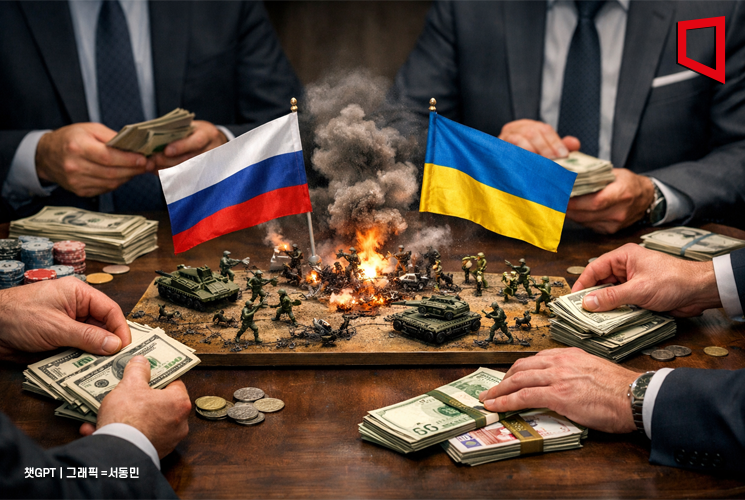
Polymarket is an online platform that offers prediction betting services on all kinds of events happening around the world. Recently, Polymarket has seen a surge in prediction items related to the Russia-Ukraine war. There has been criticism that the platform is turning a war, which causes immense suffering for countless soldiers and civilians, into a form of entertainment. While the prediction market has grown rapidly in recent years to the point of attracting the attention of Wall Street investors, the number of unethical prediction items has also increased, fueling controversy.
As of the end of last month, approximately 100 prediction items related to the Russia-Ukraine war were listed on Polymarket. Since the outbreak of the war in 2022, the conflict between the two countries has become a frequent subject in the prediction market, but most topics were political, such as "When will Russia and Ukraine hold ceasefire negotiations?" However, the situation is different now. There is a flood of items predicting specific battle outcomes, such as "Will Russia capture the Lyman region?" and "Will Ukrainian forces reclaim Crimea?" Over the course of one month last month, the total amount wagered on these items reached approximately $968,000 (about 1.43 billion KRW).
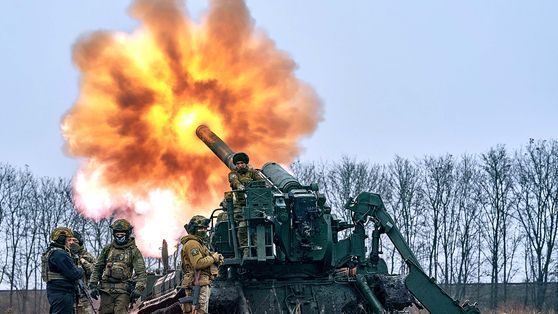
Polymarket is a global prediction market platform headquartered in New York, United States. Participants predict the outcomes of various events and take home the winnings if their predictions are correct, making it a kind of betting game. For example, during last year's U.S. presidential election, a participant who bet on Donald Trump winning the presidency reportedly earned $80 million (about 118 billion KRW), drawing attention from foreign media. According to a joint report by cryptocurrency data analytics firms Dune and Karok, the prediction market's monthly size was less than $100 million (about 148 billion KRW) last year, but as of last month, it had surged more than 100-fold to $13 billion (about 19 trillion KRW) per month.
The problem is that more people are now betting on events involving loss of life, such as wars and disasters. This is not limited to the Russia-Ukraine war. In the past, Polymarket featured numerous items predicting the course of the war following the Israeli Defense Forces' invasion of the Gaza Strip, as well as items predicting when U.S. forces would attack Venezuelan ships.
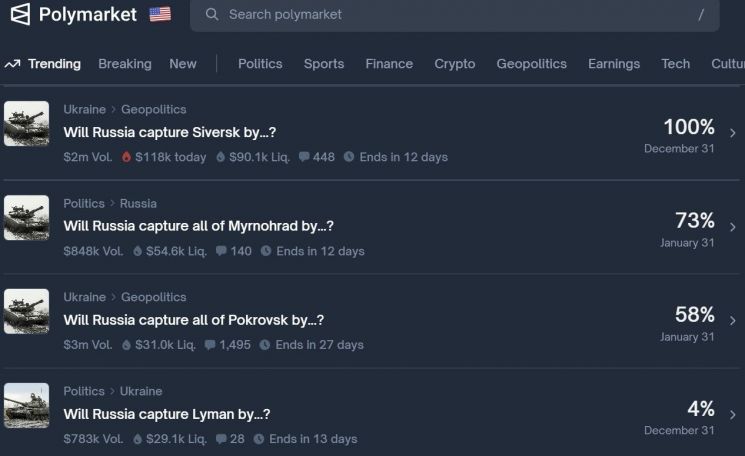 Prediction market platform Polymarket's real-time searched prediction items on the Russia-Ukraine war developments. Screenshot from Polymarket homepage
After these items became known, there was a flood of sharp criticism on overseas online communities such as Reddit and X, with comments like "Are you gambling on matters of life and death?", "You are less than human," and "I hope gambling addicts go bankrupt." Earlier this month, the Ukrainian media outlet Kyiv Post strongly condemned Polymarket, stating, "Polymarket has created a global ecosystem that monetizes the struggles of Ukrainian soldiers," and "This market is built on human suffering."
There are also negative side effects, such as services created to help soldiers being used for betting. Previously, Ukrainian volunteers developed a website called "DeepState" that provides real-time updates on combat zones within Ukrainian territory. This site uses publicly available information from social networking services, media, and official announcements from the Ministry of Defense to detail the situation in each battlefield, serving to alert both soldiers and civilians. However, when it was confirmed that some prediction market participants had been referencing this website's information, DeepState issued an official statement on the 25th of last month (local time), saying, "Our map data was created for a humanitarian mission. We will not provide information to any gambling operators."
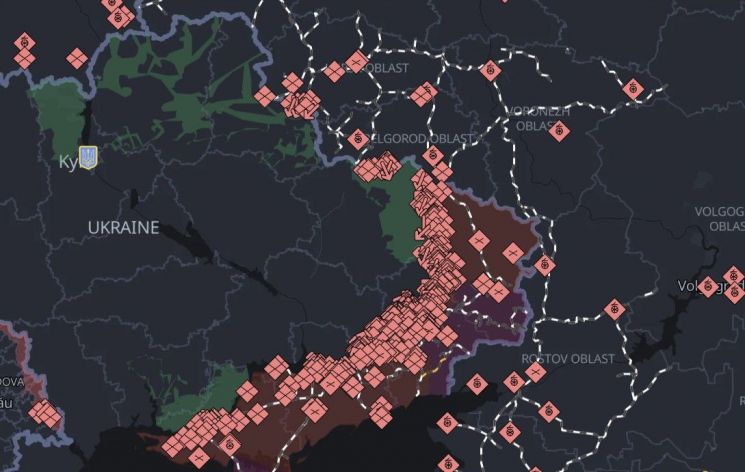 The open-source battlefield map website "DeepState," created by Ukrainian volunteers, has drawn strong backlash from its creators after it was revealed that some prediction market participants had been using the data. DeepState homepage
The Institute for the Study of War (ISW), a U.S. nonprofit think tank that analyzes the war situation for the Ukrainian Ministry of Defense and allied countries such as the United States and Europe, also stated, "We are aware that some organizations and individuals are encouraging gambling on the outcomes of the Ukraine war, and that our analytical maps are being used to determine results," adding, "We strongly condemn such actions, we are firmly opposed to our information being used for gambling, and we will never consent to it under any circumstances."
© The Asia Business Daily(www.asiae.co.kr). All rights reserved.
![Clutching a Stolen Dior Bag, Saying "I Hate Being Poor but Real"... The Grotesque Con of a "Human Knockoff" [Slate]](https://cwcontent.asiae.co.kr/asiaresize/183/2026021902243444107_1771435474.jpg)

















