A County-Level Municipality Selected Among Metropolitan Cities with Populations of 300,000 to 1 Million
Establishing an E-Mobility Industrial Hub and Economic Base... Total Project Budget of 147 Billion Won
Hoengseong County in Gangwon Province has achieved a remarkable feat by being finally selected for the Ministry of Land, Infrastructure and Transport's "2025 Second Half Urban Regeneration Innovation Zone National Pilot District" project. It is an extremely rare case nationwide for a small local government with a population of less than 50,000 to be chosen for an innovation zone, a national project typically focused on large cities. Experts say this sets a new model for small cities in the era of regional extinction.
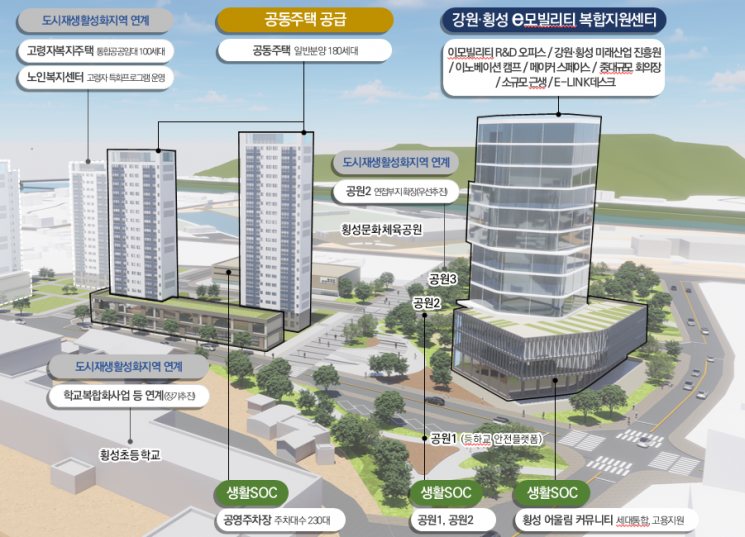
The Urban Regeneration Innovation Zone is a large-scale national project that creates economic hubs combining industry, commerce, and residential spaces in declining city centers. Until now, large metropolitan cities or key regional cities with large populations and high gross regional domestic product (GRDP), such as Yongsan in Seoul, Cheonan, and Gumi, have mostly been selected. Despite geographical and demographic limitations with a population of 46,000, Hoengseong County received high marks from the judges by presenting an original strategy that combines the future growth engine "e-mobility" industry with urban regeneration. This result proves the potential of a "small but strong economic city" based on regional specialized industries, moving beyond the big-city-centered regeneration projects.
With this selection, Hoengseong County will invest a total project budget of 147 billion won, including 25 billion won in national funding, to carry out a large-scale redevelopment of the Hoengseong-eup area.
The main projects include: ▲ Establishing an e-mobility industrial hub: building industrial infrastructure such as research centers and business support facilities ▲ Creating youth-centered residential and cultural spaces: constructing youth startup support housing and multi-purpose cultural facilities ▲ Developing a smart transportation network: introducing autonomous shuttles and smart parking systems.
The county expects this project to create about 983 jobs, generate 273.4 billion won in production inducement effects, and 104.7 billion won in added value inducement effects. In particular, they plan to directly tackle the crisis of population decline by attracting mobility-related companies and establishing a virtuous cycle of population inflow.
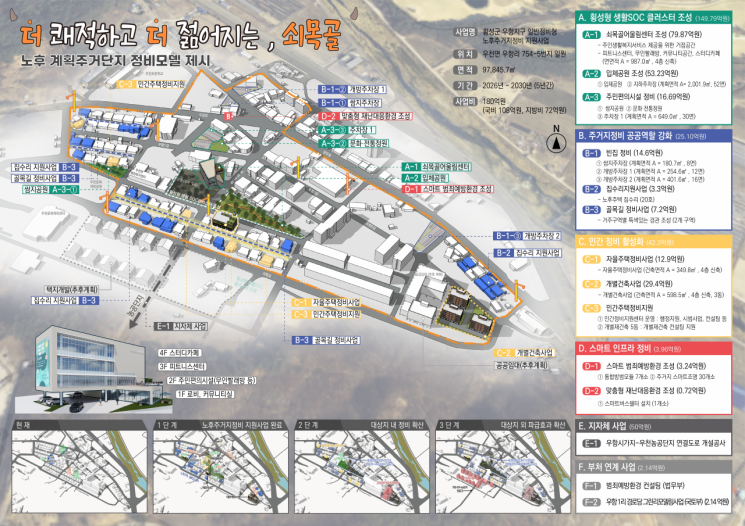 Conceptual diagram of Ucheon-myeon selected for the Ministry of Land, Infrastructure and Transport's urban regeneration contest. Provided by Hoengseong County.
Shim Cheonseop, Director of Urban Regeneration at Gangwon Special Self-Governing Province, who achieved this result through close cooperation and full support with Hoengseong County, said, "Although the population size and economic indicators were disadvantageous, Hoengseong County's clear vision and strong commitment were highly evaluated," adding, "This will serve as a hopeful example for local governments in Gangwon Province facing the crisis of population extinction, showing that even small-population areas can succeed if they have an innovative model with vision."
Han Sunghyun, Director of Investment Attraction at Hoengseong County, stated, "This selection will be a turning point for Hoengseong, transforming it from a city where people simply stay to an innovation city leading future industries," and added, "We will do our utmost to ensure that the miracle of a city with a population of 50,000 becomes the textbook for small city regeneration across South Korea."
© The Asia Business Daily(www.asiae.co.kr). All rights reserved.
![Clutching a Stolen Dior Bag, Saying "I Hate Being Poor but Real"... The Grotesque Con of a "Human Knockoff" [Slate]](https://cwcontent.asiae.co.kr/asiaresize/183/2026021902243444107_1771435474.jpg)
















