Call for Inclusion of the Southwestern Jeollanam-do Route in the National Plan
A Mega Project Worth 27 Trillion Won
On December 17, a National Assembly forum was held at the National Assembly Library Auditorium to include the construction of a high-speed railway connecting Seoul, Haenam, Wando, and Jeju in the national plan.
This forum was organized to build consensus and explore strategies for including the Seoul-Jeju high-speed railway project in the 5th National Railway Network Construction Plan. The event was co-hosted by Assemblymen Park Jie-won, Min Hongchul, Min Byungdeok, Min Hyungbae, Heo Jongsik, and Son Myungsoo, who represent the Haenam, Wando, and Jindo constituencies. It was co-organized by Haenam County, Wando County, and the Public Transport Forum.
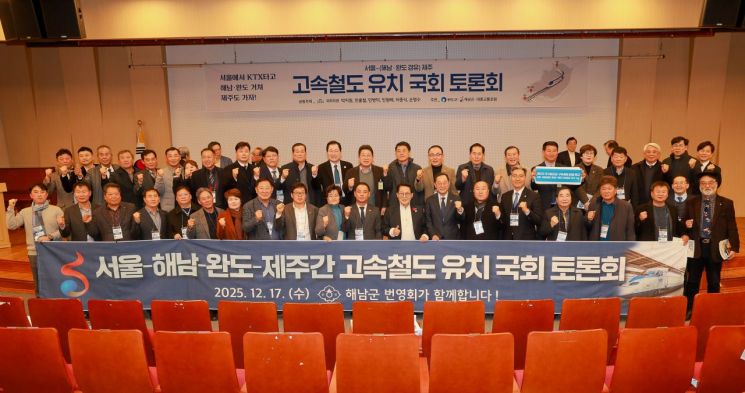 A National Assembly forum was held at the National Assembly Library Auditorium to include the construction of a high-speed railway connecting Seoul, Haenam, Wando, and Jeju in the national plan. Provided by Wando County
National Assembly Speaker Woo Wonshik, Democratic Party of Korea leader Jung Chungrae, Floor Leader Kim Byungki, National Assembly Land, Infrastructure and Transport Committee Chairman Maeng Sungkyu, and Minister of Land, Infrastructure and Transport Kim Yoonduk expressed their interest in the forum through written congratulatory messages.
In his opening remarks, Assemblyman Park Jie-won emphasized, "The Seoul-Jeju high-speed railway is a key national project that will drive balanced national development, including the southwestern region of Jeollanam-do. The route passing through Haenam and Wando will serve as a catalyst for significant advancement in the local economy and tourism industry." He added, "We must first implement the Mokpo-Yeongam-Haenam-Wando section as the first phase to realize the broader vision of balanced national development."
In his welcoming address, Wando County Governor Shin Woochul stated, "If accessibility is greatly improved by constructing the high-speed railway, it will inject new vitality into the region through population inflow and the revitalization of industry and tourism. In particular, Wando, as a wellness tourism city, will reach a turning point to become a global tourist destination."
Haenam County Governor Myung Hyunkwan said, "The Seoul-Jeju high-speed railway will dramatically improve the transportation infrastructure of Haenam and Wando, bringing significant changes to the local economy and overall living conditions. It is an essential core infrastructure for the southwestern region of Jeollanam-do to grow as a hub for the national AI and energy industries." He further emphasized, "Inclusion in the 5th National Railway Network Construction Plan will be an important turning point for balanced development in the southwestern region of Jeollanam-do."
Professor Kim Sigon of Seoul National University of Science and Technology, who delivered the keynote presentation, highlighted the need to establish a high-speed transportation network along the western axis of the Korean Peninsula. He pointed out the weather dependency of air travel and the frequent flight cancellations at Jeju International Airport, stressing the necessity of securing multiple transportation options. Professor Kim explained, "If the route passes through Haenam and Wando, the project's effectiveness can be maximized."
Following this, a panel discussion was held, chaired by Kang Seungpil, President of Goyang Urban Corporation, with participation from experts including Kwak Jaeho, Director of the Korea Railroad Research Institute, Professor Yoon Taeho of Seoul National University of Science and Technology, and Ahn Jongbae, Chairman of the Jeju World Future Development Forum. The discussion focused on the necessity and expected benefits of the project, as well as the challenges to be addressed during its implementation.
The Seoul-Jeju high-speed railway is a massive national project spanning a total length of 178.8 kilometers, with an estimated investment of approximately 27.4 trillion won. Due to abnormal weather conditions, Jeju experiences about 1,500 flight cancellations annually, which has consistently underscored the need to establish an alternative transportation network.
Haenam County and Wando County are continuing consultations with relevant agencies, including submitting a joint proposal ahead of the establishment of the 5th National Railway Network Construction Plan. Based on the strategies developed at this forum, they plan to continue efforts to secure support from the National Assembly and the central government.
The 5th National Railway Network Construction Plan is expected to be finalized early next year.
© The Asia Business Daily(www.asiae.co.kr). All rights reserved.
![Clutching a Stolen Dior Bag, Saying "I Hate Being Poor but Real"... The Grotesque Con of a "Human Knockoff" [Slate]](https://cwcontent.asiae.co.kr/asiaresize/183/2026021902243444107_1771435474.jpg)















