Perceived Time Varies by Up to 25% Depending on Light Brightness
KOREATECH Research Team Demonstrates the Effect for the First Time in the World
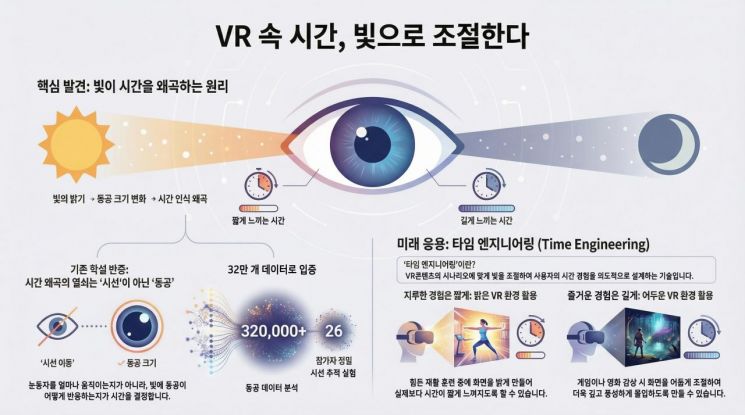
The scientific reason why time seems to pass faster or slower when immersed in virtual reality (VR) has been identified.
A research team at Korea University of Technology and Education has, for the first time in the world, demonstrated that the brightness of light in a VR environment directly alters human time perception through pupil response.
On December 18, the university announced that Professor Park Jiseop's team from the School of Future Convergence experimentally proved that simply adjusting screen brightness in a VR environment can intentionally change a user's perceived passage of time.
This research was conducted jointly with Professor Lee Cheol from the Department of Management Intelligence at Ajou University. The team conducted VR experiments using high-precision eye-tracking equipment with 26 adult participants, analyzing a total of 320,291 data points, including 38,985 instances of gaze movement and 281,306 instances of gaze fixation, to enhance the reliability of the results.
The analysis revealed a clear time distortion phenomenon depending on the brightness of light.
Participants watched a video that lasted exactly one minute, but in a dark environment with almost no light, they perceived the duration to be about 24.7% longer.
This corresponds to a perceived duration of about 1 minute and 16 seconds. Conversely, even in a very bright environment, participants tended to perceive the duration as about 11.3% longer than the actual time, or about 1 minute and 8 seconds.
The research team explained that this phenomenon is unrelated to eye movement, and that changes in pupil size in response to light directly affect the brain's perception of time.
They also found that the more the pupils dilate or are intensely stimulated, the longer the brain perceives the passage of time compared to reality.
Based on this principle, the team proposed a new concept called "Time Engineering."
They explained that VR content for rehabilitation and training could be designed with darker screens to make training sessions feel shorter, while games could use brightness adjustments to make playtime feel richer and more immersive.
The results of this study were published in the December online edition of the International Journal of Human-Computer Interaction, a leading international journal in the field of human-computer interaction (HCI).
This journal ranks in the top 14% by JCR and is ranked number one out of 148 HCI journals according to SJR, making it one of the most prestigious journals in the world.
Professor Park Jiseop, the first author, stated, "This research is significant in that it goes beyond simple visual effects to provide scientific evidence for actively designing human sensory and time perception."
© The Asia Business Daily(www.asiae.co.kr). All rights reserved.
![Clutching a Stolen Dior Bag, Saying "I Hate Being Poor but Real"... The Grotesque Con of a "Human Knockoff" [Slate]](https://cwcontent.asiae.co.kr/asiaresize/183/2026021902243444107_1771435474.jpg)
















