Ministry of Science and ICT Overhauls System from 17 Provinces and Cities to 5 Hubs and 3 Special Regions
Starting Next Year, 78.9 Billion Won to Be Invested in 4 Hubs and 3 Special Regions to Strengthen Regional Innovation Capabilities
The government will fully transition from a central government-led regional research and development (R&D) support system to a “regional autonomous R&D system,” in which regions directly plan and implement their own projects. The aim is to disperse science and technology capabilities, which have been concentrated in the Seoul metropolitan area, to other regions, and to support regions in designing innovation strategies tailored to their unique characteristics.
The Ministry of Science and ICT announced that, in line with the national policy task of “strengthening regional autonomous R&D,” it will overhaul the existing regional R&D support system, which has operated on a “17 provinces and metropolitan cities, centrally planned and open call” basis, into a “5 hubs and 3 special regions, regionally autonomous” structure and begin its full-scale implementation.
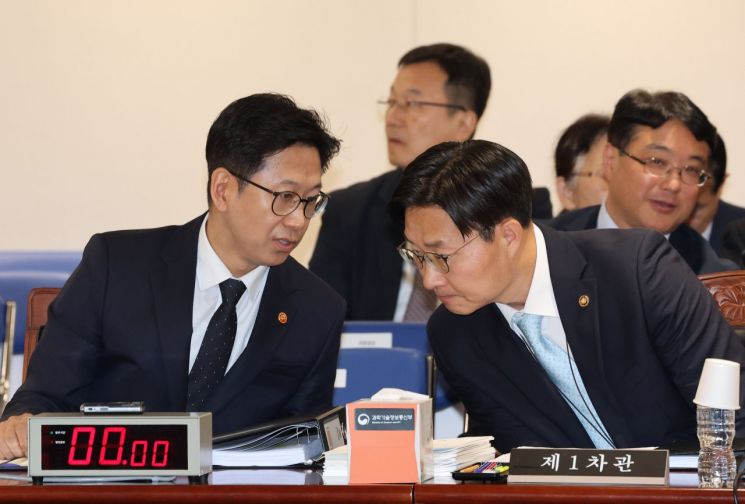 Deputy Prime Minister and Minister of Science and ICT, Paik Kyung-hoon (left), is seen conversing with First Vice Minister Koo Hyuk-chae during the National Assembly Science, Technology, Information and Broadcasting and Communications Committee's audit of the Ministry of Science and ICT held at the Government Sejong Complex on October 13. Photo by Yonhap News Agency
From 17 Provinces and Cities to 5 Hubs and 3 Special Regions…Reorganization Around Regional Hubs
The new regional autonomous R&D system will be centered around four major regional hubs (excluding the Seoul metropolitan area) and three special self-governing provinces. Starting in 2026, the Ministry of Science and ICT plans to allocate a total of 7.89 billion won, providing 1.31 billion won to each of the four hubs and 880 million won to each of the three special self-governing provinces.
The core of this reform is the transfer of planning authority. Unlike the previous method, where the central government designed projects and regions participated, each hub will now establish its own strategies and design and implement R&D projects. The central government will focus on providing financial support, coordination, and consulting.
To this end, each of the 4 hubs and 3 special regions will form a single project consortium, centered on science and technology institutes, government-funded research institutes, and regional base universities. These consortia will serve as control towers, overseeing R&D planning and management at the regional level, as well as industry-academia-research collaboration.
Each region will select key technology areas that differentiate it from other regions, based on its existing “regional science and technology innovation plan” and the “5 hubs and 3 special regions growth engines” being identified by the government. The four hubs will each focus on three key technology areas, while the special self-governing provinces will focus on two.
Focusing on the selected areas, regions will be able to autonomously plan and implement a variety of projects tailored to local conditions, such as: ▲ development of fundamental technologies for future industries based on industry-academia-research collaboration at the 4 hubs and 3 special regions level; ▲ joint talent development programs linking science and technology institutes, regional base universities, and special self-governing provinces; and ▲ projects to accelerate the commercialization of promising technologies.
Operation of Central Consulting Group…Role in Regional Coordination
To support the planning capabilities of regions, the Ministry of Science and ICT will operate a central consulting group composed of regional policy and technology experts. Consulting will be provided in two stages: ▲ the selection of key technology areas and ▲ the detailed project planning stage. In addition, if disagreements arise among local governments, the central government will mediate and coordinate to ensure stable project implementation.
To ensure a smooth transition to the new system, on December 18, the Ministry held a “4 Hubs and 3 Special Regions Science and Technology Innovation Support Project Briefing” at The White Veil in Seoul, targeting local governments, the four science and technology institutes, government-funded research institutes, regional base universities, and regional innovation organizations. Starting with this briefing, the Ministry plans to maintain ongoing communication with local governments throughout the entire project implementation process.
Koo Hyukchae, First Vice Minister of Science and ICT, stated, “It is important to spread science and technology capabilities, which have been concentrated in the Seoul metropolitan area, to other regions and to establish a foundation for regions to plan and promote their own innovation.” He added, “Through this project, we will elevate regional science and technology innovation capabilities to the next level and create a structure in which R&D achievements lead to regional industrial and economic growth.” He further emphasized, “As this is the first full-scale attempt at regional autonomous R&D, we will ensure it becomes a successful model through continuous communication with local governments and the research field.”
© The Asia Business Daily(www.asiae.co.kr). All rights reserved.
![Clutching a Stolen Dior Bag, Saying "I Hate Being Poor but Real"... The Grotesque Con of a "Human Knockoff" [Slate]](https://cwcontent.asiae.co.kr/asiaresize/183/2026021902243444107_1771435474.jpg)















