Ministry of Science and ICT Designates Three Top Corporate Research Institutes... Expands Support for Technology Commercialization
Strengthening R&D, Financial, and Tax Linkages to Actively Foster Corporate Research Capabilities
The government has newly selected 34 outstanding corporate-affiliated research institutes, which serve as key hubs for private research and development (R&D), and will expand support for technology commercialization and the strengthening of research capabilities. The strategy is to foster corporate research institutes as the core driving force of national R&D innovation amid digital transformation and the restructuring of global supply chains.
The Ministry of Science and ICT announced on the 18th that it held a certificate awarding ceremony for the designation of outstanding corporate-affiliated research institutes for the second half of 2025 at the Samjung Hotel in Seoul, selecting 34 outstanding corporate research institutes. Among them, three institutes were designated as the top outstanding corporate-affiliated research institutes, recognized for their world-class growth potential.
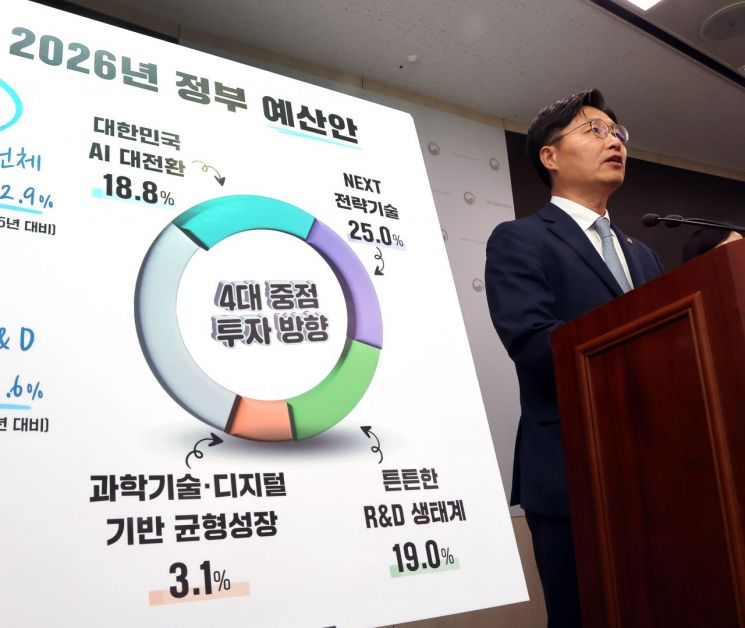 Koo Hyukchae, First Vice Minister of the Ministry of Science and ICT, is explaining the 2026 budget proposal at the Ministry of Science and ICT briefing room in the Government Complex Sejong last September. Photo by Yonhap News Agency
The "Outstanding Corporate-Affiliated Research Institute Designation System" was introduced in 2017 to promote qualitative growth in corporate R&D and to create a virtuous cycle ecosystem for private R&D through the dissemination of best practices. Including this round of selections, the total number of designated research institutes has increased to 394.
The newly selected institutes include 19 from the manufacturing sector and 15 from the service sector. On average, they invest 21% of their revenue in R&D, and 46.8% of their research staff are professionals with master's or doctoral degrees. By field, they broadly cover national strategic technologies, including biohealthcare (10 institutes), information and communications (11 institutes), advanced materials and nanotechnology (5 institutes), semiconductors (2 institutes), advanced automotive and mobility (2 institutes), and aerospace and defense technology (1 institute).
These research institutes are delivering visible results in areas such as conducting national research projects, technology transfer, and product commercialization. Notable examples include ABL Bio, which achieved approximately 4 trillion won in technology commercialization through technology transfer of its bispecific antibody platform; Dentis, which commercialized medical devices; and Inzent, which implemented smart work based on an AI data platform.
Three Top Outstanding Corporate Research Institutes Selected
Among the 34 institutes selected, three were designated as top outstanding corporate-affiliated research institutes through recommendations from the review committee and a separate evaluation process.
The ABL Bio corporate-affiliated research institute is developing anticancer drugs and treatments for degenerative brain diseases based on its Grabody bispecific antibody platform, and has expanded its clinical pipeline to include blood-brain barrier (BBB) penetration technology. The scale of technology transfer contracts this year alone amounts to about 4 trillion won.
Withmems Co., Ltd.'s research institute develops MEMS-based micro inspection components and sensor technology in the next-generation display and semiconductor packaging fields. It has secured core technological competitiveness by developing the world's first 11-micrometer pitch display panel full-contact probe unit.
Pulmuone Institute of Technology at Pulmuone Co., Ltd. has been recognized as a global food R&D hub, advancing safe and healthy ingredient-based food technology, plant-based initiatives, and animal welfare strategies, and has expanded into more than 20 countries. It continues to achieve early entry into overseas markets by pioneering new markets in Southeast Asia and Europe.
The Ministry of Science and ICT provides various benefits to outstanding corporate research institutes, including awarding certificates and plaques, additional points for participation in national R&D projects, additional points for designation as companies eligible for alternative military service, and government awards. In particular, based on the "Act on Supporting R&D of Corporate-Affiliated Research Institutes," scheduled to take effect in February 2026, the ministry plans to designate corporate R&D support centers and actively promote support linking R&D, finance, tax, and human resources.
Koo Hyukchae, First Vice Minister of the Ministry of Science and ICT, stated, "In the midst of industrial transformation such as digital innovation and global supply chain restructuring, securing technological convergence in advanced fields and corporate R&D capabilities is more important than ever," adding, "We will focus policy support so that corporate-affiliated research institutes can grow into the core driving force of our industry."
© The Asia Business Daily(www.asiae.co.kr). All rights reserved.
![Clutching a Stolen Dior Bag, Saying "I Hate Being Poor but Real"... The Grotesque Con of a "Human Knockoff" [Slate]](https://cwcontent.asiae.co.kr/asiaresize/183/2026021902243444107_1771435474.jpg)















