Launch of Research Council Involving Eight Universities in Busan, Ulsan, and Gyeongnam
Full-Scale Ultra-Wide-Area Industry-Academia-Research Collaboration Begins
Pusan National University has officially launched an advanced research hub to consolidate the secondary battery research capabilities of the southeastern region, initiating the establishment of an ultra-wide-area cooperation system.
On the afternoon of December 16, Pusan National University held the "Pusan National University Advanced Battery Technology Center Launch Ceremony and the Signing Ceremony for the Southeastern Region Secondary Battery University Research Council Business Agreement" at the Grand Josun Hotel Busan.
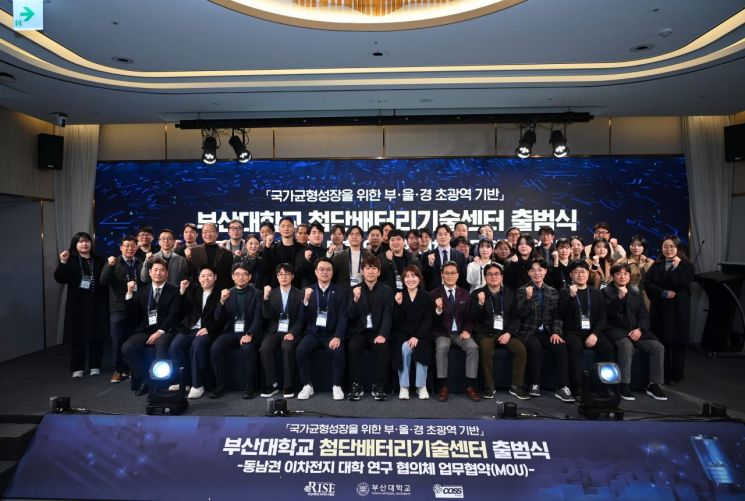 Pusan National University is launching the Advanced Battery Technology Center and taking a commemorative photo. Photo by Pusan National University
The launch of the center and the formation of the council are proactive measures in response to the government's "Five Poles, Three Special Zones" national balanced development policy and the "Creating 10 Seoul National Universities" initiative. As a regional hub university in the southeastern region, Pusan National University aims to consolidate research capabilities in the advanced secondary battery field and establish a foundation for ultra-wide-area cooperation.
The event was jointly organized by the Pusan National University RISE Project Group and the Secondary Battery Innovation Convergence University Project Group. It drew significant attention, with participants including officials from the Busan Metropolitan Government and the Busan RISE Innovation Center, professors and researchers in the secondary battery field, secondary battery companies from the southeastern region, and representatives from government-funded research institutes.
The event focused on the launch of the Advanced Battery Technology Center and the signing of the business agreement for the Southeastern Region Secondary Battery University Research Council. Jinwoo Oh, Deputy Director of the Pusan National University RISE Future Industry Leading Headquarters and Professor at the School of Advanced Convergence, delivered a special lecture on "Strategies for Securing National R&D Projects and Know-how in Planning Large-Scale Research Projects."
The newly launched Pusan National University Advanced Battery Technology Center, headed by Professor Park Minjun of the School of Advanced Convergence, is set to become an ultra-wide-area secondary battery research hub led by a regional university, moving beyond the Seoul metropolitan area-centered research structure. The center plans to systematically strengthen industry-academia-research collaboration, conduct joint research linked to local industries, foster professional talent, and promote technology commercialization, all centered around core advanced secondary battery technology research.
The Southeastern Region Secondary Battery University Research Council, which was also launched, is a cooperative system involving eight universities based in the Busan, Ulsan, and Gyeongnam ultra-wide-area region (Pusan National University, Gyeongsang National University, Pukyong National University, Changwon National University, Korea Maritime & Ocean University, Dong-A University, Silla University, and UNIST). The council will gradually promote joint research in advanced secondary battery fields, professional talent development, and industry-academia-research collaboration activities.
This represents a region-driven cooperation model aligned with the government's advanced industry promotion and national balanced development policies. It is expected to strengthen the competitiveness of the southeastern region's secondary battery industry and produce sustainable outcomes in research, education, and industry linkage.
Park Minjun, Director of the Pusan National University Advanced Battery Technology Center, stated, "The launch of this center marks a starting point for southeastern region universities to lead in the advanced secondary battery field in line with the government's national balanced development policy. Through inter-university cooperation and industry-academia-research collaboration, we will make a tangible contribution to strengthening the national secondary battery industry's competitiveness."
© The Asia Business Daily(www.asiae.co.kr). All rights reserved.
![Clutching a Stolen Dior Bag, Saying "I Hate Being Poor but Real"... The Grotesque Con of a "Human Knockoff" [Slate]](https://cwcontent.asiae.co.kr/asiaresize/183/2026021902243444107_1771435474.jpg)















