Work Briefings from Industry, Climate, and Nuclear Safety Authorities
Key Issues: Great Whale Project, Offshore Wind Power, Nuclear Energy
"Nuclear Power Requires Discussion on Efficiency, Validity, and Necessity"
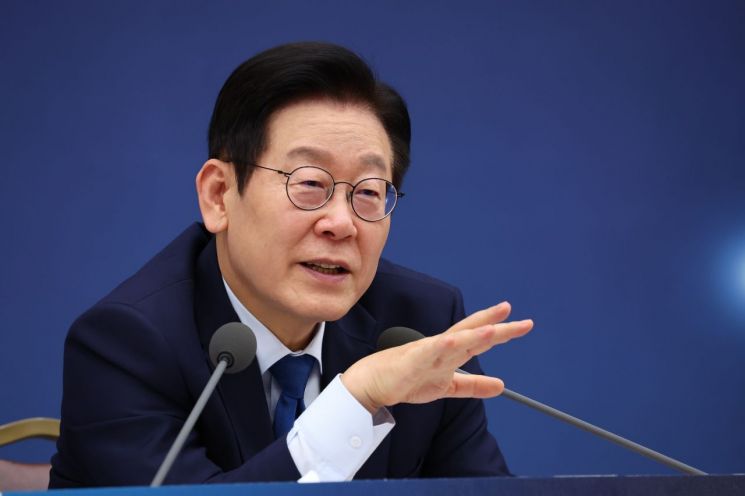 President Lee Jae-myung is speaking at the Ministry of Climate Energy and Environment (Korea Meteorological Administration) and Nuclear Safety Commission briefing held at the Government Sejong Convention Center on December 17, 2025. Photo by Yonhap News
On December 17, at the Sejong Convention Center, President Lee Jae-myung posed a series of sharp questions regarding the energy sector during a work briefing attended by the Ministry of Trade, Industry and Energy, the Ministry of Climate, Energy and Environment, and the Nuclear Safety and Security Commission. Throughout the session, President Lee repeatedly pointed out the ideological polarization surrounding energy issues. He also emphasized the need for serious discussions on the efficiency, validity, and necessity of nuclear power.
The first target of President Lee's scrutiny that day was Korea National Oil Corporation. President Lee persistently questioned the business feasibility of the so-called "Great Whale" project, a deep-sea gas field development in the East Sea promoted during the Yoon Suk-yeol administration.
President Lee: "Should we invest hundreds of billions without knowing the development value?"
President Lee asked, "Assuming oil is discovered in the Great Whale project, what is the estimated production cost per barrel?" When Choi Moon-kyu, Acting President of Korea National Oil Corporation, responded that there were too many variables to calculate, President Lee pressed further, asking, "If there are so many variables, shouldn't we refrain from proceeding? Were you planning to invest hundreds of billions of won in something without knowing its development value?"
President Lee also inquired about plans to normalize the management of Korea National Oil Corporation, which is suffering from accumulated debt of 20 trillion won and capital impairment. When Acting President Choi answered that the company plans to sell off poor overseas assets, reorganize around quality assets, and implement strong restructuring, President Lee responded skeptically, saying, "I don't think selling off poor assets will solve the problem."
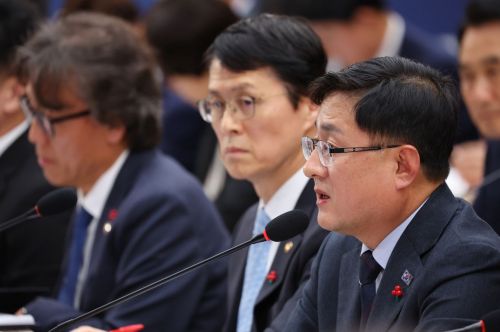 Kim Sung-hwan, Minister of Climate, Energy and Environment, is answering President Lee Jae-myung's question at the Government Sejong Convention Center on December 17, 2025. Photo by Yonhap News.
During the Ministry of Climate, Energy and Environment's work briefing, the cost of offshore wind power generation became a key issue. The ministry reported plans to reduce the unit cost of offshore wind power generation from 330 won per kilowatt-hour (kWh) to below 250 won, onshore wind from the 180-won range to the 150-won range, and solar power to below 100 won.
In response, President Lee asked, "Even if you lower the unit cost of offshore wind power, it is still 250 won. Why pursue it?" Minister Kim Sung-hwan explained, "Korea is well-suited for large-scale production due to the quantity and quality of sea winds. Currently, the installed capacity is only 0.3 GWh, so the unit cost is 330 won, but with significant expansion, it can be reduced to below 200 won."
Nevertheless, President Lee remarked that it was difficult to understand why offshore wind should be pursued so vigorously when, in the long term, it is more expensive than solar power.
Shim Jin-soo, Director of Renewable Energy Policy at the Ministry of Climate, Energy and Environment, responded that offshore wind could be fostered as a "second shipbuilding plant industry," and that overseas cases show that installing 3 GW or more, or even over 10 GW, can bring the unit cost below 150 won. Lee Hohyun, Second Vice Minister of the ministry, added that by 2035, more than 25 GW could be installed, reducing the unit cost to around 150 won, but this would require ships, as well as infrastructure such as ports and cables. Only then did President Lee acknowledge, "So, you are saying we are currently in the investment phase."
President Lee also addressed safety incidents at power generation public enterprises, stressing that "the very existence of public enterprises is to implement national policy," and that excessive pursuit of profitability must not lead to industrial accidents or wage misappropriation. He emphasized, "The state should be a model employer, not a malicious one," and warned against falling into the trap of efficiency at all costs.
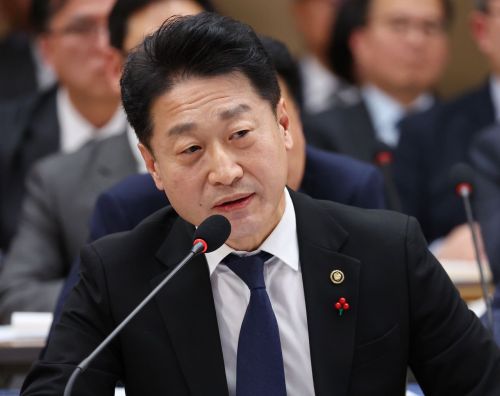 Lee Hohyun, Second Vice Minister of the Ministry of Climate, Energy and Environment, is answering President Lee Jae-myung's question during the Ministry of Climate (Korea Meteorological Administration) and Nuclear Safety and Security Commission briefing held at the Government Sejong Convention Center on December 17, 2025. Photo by Yonhap News.
President Lee continued with sensitive questions regarding nuclear power. He asked, "How long does it take to build a new nuclear power plant from scratch?" This appears to reflect the controversy that arose after he mentioned at his 100th day press conference in September that "it takes 15 years to build a nuclear power plant."
When Minister Kim Sung-hwan replied, "It actually takes 10 to 15 years," President Lee said, "I can't trust Minister Kim because he's with the Democratic Party," and requested input from a participant without political affiliation.
Jeon Daewook, Acting President of Korea Hydro & Nuclear Power, explained, "According to the 11th Basic Plan for Electricity Supply and Demand, it takes 13 years and 11 months: 2 years for site selection, 3 years and 4 months for licensing, and 7 years and 7 months from groundbreaking to completion."
On Nuclear Power: "Let someone without party affiliation speak"
Regarding small modular reactors (SMRs), President Lee asked, "The plan is to obtain design approval in 2028, construction approval in 2030, and complete construction by 2035. Isn't this an optimistic outlook? Is there any guarantee it will be realized?"
Acting President Jeon replied, "From our perspective, considering the technical aspects and global energy supply and demand, it is necessary and fully achievable."
President Lee also questioned whether the risks associated with SMRs differ from those of conventional reactors. Acting President Jeon explained, "Technically, the risk is one-thousandth that of conventional large reactors. They are built as integrated units, and in the event of an accident, the reactor can be immediately submerged in a pool, ensuring safety."
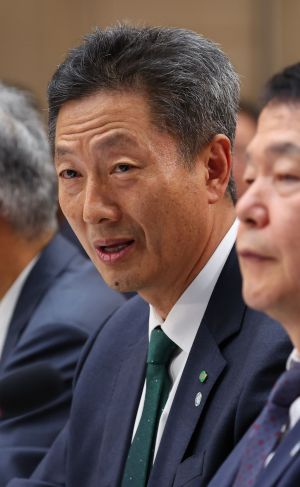 Jeon Daewook, Acting President of Korea Hydro & Nuclear Power, is answering President Lee Jae-myung's question at the ministry work report held at the Government Sejong Convention Center on the 17th. 2025.12.17 Yonhap News Agency
President Lee further inquired, "Through negotiations with the United States, we have secured the ability to enrich uranium and reprocess spent nuclear fuel domestically. Some claim that reprocessing spent fuel significantly reduces its volume. Is this true?"
Choi Won-ho, Chair of the Nuclear Safety and Security Commission, answered, "It is reduced to one-fifth." However, Cho Seong-don, Director of Korea Radioactive Waste Agency, offered a different view, stating, "Korea and the United States have invested 800 billion won in research, but no conclusion has been reached yet." He also explained that "in Korea, 50% of spent nuclear fuel is from CANDU reactors, which cannot be reprocessed."
When President Lee asked about reprocessing practices in countries such as France, Lee Hohyun, Second Vice Minister of the Ministry of Climate, Energy and Environment, explained, "France, which uses wet reprocessing, has research results showing a reduction to one-fifth of the original volume. However, the dry reprocessing method currently being jointly researched with the United States does not significantly reduce volume." He added that wet reprocessing requires strict international oversight because it can extract plutonium, which can be used as nuclear weapons material.
President Lee noted, "Some say that reprocessed nuclear fuel is a highly useful resource, while others disagree," and requested input from someone without party affiliation.
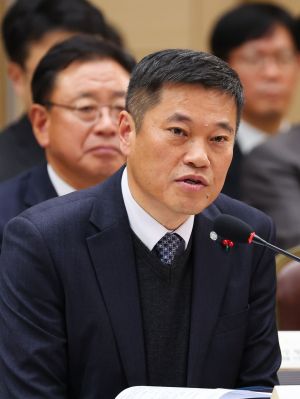 Seungchul Lim, President of the Korea Institute of Nuclear Safety, is responding to a question from President Lee Jae-myung during a government ministry briefing held at the Sejong Convention Center on the 7th. 2025.12.17 Yonhap News Agency
In response, Seungchul Lim, President of the Korea Institute of Nuclear Safety, who specializes in nuclear engineering, explained, "After burning nuclear fuel in a reactor for 3 to 4 years, the uranium-235 content, originally at 4%, drops to just 1%, and 0.5% of uranium-238 is converted to plutonium. Scientists argue that the remaining uranium should be recycled."
Plutonium can be used either for nuclear weapons or as fuel for power plants, but Lim noted that using it for power generation is technically more challenging than using pure uranium.
On this day, President Lee commented on the social controversy over nuclear power, stating, "Our society is divided into factions and only fights, so untruths are circulated as if they were facts. We need serious discussions on the efficiency, validity, and necessity of nuclear power, rather than turning it into a political agenda."
He also remarked, "Even in scientific debates, people are dividing into sides. Strangely, even scientists are taking sides."
© The Asia Business Daily(www.asiae.co.kr). All rights reserved.
![Clutching a Stolen Dior Bag, Saying "I Hate Being Poor but Real"... The Grotesque Con of a "Human Knockoff" [Slate]](https://cwcontent.asiae.co.kr/asiaresize/183/2026021902243444107_1771435474.jpg)

















