Exchange Rate Surges Past 1,480 Won, Triggering Emergency Response from FX Authorities
Flexible Adjustments Introduced for Foreign Exchange Soundness Regulations
Requirements on Foreign Currency Holdings for Financial Institutions Also Eased
The government will partially ease the regulations on forward foreign exchange position, which is one of the tools for managing the inflow and outflow of foreign capital in Korea. Supervisory measures that were scheduled to be implemented for financial institutions that fail the foreign currency liquidity stress test will also be temporarily deferred until next year. These measures are intended to increase dollar liquidity in response to the pressure of domestic capital outflows caused by structural factors such as the expansion of overseas investment and a preference for the US dollar. Although the foreign exchange authorities have repeatedly expressed their commitment to stabilizing the exchange rate, criticism remains that they lack effective means to defend the won and are therefore unable to reverse the current trend. The exchange rate has fallen to levels last seen immediately after the declaration of martial law, when political instability surged before the launch of the current administration.
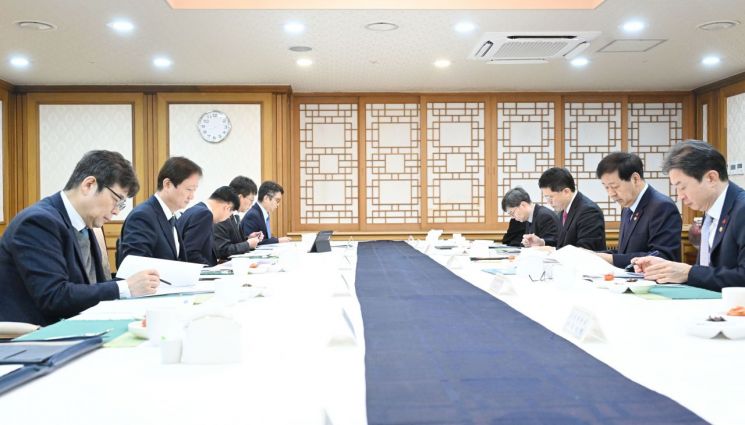 Deputy Prime Minister and Minister of Economy and Finance Koo Yoon-chul is presiding over the Market Situation Review Meeting held on the 18th at the Government Seoul Office in Jongno-gu, Seoul. (Source: Ministry of Economy and Finance)
On the 18th, the Ministry of Economy and Finance, the Financial Services Commission, the Bank of Korea, and the Financial Supervisory Service jointly announced a plan to reform the foreign exchange soundness system. Under the revised plan, supervisory measures related to the foreign currency liquidity stress test will be temporarily deferred until the end of June next year. The intention is to prevent financial institutions from holding excessive foreign currency liquidity beyond what is needed for normal business operations, out of concern for supervisory actions. Each financial institution must assess its daily foreign currency surplus or deficit, and if the period during which foreign currency inflows exceed outflows (net inflow) does not meet supervisory standards, it must submit a plan to secure additional liquidity. Jung Yeo-jin, Director of the Foreign Currency Funds Division at the Ministry of Economy and Finance, stated, "Conservative domestic financial institutions such as banks tend to hold much more foreign currency than required by supervisory authorities in order to prepare for unexpected variables. According to financial companies, this deferral is expected to have the greatest effect in releasing dollars to the market among the measures announced."
In addition, the regulation on the forward foreign exchange position ratio for foreign bank subsidiaries in Korea (Standard Chartered Bank Korea and Citibank Korea) will be relaxed from 75% to 200% of their equity capital. The forward foreign exchange position regulation ensures that the amount by which forward foreign currency assets exceed forward foreign currency liabilities does not exceed a certain percentage of the bank's equity capital. Foreign bank subsidiaries operating in Korea with foreign currency borrowed from their overseas headquarters have so far been subject to the same 75% ratio regulation as domestic banks, in order to prevent speculative capital inflows. In contrast, foreign bank branches in Korea, which differ in terms of capital and foreign currency borrowing size, are subject to a much more relaxed 375% limit.
The Ministry of Economy and Finance explained, "We considered the fact that the current system does not sufficiently reflect the actual business structure of foreign bank subsidiaries in Korea, and thus acts as a factor limiting additional foreign currency inflows." As of the end of the third quarter this year, Standard Chartered Bank Korea's total equity capital was 5.634 trillion won, and Citibank Korea's was 5.5333 trillion won. Multiplying the increased forward foreign exchange position of 125 percentage points by these figures, Standard Chartered Bank Korea's amount is 7.0425 trillion won, and Citibank Korea's is 6.9166 trillion won, totaling about 14 trillion won, or approximately 950 million US dollars.
The restrictions on foreign currency loans for won-based use will also be further eased. In principle, it is prohibited for domestic companies or individuals to borrow foreign currency in Korea and convert it into won for domestic use. However, immediately after the declaration of martial law last year, foreign currency loans for domestic facility investment purposes were allowed for export companies. This time, in addition to facility investment, foreign currency loans for domestic working capital purposes will also be permitted. The government will also promote the activation of integrated accounts for foreign investors, allowing them to trade Korean stocks directly through local securities firms without the need to open a separate account with a domestic securities company.
These measures are based on the government's recognition that the recent weakness of the won is rooted in structural issues such as capital outflows and increased demand for investment in the US. The preference for dollars and overseas investment sentiment among export companies and retail investors investing abroad has intensified supply-demand imbalances, pushing up the exchange rate. On the previous day, the won-dollar exchange rate closed weekly trading just below 1,480 won. During the session on this day, the rate surged to as high as 1,482.10 won. This is the first time in eight months that the won-dollar exchange rate has exceeded the 1,480 won level since April 9, when political uncertainty surged due to martial law and the impeachment of the president. The psychological defense line for the exchange rate, as seen by the government, is the 1,480 won level that was established during the martial law period before the launch of the current administration.
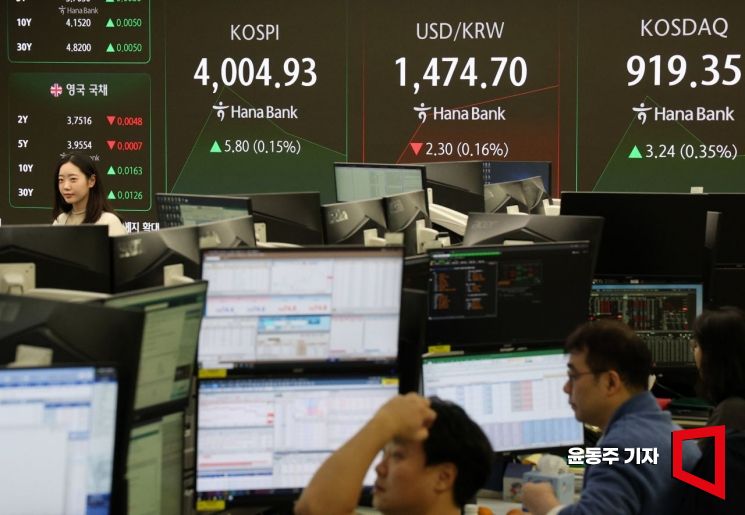 The KOSPI index started the session higher on the 17th compared to the previous day. The status board in the dealing room of Hana Bank in Jung-gu, Seoul, displays the KOSPI, exchange rate, and KOSDAQ indices. 2025.12.17 Photo by Yoon Dongju
The foreign exchange authorities continue to make verbal interventions to stabilize the exchange rate, but they lack effective tools to reverse the trend. On the 16th, the authorities met with major domestic export companies, including Samsung Electronics, SK Hynix, Hyundai Motor, and Hanwha Ocean, asking for cooperation to stabilize the foreign exchange market, such as expanding foreign exchange hedging. However, the exchange rate rose to a one-month high of 1,477.0 won that day.
The National Pension Service extended the expiration date by one year for the provision that allows up to 10% of strategic foreign exchange hedging through dollar sales as of the 15th. If the National Pension Service engages in strategic foreign exchange hedging for overseas investment assets, this would release dollar sell orders into the market and exert downward pressure on the exchange rate. However, there has not yet been any officially confirmed case of such strategic hedging being implemented. On this day, the National Pension Service also extended its foreign exchange swap agreement with the Bank of Korea, with a limit of 65 billion US dollars, for another year until the end of next year. Although a swap between Kookmin Bank and the Bank of Korea was partially activated the previous afternoon, it had little effect on stabilizing the market.
© The Asia Business Daily(www.asiae.co.kr). All rights reserved.
![Clutching a Stolen Dior Bag, Saying "I Hate Being Poor but Real"... The Grotesque Con of a "Human Knockoff" [Slate]](https://cwcontent.asiae.co.kr/asiaresize/183/2026021902243444107_1771435474.jpg)
















