900,000-Ton Single NCC System Based on Ethylene Production
Debt Ratio at 21% and Current Ratio Over 200%
Distinct Financial and Performance Edge... Competitiveness Even With General-Purpose Products
Daehan Petrochemical, which operates a single naphtha cracking center (NCC) with an ethylene production capacity of 900,000 tons, is regarded as maintaining a stable position despite the sweeping restructuring underway in the petrochemical sector. While companies with large-scale NCCs, such as LG Chem and Lotte Chemical, are at the center of production cut and integration scenarios, Daehan Petrochemical, established in 1970, has consistently adhered to a strategy of "endurance" during each industry crisis.
According to the industry on December 18, among the three NCC operators in Ulsan Industrial Complex (SK Geocentric, Daehan Petrochemical, and S-Oil), Daehan Petrochemical is reportedly maintaining its facilities. Although there is a possibility that its operating rate may be adjusted through joint operations with SK Geocentric's 660,000-ton facility, the closure of facilities is being considered first for SK Geocentric's NCC. In Yeosu Industrial Complex, Yeocheon NCC is considering shutting down its second and third plants, which have a combined capacity of 1.4 million tons, leaving only the 900,000-ton first plant. Some within the company say this strategy is aimed at "stabilizing Yeocheon NCC in the same way as Daehan Petrochemical."
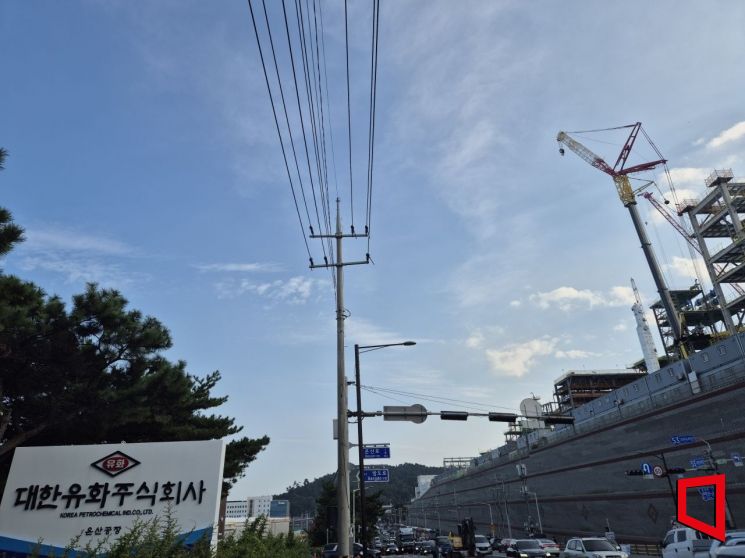 Entrance of Daehan Petrochemical Onsan Plant in Ulju-gun, Ulsan. Opposite is the S-Oil Shahin Project under completion. Ulsan ? Photo by Oh Jieun
Over more than 50 years in business, Daehan Petrochemical has grown by consistently operating a single facility rather than expanding or entering into joint ventures. The company's business structure is simple: it operates one NCC at the Onsan Industrial Complex in Ulju-gun, Ulsan, producing basic petrochemical feedstocks such as ethylene and propylene, and then manufactures general-purpose petrochemical products such as polyethylene (PE) and polypropylene (PP) at its plant in Nam-gu, Ulsan.
As of 2024, Daehan Petrochemical's debt ratio stands at around 21%, and its current ratio is about 219%. Even amid a sluggish market, its financial burden remains relatively low. Its performance is also noteworthy: in the third quarter of this year, Daehan Petrochemical posted sales of 909.9 billion won and an operating profit of 42.8 billion won, returning to profitability for the first time in over two years. Despite a business structure centered on general-purpose products, the company has succeeded in defending its profit margins.
However, the launch of S-Oil's Shahin Project may introduce new variables in both raw material procurement and product price negotiations. The naphtha supply structure, which had relied on pipelines from S-Oil, is changing, raising the possibility of increasing imports from overseas or expanding supply from SK Energy. As a result, logistics and storage costs may rise. In addition, if S-Oil begins producing low-cost ethylene with its new facilities in Ulsan, it may become more difficult for Daehan Petrochemical to maintain its margins in product price negotiations.
© The Asia Business Daily(www.asiae.co.kr). All rights reserved.
![Clutching a Stolen Dior Bag, Saying "I Hate Being Poor but Real"... The Grotesque Con of a "Human Knockoff" [Slate]](https://cwcontent.asiae.co.kr/asiaresize/183/2026021902243444107_1771435474.jpg)















