1st Barrier-Free Tourism Governance General Assembly
Policies to Create Unrestricted Travel Environments
for Tourism-Vulnerable Groups Including People with Disabilities and the Elderly
Now a Core Element of Regional Competitiveness
The "barrier-free tourism policy," which aims to expand the right to enjoy tourism as a universal right for everyone, marks its 10th anniversary this year. This policy, which seeks to create an environment where anyone, including people with disabilities and the elderly-traditionally considered vulnerable groups in tourism-can travel without restrictions, has now become a core factor not only in welfare but also in determining the competitiveness of the tourism industry and local regions.
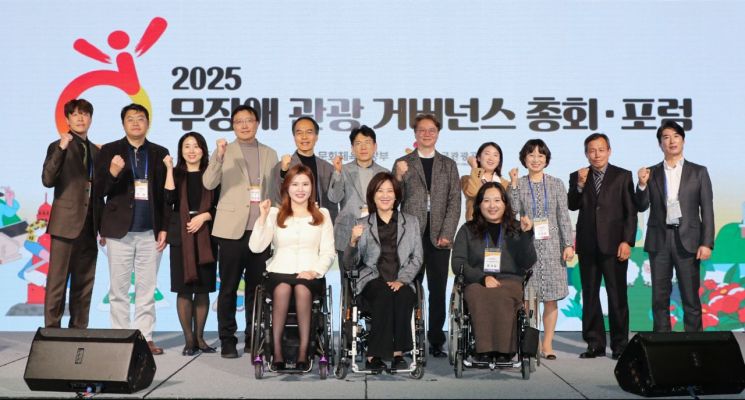 At the "1st Barrier-Free Tourism Governance General Assembly and Forum" held at The Westin Chosun Seoul on the 16th, attendees are shouting "Fighting" in a pledge to spread barrier-free tourism. Provided by Korea Tourism Organization
The Ministry of Culture, Sports and Tourism and the Korea Tourism Organization held the "1st Barrier-Free Tourism Governance General Assembly and Forum" at The Westin Chosun Seoul on the 16th, where they reviewed the achievements of the past decade and discussed the future direction and cooperation structure of the barrier-free tourism policy. During the event, they also announced the selected sites for the 2026 Barrier-Free Tourism Connectivity Enhancement Project and the newly designated "Open Tourist Sites."
Korea's barrier-free tourism policy began in earnest with the 2014 amendment of the Tourism Promotion Act, which institutionally specified the right of people with disabilities to participate in tourism activities. Based on this, the government-led Open Tourist Site Development Project was launched in 2015. While the initial focus was on improving facilities and providing convenience, the scope and nature of the policy have greatly expanded over the past 10 years.
Through the Open Tourist Site Development Project, a total of 182 tourist sites nationwide have improved their physical and informational accessibility to date. Starting with just six sites in 2015, the project has expanded to cover about 6.6% of major tourist attractions across the country. Along the way, Korea was recognized internationally for its competitiveness as a barrier-free tourism destination, being selected in 2021 as a best practice for natural area accessibility and inclusive tourism development by the UN Tourism, and winning the Gold Award in the "Tourism for All" category at the Pacific Asia Travel Association (PATA) Awards in 2022.
The policy environment is also at a turning point. The year 2025 marks the 10th anniversary of the barrier-free tourism policy and the implementation of the so-called "Four Barrier-Free Tourism Acts": the Framework Act on Tourism, the Tourism Promotion Act, the Tourism Development Fund Act, and the Welfare of Disabled Persons Act. There is a growing consensus that the institutional foundation for promoting barrier-free tourism as a sustainable policy, rather than as a one-off project, has been significantly strengthened.
Recently, the policy focus has shifted from improving individual tourist sites to enhancing the "entire travel experience." The "Barrier-Free Tourism Connectivity Enhancement Project," which has been underway since 2022, aims to improve accessibility throughout the entire travel process, from information and transportation to tourism and services. The key is to expand the barrier-free environment beyond tourist site facilities to include transportation, accommodation, food and beverage, and private sector services.
At the general assembly, Suwon City in Gyeonggi Province was selected as the target site for the 2026 Barrier-Free Tourism Connectivity Enhancement Project. Over the next three years, Suwon City plans to create a barrier-free tourism zone by matching up to 4 billion won (approximately 4 million US dollars) in national funding with local government funds, covering improvements in transportation and tourism infrastructure, information provision, and service connectivity. In addition, 13 local governments and 30 tourist sites nationwide were newly designated as Open Tourist Sites, and for the first time, the "Open Tourist Site Plus" category was introduced to enhance the content of existing sites.
The event was attended by more than 200 participants, including representatives from local governments, academia, industry, and field experts, who discussed the direction and strategies for expanding barrier-free tourism. The participants reached a consensus that barrier-free tourism should be viewed not as welfare support, but as an investment to improve the structure of local tourism and enhance industry competitiveness. With the acceleration of population aging and diversification of travel demand, accessibility is now considered an essential condition for tourism competitiveness, not a matter of choice.
The event continued with a forum following the sharing of project implementation plans for the selected local governments. The keynote speech, titled "The Future of Tourism for All," was delivered by Professor Lee Hoon of Hanyang University. Gangneung City presented its case as a barrier-free tourism city, while Chuncheon City introduced the Uiam Lake King Canoe barrier-free tourism content. Former KBS anchor and visually impaired individual Heo Woori emphasized the importance of barrier-free tourism governance based on his own travel experiences.
On the same day, the Korea Tourism Organization signed business agreements with 13 local governments, including Suwon City, which were selected for the Open Tourist Site Development Project, and presented the President's Award to outstanding local governments that achieved notable results in development and monitoring. Gangneung Tourism Development Corporation and Korea Accessible Tourism Network were among the awardees.
Seo Jungmu, Deputy Manager of Gangneung Tourism Development Corporation, said, "It is especially meaningful that the efforts we have steadily built in the field, believing that barrier-free tourism is a basic principle rather than an act of consideration, have been recognized at this general assembly. Gangneung, as Korea's first barrier-free city, will continue to play a leading role going forward." Jeon Yoonseon, CEO of Korea Accessible Tourism Network, stated, "Twenty years ago, when I started working in barrier-free tourism, everyone turned a blind eye. However, as the Open Tourist Site Development Project gained momentum a decade ago, things began to change, and now, another ten years later, we have reached a stage where everyone is involved. Now, even as a wheelchair user, I can travel with peace of mind to many places. It was only possible to achieve such significant changes because everyone worked together. I am confident that in another ten years, we will have a barrier-free tourism environment where people can travel spontaneously, without the need for advance planning."
If the past ten years of Open Tourism have been a period of accumulating achievements, the next decade is expected to be a process of spreading these results into everyday tourism experiences. A Korea Tourism Organization official said, "The year 2025 marks the 10th anniversary of the Open Tourist Site Project and the first year when all barrier-free tourism stakeholders nationwide come together as one. Based on the governance established through this general assembly, we will expand collaborative projects that people can truly feel, and lead Korea to become a world-class inclusive tourism nation."
© The Asia Business Daily(www.asiae.co.kr). All rights reserved.
![Clutching a Stolen Dior Bag, Saying "I Hate Being Poor but Real"... The Grotesque Con of a "Human Knockoff" [Slate]](https://cwcontent.asiae.co.kr/asiaresize/183/2026021902243444107_1771435474.jpg)
















